“ Stevenson, as we shall see, was himself devoted to the penny whistle, and in view of that devotion it is curious to remark the observation in this story that one seldom, if ever, encounters a person learning to play that instrument. ”
Penny whistle
Definition and stakes
The theme of “penny whistle” has been addressed by authors such as Mildred A. Wirt, Thomas Firminger Thiselton Dyer, Edna Geister, Henry Mayhew and Various. It is often associated with terms like Whistler, James, Abbott, whistling and Thomas.
Quotes about “penny whistle”
“ I may be said to live for these instrumental labors now; but I have always some childishness on hand.” To play a bass of any kind on a tin whistle must indeed have been “no joke.” But the instrument appears to have had quite a fascination for Stevenson at this time. He even proposed to associate it with the title of what he ultimately called “A Child’s Garden of Verses.” When he sent the manuscript for publication he could not decide about the title, but after some banter on the subject he tentatively fixed on “The Penny Whistle: Nursery Verses, &c.” ”
“ It goes without saying that, notwithstanding all this practice, Stevenson was exceedingly modest about his accomplishments. “Even my clumsinesses are my joy,” he said—“my woodcuts, my stumbling on the pipe.”But we must not forget the penny whistle. That instrument seems to have at one time quite ousted the flageolet. “I am a great performer before the Lord [Pg 92] on the penny whistle,” he writes to Miss Boodle from Saranac in 1888. “We now perform duets on two D tin whistles; it is no joke to make the bass ”
 Miles Franklin,
My Brilliant Career
Miles Franklin,
My Brilliant Career
“ If the souls of lives were voiced in music, there are some that none but a great organ could express, others the clash of a full orchestra, a few to which nought but the refined and exquisite sadness of a violin could do justice. Many might be likened unto common pianos, jangling and out of tune, and some to the feeble piping of a penny whistle, and mine could be told with a couple of nails in a rusty tin-pot. ”
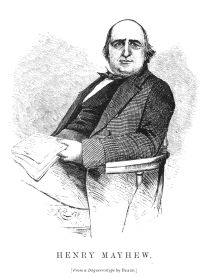 Henry Mayhew,
London Labour and the London Poor…
Henry Mayhew,
London Labour and the London Poor…
“ There was a man as played on the clarionet as used to be a favourite among haymakers, but they prefer the penny tin whistle, because it makes more noise, and is shriller, and is easier heard; besides, I’m very rapid with my fingers, and makes ’em keep on dancing till they are tired out. ”
“ He had such a cheery way of whistling, she had told me, it had always brightened her at her work to hear him whistling, and when he whistled he stood with his legs apart, and his hands in the pockets of his knickerbockers. I decided to trust to this, so one day after I had learned his whistle (every boy of enterprise invents a whistle of his own) from boys who had been his comrades, I secretly put on a suit of his clothes, dark grey they were, with little spots, and they fitted me many years afterwards, and thus disguised I slipped, unknown to the others, into my mother’s room. ”
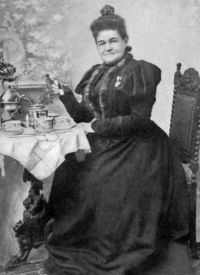 Marion Harland,
When Grandmamma Was New: The Story of a Virginia Childhood
Marion Harland,
When Grandmamma Was New: The Story of a Virginia Childhood
“ They go on whistling after they are dry. You see, the trouble with the whistles other people [Pg 36] make for me, is that they shrivel all up by next day, and there isn't a bit of whistle left in them.""That's the way with most of my whistles, too, Namesake. And then I throw them away and want new ones. Heigh-ho! What's the use of a whistle when all the whistle has gone out of it? I must ask Mr. Frank Morton how he makes his."I gave a jump and a little squeak."Oh, Cousin Molly Belle! there's a great, big race-horse on you!" ”
Fred. W. Burgess, Chats on Household Curios
“ Of antique whistles there are many types, those shown in Fig. 90 being the most frequently met with. The one marked "D" is said to be an attempt to increase the volume of sound by the extension of a cutting edge. A double sound is produced by that marked "F," whereas "A" is of the more familiar type, the example illustrated being an ivory whistle used upwards of a hundred years ago.From the whistle came the tin pipe capable of producing tunes in the hands of a skilful player. The whistle and pipe were in olden times associated with coaching days and inns. ”
William H. Elson, The Elson Readers, Book 5
“ In a letter to a friend in 1779, Franklin tells the story, "The Whistle." "An Ax to Grind" is from his autobiography.THE WHISTLE When I was a child seven years old, my friends on a holiday filled my pocket with coppers. I went directly to a shop where they sold toys for children, and, being charmed with the sound of a whistle that I met by the way in the hands of another boy, I voluntarily offered and gave all my money for one. I then ran home and went whistling all over the house, much pleased with my whistle, but disturbing all the family. ”
Various, Popular Science Monthly (1888)
“ In the former (13) the extremities A and D may be regarded as mouths, and the sounds are also modified by closing alternately or in succession the openings B and C. In the second (13) , by leaving all open, we obtain a quite characteristic mixed and false sound. Special modifications are obtained with the roulette whistle (1) and the bird whistle, with which the songs of various birds are imitated. Fancy has run rife in devising typical whistles, like the dog's-head whistle (10) for hunters, and many-ended whistles, like the army whistle with compass (11) , the match-box whistle ”
William Eastman Chenery, Home Entertaining: Amusements for Every One
“ The same thing is repeated until there are two people left to one chair. It is very amusing to watch these two cautiously moving about this chair, ready to seize it the instant the music stops.Find the Whistle. All the children but one sit down in a circle. The one that is left standing, must be the one who does not know the game. Some one takes a string, fastens a whistle to one end of it, and a bent pin to the other, then quietly and secretly attaches the [72] string by the hook to the person’s back. Every time he turns his back toward any one, the whistle is taken and blown. ”
Various, Cassell's Book of In-door Amusements…
“ No lad, however, need be without a whistle even when no toy-shop is near. A good whistle may be made out of almost any straight piece of scooped-out wood, the model of the tin whistle being adhered to as closely as possible. ”
Allen French, St. Nicholas — The Runaway (1873)
“ It was like the noise of machinery, and yet was unlike. At any rate, it was an irregular, creaky, jumpy kind of machinery. It continued monotonously on and on; it was, he reflected, a pretty soothing kind of noise to sleep to. And then a new sound came to his ears: a cheerful and yet a thoughtful whistle. A man's whistle—a boy would not whistle so thoughtfully. ”
 Howard Roger Garis,
Rick and Ruddy: The Story of a Boy and His Dog
Howard Roger Garis,
Rick and Ruddy: The Story of a Boy and His Dog
“ Just how Haw-Haw learned to whistle Rick never found out. Certainly the boy did not cut the crow's tongue, and perhaps whistling came natural to the black bird. And it may be that it was not a regular "whistle" at all, but merely a sound like that. Of course a bird has no lips to pucker [Pg 153] up and whistle with, as boys have, and some girls, too. But many birds utter whistling notes when they sing, or give their calls. The quail, or Bob White, seems to whistle, and so does the Whip-poor-will. And I have heard many men who can, by whistling with their tongue and lips, imitate many birds. ”
Thomas Firminger Thiselton Dyer, Popular Science Monthly (1883)
“ Indeed, few subjects have given rise to a greater variety of popular every-day sayings than whistling. Thus the expression, to "pay for one's whistle"—a favorite phrase with George Eliot—means to gratify one's fancy. Again, a thing worthy of notice is said in common parlance to be "worth the whistle"; the reference obviously being to the ordinary way of calling up a dog. Heywood, for instance, in one of is proverbs, says, "It is a poor dog that is not worth the whistling." Shakespeare, too, makes Goneril say to Albany, in "King Lear" (Act iv, scene 2) : "I have been worth the whistle." ”
Various, Popular Science Monthly (1888)
“ Experiments have shown that do and mi in particular have a round, full, well-supported sound, which in the Baduel regulation whistle can be heard for a distance of more than six hundred metres. Competent observers have asserted that the manner of whistling is not always the same, and that there are some unhappy persons who can not whistle at all. ”
Various, Encyclopaedia Britannica, 11th Edition…
“ Whistles.—Whistles, whether sounded by air or steam, are not used in Great Britain, except in two instances of harbour signals under local control. It has been objected that their sound has too great a resemblance to steamers’ whistles, and they are wasteful of power. In the United States and Canada they are largely used. The whistle usually employed consists of a metallic dome or bell against which the high-pressure steam impinges. Rapid vibrations are set up both in the metal of the bell and in the internal air, producing a shrill note. ”
Emma C. Dowd, Doodles, the Sunshine Boy
“ It was little more than a breath, but Tom caught it, and glanced down with the hint of a smile as he recognized Blue Stickney.“Sure! Blow my whistle!” was the quick answer, in a tone to match the query. With a deft motion, the little instrument was in the boy’s hand.Thomas Fitzpatrick’s whistle! Blue could scarcely comprehend the truth. For the joy of this moment he would have braved greater dangers than the present. Only a few days ago—or so it seemed—the kindly officer had explained the uses of his whistle, telling over his various signals. Blue remembered them every one. ”
Thomas T. Harman, Showell's Dictionary of Birmingham
“ Whistles of all sizes and sorts, from the child's tin whistle to the huge and powerful steam whistles used on board the American liners, are made in this town, and it might be imagined there could be but little novelty in any new design. ”
Edward Lucas White, ../../../ (1925)
“ Van Rieten queried. "We could hear Stone talking away, his big, deep-chested baritone rumbling along, and through it all we could hear a high, shrill whistle, the oddest, wheezy sound. You know, no matter how shrilly a grown man may whistle, the note has a different quality from the whistle of a boy or a woman or little girl. They sound more treble, somehow. Well, if you can imagine the smallest girl who could whistle keeping it up tunelessly right along, that whistle was like that, only even more piercing, and it sounded right through Stone's bass tones." ”
Thomas Firminger Thiselton Dyer, Popular Science Monthly (1883)
“ In some districts of North Germany the villagers say that if one whistles in the evening it makes the angels weep. Speaking, however, of ladies in connection with whistling, it is a widespread superstition that it is at all times unlucky for them to whistle, which, according to one legend, originated in the circumstance that, while the nails for our Lord's cross were being forged, a woman stood by and whistled. ”
 Elizabeth Robins Pennell,
The Life of James McNeill Whistler
Elizabeth Robins Pennell,
The Life of James McNeill Whistler
“ Three, The Winged Hat, The Tyresmith, and Maunder's Fish Shop, Chelsea, were published this year in the short-lived occasional weekly The Whirlwind, edited by Herbert Vivian and Stuart Erskine "in the Legitimist cause" and to their own great amusement. Drawings by Sidney Starr after three of Whistler's pictures appeared, and the editors boasted in their own pages within a few weeks that the lithographs, issued for a penny, could be had only for five shillings. Five guineas would now be nearer the price. ”
Willard W. Glazier, Peculiarities of American Cities
“ The mouth-piece of a trumpet has been fixed against the aperture of the rock, and the waves dashing against it with force enough to crush a ship to pieces, blows the whistle. This fog whistle ceases entirely at low water, and its loudness at all times depends upon the force of the waves. ”
 William Henry Giles Kingston,
The Three Midshipmen
William Henry Giles Kingston,
The Three Midshipmen
“ Anybody whistle, cost nothing. Chinaman spend money, buy gold paper, make junk, much trouble. Dat please Chinaman’s lady-god more dan empty whistle can Englishman’s fetish, or whatever he whistle to.”“Excellent,” exclaimed Murray. “The Malay has hit us very hard. That whistling for a breeze is, in most cases, merely a foolish trick, but it is too indicative of unsound principles to be witnessed without pain. If we really considered the matter rightly, we should feel that every time we whistle for a breeze, we are offering a senseless insult to the Great Ruler of the universe. ”
Hermann Smith, The World's Earliest Music
“ Had Polyphemus had the20 ordering of a musical scale, most surely the intervals would have been considerably larger; he would have suited his own fingers whether with lengths of strings or with holes in pipes.Imagine yourself a prehistoric man. How would you set about whistling? The lips are in the control of the imitative faculty; the effect called whistling would naturally be first elicited by accident of emotion, or sensibility of one kind or other. The intent to whistle would arise in desire to imitate ”
 Edgar Rice Burroughs,
Pirates of Venus
(1934)
Edgar Rice Burroughs,
Pirates of Venus
(1934)
“ One has one's own distinctive whistle. Some of them are quite elaborate airs. One soons learns to recognize the signals of one's friends. A knock merely informs you that some one wishes to enter; a whistle tells you the same thing and also reveals the identity of your caller.My signal, which is very simple, consists of two short low notes followed by a higher longer note; and as I stood before the door of Duare and sounded this, my mind was not upon the princess within but upon another girl far away in the tree city of Kooaad, in Vepaja. ”
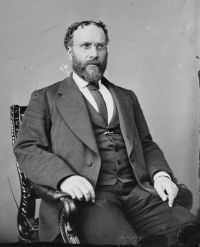 Robert Barnwell Roosevelt,
The Game-Birds of the Coasts and Lakes of the Northern States of America
Robert Barnwell Roosevelt,
The Game-Birds of the Coasts and Lakes of the Northern States of America
“ It is true that when the snipe are near at hand and about alighting, a lower whistle is better, for the reason that it is more perfect, and because the cry changes to a note of welcome when the flock receives its fellows. And often, when the birds once head for the stools, if not distracted by neighboring stands, or alarmed, they will come straight on without any whistling, although this is by no means invariably the case.Many persons find insuperable difficulty in whistling the clear, shrill, sharp calls ”
Elizabeth Robins Pennell,
The Life of James McNeill Whistler
“ A still younger child gave him sittings, a baby of not more than three, the model for many of the pastels. She and her mother were resting one afternoon, Whistler watching her every movement. "Really," he said, "you are a beautiful [Pg 360] little thing!" She looked up at him, "Yes, I is, Whistler," she lisped. And there is the old story: "Where did you come from, Mr. Whistler?" "I came from on high, my dear." "H'm, never should have thought it," said the child; "shows how we can deceive ourselves." ”
C. Stansfeld Hicks, The Boy's Own Book of Indoor Games and Recreations
“ The principle of the whistle, and, indeed, of all instruments of the flute and flageolet type, being that certain of the holes in different combinations should be left open in order to give the different notes, and that the expression should be given by the modulation of the wind strength, it follows that the fingering is merely mechanical. ”
Elizabeth Robins Pennell,
The Life of James McNeill Whistler
“ Whistler does not efface himself in his devotion to the masters. This is felt in the way a head or a figure is placed on the canvas. The arrangement of the pictures on the wall and the mouldings of the dado in At the Piano, the harmonious balance of the black and white in the dresses of the mother and the little girl, show the sense of design, of pattern, which he brought to perfection in the Mother, Carlyle, and Miss Alexander. ”
Elizabeth Robins Pennell,
The Life of James McNeill Whistler
“ In the lower design, chimneys are gaily smoking, and on the upper part of the plate several figures, obviously reminiscent of prints and drawings, are sketched: an old peasant woman; a man in a tall Italian hat, or, Mr. Key says, Whistler [Pg 32] himself as a Spanish hidalgo; another in a Sicilian bonnet; a mother and child in an oval, meant for Mrs. Partington and Ike, as Mr. Key remembers; a battered French soldier; a bearded monk in a cowl. The drawing is schoolboy-like, though it shows certain observation, but the biting is remarkable. ”
Elizabeth Robins Pennell,
Nights: Rome, Venice, in the Aesthetic Eighties…
“ It was just after our Thursday nights, for instance, that we began what I might call our Whistler nights, and a more stimulating talker than Whistler never talked, a more stimulating fighter never fought. I do not mean in the impossible way meant by those whose judgment of him rests solely on The Gentle Art. They think he fought for no other end than to make enemies [Pg 217] when, really, he enjoyed far more the good give-and-take argument that preserved to him his friends, provided those friends fought fair and did not play the coward, or the toady, to escape the combat. ”
Related terms
Authors who wrote about “penny whistle”
Mildred A. WirtThomas Firminger Thiselton DyerEdna GeisterHenry MayhewVarious J. M. BarrieFred. W. BurgessMarion HarlandAllen FrenchWilliam Eastman CheneryHoward Roger GarisWilliam H. ElsonMiles FranklinThomas T. HarmanEmma C. DowdEdward Lucas WhiteCarl EngelWilliam Henry Giles KingstonHermann SmithElizabeth Robins Pennell
Henry MayhewVariousJ. M. BarrieFred. W. BurgessMarion HarlandAllen FrenchWilliam Eastman CheneryHoward Roger GarisWilliam H. ElsonMiles FranklinThomas T. HarmanEmma C. DowdEdward Lucas WhiteCarl EngelWilliam Henry Giles KingstonHermann SmithElizabeth Robins Pennell