Popular Science Monthly (1879)
“ The purple robe has not only become frayed, but the wearer is sometimes under a strong temptation to exchange it for a dressing-gown. It is hard to say what is the safest general behavior for a royal personage. ”
Popular Science Monthly (1879)
“ The purple robe has not only become frayed, but the wearer is sometimes under a strong temptation to exchange it for a dressing-gown. It is hard to say what is the safest general behavior for a royal personage. ”
Harold Whetstone Johnston, The Private Life of the Romans
“ Probably the stripes worn by the knights and senators on the tunics and togas were much nearer our crimson than purple. Under the Empire the garments worn by women were dyed in various colors, and so, too, perhaps, the fancier articles worn by men, such as the lacerna (§247) and the synthesis (§249) . The trabea of the augurs seems to have been striped with scarlet and purple, the palūdāmentum of the general to have been at different times white, scarlet, and purple, and the robe of the triumphātor purple. ”
 O. Henry,
The Trimmed Lamp
(1907)
O. Henry,
The Trimmed Lamp
(1907)
“ THE PURPLE DRESS WE are to consider the shade known as purple. It is a color justly in repute among the sons and daughters of man. Emperors claim it for their especial dye. Good fellows everywhere seek to bring their noses to the genial hue that follows the commingling of the red and blue. We say of princes that they are born to the purple; and no doubt they are, for the colic tinges their faces with the royal tint equally with the snub-nosed countenance of a woodchopper’s brat. All women love it—when it is the fashion. ”
O. Henry,
The Trimmed Lamp, and Other Stories of the Four Million
“ All women love it—when it is the fashion. And now purple is being worn. You notice it on the streets. Of course other colors are quite stylish as well—in fact, I saw a lovely thing the other day in olive green albatross, with a triple-lapped flounce skirt trimmed with insert squares of silk, and a draped fichu of lace opening over a shirred vest and double puff sleeves with a lace band holding two gathered frills—but you see lots of purple too. Oh, yes, you do; just take a walk down Twenty-third street any afternoon. ”
Various, The Galaxy, May, 1877
“ Such combinations may be justly regarded as the rule in Englishwomen's dress. For purple they have strong liking. They not only wear it in gowns, but they use it for trimming, in bands and flounces, in ribbons, in feathers. They combine it with all other colors. An Englishwoman seems to think herself "made" if she can deck herself in some way with purple silk or velvet, or ribbons or feathers. Of course I am excepting from these remarks a few who have intuitive good taste, and other few who employ French modistes, and who submit implicitly to their authority. ”
“ The flickering candles in tin sconces against the walls, or depending in rude chandeliers of barrel-hoops from the ceiling, lit up the most astounding diversity of female costume the master had ever seen. Gowns of bygone fashions, creased and stained with packing and disuse, toilets of forgotten festivity revised with modern additions; garments in and out of season—a fur-trimmed jacket and a tulle skirt, a velvet robe under a pique sacque; fresh young faces beneath faded head-dresses, and mature and buxom charms in virgin' white. ”
 Nathaniel Parker Willis,
Famous Persons and Places
Nathaniel Parker Willis,
Famous Persons and Places
“ His dress was a mixture of oriental and English fashions—a pair of baggy blue pantaloons, bound around the waist with a rich shawl, a splendid scarlet waistcoat buttoned close over his spacious chest, and a robe of a very fine snuff-colored cloth something like a loose dressing gown without a collar. A cap of silver cloth, and a brilliant blue-satin cravat completed his costume, unless in his covering should be reckoned an enormous turquoise ring, which almost entirely concealed one of his fingers. ”
 Murasaki Shikibu,
The Tale of Genji
Murasaki Shikibu,
The Tale of Genji
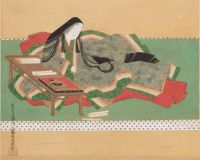
“ A complete description of people’s costumes is apt to be tedious, but as in stories the first thing that is said about the characters is invariably what they wore, I shall once in a way attempt such a description. Over a terribly faded bodice of imperial purple she wore a gown of which the purple had turned definitely black with age. ”
 L. Frank Baum,
The Marvelous Land of Oz — Chapter 8…
(1904)
L. Frank Baum,
The Marvelous Land of Oz — Chapter 8…
(1904)
“ She wore a costume that struck the boy as being remarkably brilliant: her silken waist being of emerald green and her skirt of four distinct colors—blue in front, yellow at the left side, red at the back and purple at the right side. ”
Florence Mary Gardiner, The Evolution of Fashion
“ A peculiar feature in the costume of both sexes was sleeves distinct from the gown, but attached (so as to be changed at pleasure) to the waistcoat. Among the inventories we find three pairs of purple satin sleeves for women, one pair of linen sleeves paned with gold over the arm, quilted with black silk and wrought with flowers; one [Pg 8] pair of sleeves of purple gold tissue damask wire, each one tied with aglets of gold; one pair of crimson satin sleeves, four buttons of gold being set on each, and in every button nine pearls. ”
 Lillian Eichler,
Book of Etiquette, Volume 2, Part 4…
(1921)
Lillian Eichler,
Book of Etiquette, Volume 2, Part 4…
(1921)
“ Pink is the ideal color for the blond woman with warm coloring; black for the woman with fair skin. Pink and green are for youth; purple and black are for age. The other colors may be used according to the artistic sense of the wearer. In selecting material for a gown, the fashionable modiste will first consider the eyes of the lady who is to wear it. Though few but the artist realize it, the eyes are the keynote of the entire costume. They determine whether the dress shall be frivolous or demure, gay or somber, vivid or soft. ”
“ The garments worn by high personages in the embroidery, and meant to imitate a golden textile, were done in gold passing sometimes by itself, sometimes with coloured silk thread laid down alternately aside it, so as to lend a tinge of green, crimson, pink, or blue, to the imagined tissue of the robe, as if it were made of a golden stuff shot with the adopted tint. ”
Various, Harper's New Monthly Magazine, No…
“ Some are formed of long velvet leaves in shaded green, pink, and white; while others, of a grenat color, are sable and gold. Several pretty little head-dresses for home costume have appeared, composed entirely of shaded ribbon-velvets, or a square net-work of various colors, which have a novel and picturesque appearance.Fashionable Colors are dark, rich, and full, such as grenat, narcarat, dark green, reddish brown, violet, and a reddish gray; while white, amber, purple, and pink predominate for evening dresses. FOOTNOTES: [1] From "John Howard and the Prison World of Europe." ”
James H. Head, Home Pastimes; or Tableaux Vivants
“ The costume consists of a long white dress, worn without many skirts, over which is draped a robe of white muslin; a long, white gauze veil should be loosely tied around the head; the hair is allowed to hang loosely over the shoulders. The face, and arms, and neck must be made as white as possible by the use of pearl-powder. The features should express sternness.The bridegroom should be dressed in a velvet coat trimmed with gold lace, velvet breeches, white vest, white hose, low shoes, knee and shoe buckles, ruffled bosom, white lace collar. ”
Percy Greg, Across the Zodiac: the Story of a Wrecked Record (1880)
“ The dress of all was, except in colour and in certain omissions and additions, much the same. The under-garments must have been slight in material and few in number. Nothing was to be seen of them save the sleeves, which were of a delicate substance, resembling that of the finest Parisian kid gloves, but far softer and finer. Over all was a robe almost without shape, save what it took from the figure to which it closely adapted itself, suspended by broad ribbons and jewelled clasps from the shoulders, falling nearly to the ankles, and gathered in by a zone at the waist. ”
James Augustus St. John, The History of the Manners and Customs of Ancient Greece… (1842)
“ Other garments seem to have been affected by the middle class of citizens, who, being unable to dress in purple, [170] the distinguishing colour of the wealthy and the noble, brought into fashion the Paruphes and Paralourges, robes adorned on either side with a purple stripe. As much dignity is supposed to belong to ample drapery, our citizen ladies took care not to be sparing of stuff, their dresses trailing to the ground, and displaying numerous folds, produced purposely at the extremity by a band passing round the edge. These garments were generally of linen ”
M.A. William Davis, Hosiery Manufacture
“ Real secondary purple has a depth, richness, saturation and bloom which cannot be approached by any other colour, the aggressive qualities of the red are effectively subdued by the retiring qualities of the blue, whilst in both is a strength of character which is the basis of the undoubted handsomeness of the purple. There is an air of quiet dignity about purple, qualities are held in reserve which do not strike the eye at first sight, and these undoubtedly form the basis of its use for ceremonial robes, where it is desired to give the fullest expression to dignity, pomp and power. ”
Samuel Birch, History of Ancient Pottery: Greek…
“ At first there is a tendency to use purple in large masses, and even for the flesh of men; but it is generally employed for folds or portions of drapery, and for throwing up different parts of animals’ figures, or of the decorative patterns, such as palmettes and lotos-buds. White is employed for the hair of old men, for rocks and details of buildings, for the long garment worn by charioteers, and above all for the flesh of women. ”
G. Woolliscroft Rhead, Chats on Costume
“ The robe is made of plain sattin, chiefly white, worn without a hoop, round, and a long train. It is drawn up in the front, on one side, and fastened with tassels of silver, gold, or silk, according to the taste of the wearer; and this discloses a puckered petticoat of gauze or sarsenet, of a different colour. The sleeves are wide and short, drawn up near the shoulder with small tassels, or knots of diamonds; under sleeves of the finest cambrick, full plaited, and trimmed at the elbow with Brussels or point, give infinite charms to the whole. ”
Edwin W. Fuller, Sea-gift: A Novel
“ The said wardrobe consisted of several long sacerdotal robes, of the finest cambric; a dozen or more very unsacerdotal looking nether garments of linen and cambric, ruffled and trimmed with thread lace; a number of gowns of rich material; also a couple of flannel skirts, heavily embroidered, and seemingly intended only to tangle the feet; and quite a pile of unmentionables, with necessary fastenings.There was also an elegant India muslin robe, trimmed with embroidery and fretted with lace, and a handsome lace cap, laid apart to themselves. ”
“ Among the many thousands of those who came forth from Damascus to the Greek general, Parmenio, numbers were so clad: “They wore robes splendid with gold and purple.” All over India the same fashion was followed in dress. When an Indian king with his two sons came to Alexander, the three were so arrayed. Princes and the high nobility, all over the east, are called by Quintus Curtius “purpurati.” Not only garments but hangings were made of the same costly fabric. ”
Miss Pardoe, The City of the Sultan; and Domestic Manners of the Turks…
“ Her costume was an odd admixture of the European and the Oriental. She wore trowsers of pale blue cotton flowered with yellow; and an antery of light green striped with white, and edged with a fringe of pink floss silk; while her jacket, which was the production of a Parisian dress-maker, was of dove-coloured satin, thickly wadded, and furnished with a deep cape, and a pair of immense sleeves, fastened at the wrists with diamond studs. But the most striking feature of the costume in the Imperial Palaces is the head-dress. Nothing can be imagined more hideous! ”
 Eliza Davis Aria,
Costume: Fanciful, Historical, and Theatrical…
(1906)
Eliza Davis Aria,
Costume: Fanciful, Historical, and Theatrical…
(1906)
“ The Princess of Orange's dress was the prettiest thing that ever was seen—a corps de robe—that is, in plain English, a stiff bodied gown. The eight peers' daughters that held up her train were in the same sort of dress, all white and silver, with great quantities of jewels in their hair and long locks; some of them very pretty and well-shaped, it is a most becoming dress. ”
Eliza Davis Aria,
Costume: Fanciful, Historical, and Theatrical
(1906)
“ The over-part of the dress and the skirt beneath it were boned and wired, and tight lacing ruled in an injurious degree, though the enormous sleeves, ruffles, and skirts might well have accorded such an effect of slimness as to render stringent measures unnecessary. Dress was a magnificent affair altogether; velvet and taffeta and fine scarlet cloth were used, lace played its part bravely, and silken scarves fringed with gold and silver were thrown over the shoulders, with deep capes of satin or velvet edged with lace. ”
Eliza Davis Aria,
Costume: Fanciful, Historical, and Theatrical
(1906)
“ The dress and bodice of orange-coloured silk bear an application of padded oranges and leaves on the skirt, beneath a chenille fringe of black with heavy netting, velvet streamers and oranges are used at discretion to adorn the hair, and the petticoats beneath the yellow skirt are of green, the stockings and shoes being of the same tone. At a fancy-dress ball the costume which is merely original and not pretty should be condemned except when the novelty prize is the desideratum of the occasion. ”
Ardern Holt, Fancy dresses described (1887)
“ Or classical dress of apple green "Liberty" silk, the draperies-caught up with white and purple grapes; large wreath of grapes on the head; flesh coloured stockings; the sandals; tied with purple ribbon. BACKGAMMON. Maize satin low bodice and short skirt, trimmed with black velvet and gold braid; upper skirt; cut in deep points alternately cerise and black satin, bordered with gold braid; velvet necklet, backgammon men as pendents. Enamel dice for ear-rings; bracelet clasps, and ornaments; cerise satin cap. Cup for dice suspended by gold cord from waist to hold handkerchief. ”
active 19th century Lady of distinction, The Mirror of the Graces (1831)
“ The morning robe should cover the arms and the bosom, nay even the neck. And if it be made tight to the shape, every symmetrical line is discovered with a grace so decent, that vestals, without a blush, might adopt the chaste apparel. This simple garb leaves to beauty all her empire; no furbelows, no heavy ornaments, load the figure, warp the outlines, and distract the attention. All is light, easy, and elegant; and the lovely wearer, “with her glossy ringlets loosely bound,” moves with the Zephyrs on the airy wing of youth and innocence. ”
Emily Sarah Holt, For the Master's Sake: A Story of the Days of Queen Mary
“ The gentlemen dress in the Blue-Coat style, occasionally varying it by a short tunic-like coat instead of the long gown, and surmounting it by a low flat cap, which the nobles ornament by an ostrich feather. The ladies array themselves in long dresses, full of plaits, and often stiff as crinoline—plain for the commonalty, but heavily laden with embroidery, and deeply edged with fur, in the case of the aristocracy. ”
Eliza Davis Aria,
Costume: Fanciful, Historical, and Theatrical
(1906)
“ An audacious selection is the costume of the Wallflower in gold and brown, which looks its best when made in chiffon and velvet. As a rule, it must be admitted that the finest fancy dress looks the best, and however charming may be the effects arrived at with muslin, cotton, crepe, and calico, she who stands out in the vast crowd will be she who has the most magnificent clothes. ”
Harry Collingwood, The Adventures of Dick Maitland…
“ All these people wore garments of exceedingly fine material, mostly white, richly trimmed with elaborate embroidery in colours or gold, the women’s dress being a long, sleeveless garment reaching from the throat to the feet and confined at the waist by an ornamental belt, handsome sandals, much jewellery, and the head bare, the heavy masses of dark hair being wound upon the head very becomingly, and intertwined with ribbon or strings of coloured beads. ”
 Alice Morse Earle,
Two Centuries of Costume in America…
Alice Morse Earle,
Two Centuries of Costume in America…
“ I had a baffled thought after examining it that I knew less of Puritan dress than without it. I see that they gather up their gowns for walking after a mode known in later years as washerwoman style. And by that very gathering up we lose what the drawing might have told us; namely, how the gowns were shaped in the back; how attached to the waist or bodice; and how the bodice was shaped at the waist, whether it had a straight belt, whether it was pointed, whether slashed in tabs or laps like a samare. The sleeve, too, is concealed, and the kerchief hides everything else. ”


