 Henry Adams,
Mont-Saint-Michel and Chartres
(1904)
Henry Adams,
Mont-Saint-Michel and Chartres
(1904)
“ Religious art is the measure of human depth and sincerity; any triviality, any weakness, cries aloud. ”
Religious art includes visual and creative expressions based on spiritual beliefs, acting as a link between the sacred and human experience. From Buddhist mandalas designed as meditative aids to Christian iconography illustrating theological stories, this field varies greatly in form and purpose.
Authors like Clive Bell highlight its universal appeal beyond doctrine, while Evelyn Underhill views it as a symbol of faith's inner dimensions. Henry Green connects Christian art to wider religious symbols, and Vernon Lee emphasizes its depth in contrast to secular works. These viewpoints together show religious art as a complex conversation between devotion and artistic creativity.
Henry Adams,
Mont-Saint-Michel and Chartres
(1904)
“ Religious art is the measure of human depth and sincerity; any triviality, any weakness, cries aloud. ”
Henry Green, Shakespeare and the Emblem Writers
“ Christian Art, like the Religious Art of the world in general,—from the thou and thee of simplest Quakerism, outward and audible sounds of an inward and silent spirit, up to the profoundest mystic ritualism of the Buddhist,—Christian Art abounds in Emblems ”
“ Let me insist once again that, when I speak of the Christian ferment or the Christian slope, I am not thinking of dogmatic religion. I am thinking of that religious spirit of which Christianity, with its dogmas and rituals, is one manifestation, Buddhism another. And when I speak of art as a manifestation of the religious spirit I do not mean that art expresses particular religious emotions, much less that it expresses anything theological. I have said that if art expresses anything, it expresses an emotion felt for pure form and that which gives pure form its extraordinary significance. ”
 Evelyn Underhill,
The Life of the Spirit and the Life of To-day
Evelyn Underhill,
The Life of the Spirit and the Life of To-day
“ Here we stand at the sources of religious art: which, when it is genuine, is a symbolic picture of the experiences of faith, and in those minds attuned to it may evoke again the memory or very presence of those experiences. But many minds are, as it were, their own religious artists; and build up for themselves psychic structures answering to their intuitive apprehensions. ”
“ Art and Religion are, then, two roads by which men escape from circumstance to ecstasy. Between aesthetic and religious rapture there is a family alliance. Art and Religion are means to similar states of mind. And if we are licensed to lay aside the science of aesthetics and, going behind our emotion and its object, consider what is in the mind of the artist, we may say, loosely enough, that art is a manifestation of the religious sense. ”
 Vernon Lee,
Laurus Nobilis: Chapters on Art and Life
Vernon Lee,
Laurus Nobilis: Chapters on Art and Life
“ But with what are you going to replace religion itself in art? For the religious feeling, whenever it existed, gave art an element of thoroughness which the desire for pleasure and interest, even for æsthetic pleasure and interest, does not supply. An immense fulness of energy is due to the fact that beautiful things, as employed by religion, were intended to be beautiful all through, adequate in the all-seeing eye of God or Gods, not merely beautiful on the surface, on the side turned towards the glance of man. For, in religious art, beautiful things are an oblation ”
 Joseph Addison,
The Spectator, Volumes 1, 2 and 3
Joseph Addison,
The Spectator, Volumes 1, 2 and 3
“ Musick among those who were styled the chosen People was a Religious Art. ”
The Good Housekeeping Marriage Book
“ When religion can change the lives of millions, when it can produce supreme creations in art, it is a force worth serious consideration.Religious faith has produced the finest architecture, the finest painting, the finest music, the finest literature in the world. ”
Lewis F. Day, Windows: A Book About Stained & Painted Glass
“ What, then, is the difference between the two kinds of glass? It is not that the one is ecclesiastical the other secular, the one religious the other profane art. “Sacred Art” is a term consecrated by use; but, strictly speaking, it is a meaningless combination of words, signifying, if it signify anything, that the speaker confounds the art of telling with the thing told. Art has no more a religion than it has a country. No doubt there clings always to the art of the devout believer some fervour of faith, as there may hang about the sceptic’s doing a chill of doubt. ”
 G. Stanley Hall,
Senescence, the Last Half of Life
(1922)
G. Stanley Hall,
Senescence, the Last Half of Life
(1922)
“ One eminent artist finds all the religion he needs in art; students of science find it in nature; students of the humanities, in the study of the deeper nature of man. The beautiful is just as religious, if not more so, than the good or the true. “There is only one great word in the world and that is love.” “I preached all the doctrines and found some truth in many of them but have rejected most, and perhaps the form of all, as pulp and rind.” ”
graf Leo Tolstoy, The Kingdom of God is Within You…
“ And having acknowledged an article to belong to real Christian art, we must then, according to whether it transmits the feelings flowing from love to God and man, or merely the simple feelings uniting all men, assign it a place in the ranks of religious art or in those of universal art. ”
H. Fielding, The Hearts of Men
“ But when religious emotions have cooled, and room is left for other feelings, then art may arise. And if it does so, and is a great art, it allies itself with religion, if the religion permits of it. Some forms of faith would never permit it. Which of the emotions of which Puritanism is composed could be expressed in art? Art is almost always the cult of emotions that are beautiful, are happy, are joyous. ”
graf Leo Tolstoy, What Is Art?
“ I know that according to an opinion current in our times, religion is a superstition, which humanity has outgrown, and that it is therefore assumed that no such thing exists as a religious perception common to us all by which art, in our time, can be estimated. ”
Ernest Arthur Gardner, Religion and Art in Ancient Greece
“ The association of acts of worship with certain specially sacred objects or places lies at the basis of much religious art, though very often art has little or nothing to do with such objects in a primitive stage of religious development. ”
Henry Norman Hudson, Shakespeare: His Life, Art, And Characters…
“ Thus the several forms of Art have had their source and principle deep in man's religious nature: all have come into being as so many projections or outgrowths of man's religious life. And it may well be questioned whether, without the motives and inspirations of religion, the human soul ever was, or ever can be, strong and free enough to produce any shape of art. In, other words, it is only as the mind stands dressed in and for religion that the Creative Faculty of Art gets warmed and quickened into operation. So that religion is most truly the vivifying power of Art in all its forms ”
 John Bruce Glasier,
William Morris and the Early Days of the Socialist Movement
(1921)
John Bruce Glasier,
William Morris and the Early Days of the Socialist Movement
(1921)
“ This idea of his, whimsically put as it was, that religion or religious worship, if we are to have religion at all, should be some mode of expressing the happiness of life, even as art should be, appears to have been deeply rooted in his mind. ”
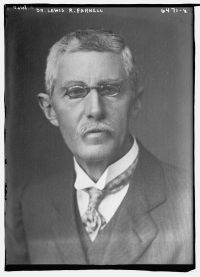 Lewis Richard Farnell,
Greece and Babylon
(1911)
Lewis Richard Farnell,
Greece and Babylon
(1911)
“ One discerns that the religious art, and to some extent the religious poetry, developed {57} and strengthened the anthropomorphic faith and perception of the people, but not so powerfully as to preclude a mysticising tendency towards metaphysical speculation that transcended the limits of a polytheism of concrete personalities. ”
H. Fielding, The Hearts of Men
“ Art may often be the representative of religion, it is never the outcome of religious people or a religious age. The very contrary is the fact. [Pg 258] These are strong arguments, and there are more. But these will suffice.What is the truth? What connection has art with religion?I do not think the answer is difficult. The connection depends upon what you define religion and art respectively to be. With the old definitions no answer is forthcoming. But when you see religion as it really is, when you understand its genesis and its growth, the answer is clear. ”
“ And yet there is a connection between art and religion, even in the common and limited sense of that word. There is an historical connection: or, to be more exact, there is a fundamental connection between the history of art and the history of religion. Religions are vital and sincere only so long as they are animated by that which animates all great art—spiritual ferment. It is a mistake, by the way, to suppose that dogmatic religion cannot be vital and sincere. Religious emotions tend always to anchor themselves to earth by a chain of dogma. ”
Thomas Hanly Ball, Sketch of Handel and Beethoven
“ It is to bow to their immutable terms, to lay all passion and vexation of spirit prostrate at [81] their feet, and to approach their divine presence with a mind so calm and so void of littleness as to be ready to receive the dictates of fantasy and the revelations of truth. Thus the art becomes a divinity, man approaches her with religious feelings, his inspirations are God's divine gifts, and his aim fixed by the same hand from above which helps him to attain it. ”
 John Cowper Powys,
One Hundred Best Books
John Cowper Powys,
One Hundred Best Books
“ And, with the rest, we seem to be aware of a secret attitude not only towards art but towards life also, to miss the key to which would be to fail in that architecture of the soul and senses which is the object of the discipline not merely of the æsthetic but of the religious cult. ”
 Herbert Spencer,
Essays on Education and Kindred Subjects
Herbert Spencer,
Essays on Education and Kindred Subjects
“ In Christian art we may clearly trace a parallel re-genesis. All early paintings and sculptures throughout Europe were religious in subject—represented Christs, crucifixions, virgins, holy families, apostles, saints. ”
 William Ralph Inge,
Christian Mysticism
William Ralph Inge,
Christian Mysticism
“ We find, indeed, in these writers a marked tendency to exalt the religious value of natural beauty, and to disparage the function of art—a premonition, perhaps, of iconoclasm. Pagan art, which was decaying before the advent of Christ, could not, it appears, be quietly Christianised and carried on without a break. ”
 John Haslam,
Observations on Madness and Melancholy
John Haslam,
Observations on Madness and Melancholy
“ Instituting a generous and tolerant survey of religious opinions, we see nothing in the solemn pomp of catholic worship which could disorganize the mind; as human beings, they have employed human art to render the impression more vivid and durable. ”
 Jean-Marie Guyau,
The Non-religion of the Future…
Jean-Marie Guyau,
The Non-religion of the Future…
“ III. Associations for æsthetic purposes—Worship of art and nature—Art and poetry will sever their connection with religion and will survive it—Necessity of developing the æsthetic sentiment and the worship of art, as the religious sentiment becomes more feeble—Poetry, eloquence, music; their rôle in the future—Final substitution of art for rites—Worship of nature—Feeling for nature originally an essential element of the religious sentiment—Superiority of a worship of nature over worship of human art—Nature is the true temple of the future. ”
 Georg Wilhelm Friedrich Hegel,
The Philosophy of Fine Art, volume 2…
Georg Wilhelm Friedrich Hegel,
The Philosophy of Fine Art, volume 2…
“ However intimate the connection between religion and art may be we are not here concerned to pass in review either symbols or religion under the range which is co-extensive with the wider signification of the word symbol or emblematical conceptions; we have exclusively to consider that aspect of them, according to which they belong to art in its own right, handing over their religious aspect to the historian of mythology and symbolism. ”
Henry Norman Hudson, Shakespeare: His Life, Art, And Characters…
“ Thus there appears to be a profound natural sympathy or affinity between the forces of religion and the forms of Art. Therefore it is that the higher efficacies of Christian culture and the deeper workings of religious thought and emotion have instinctively sought to organize and enshrine themselves in artistic creations; no other mode or power of expression being strong enough to hold them, or inclusive enough to contain them. It is in such works as the ancient marvels of ecclesiastical building that the Christian mind has found its most fitting and most operative eloquence. ”
graf Leo Tolstoy, What Is Art?
“ Look carefully into the causes of the ignorance of the masses, and you may see that the chief cause does not at all lie in the lack of schools and libraries, as we are accustomed to suppose, but in those superstitions, both ecclesiastical and patriotic, with which the people are saturated, and which are unceasingly generated by all the methods of art. Church superstitions are supported and produced by the 184poetry of prayers, hymns, painting, by the sculpture of images and of statues, by singing, by organs, by music, by architecture, and even by dramatic art in religious ceremonies. ”
G. H. Percival, The Incarnate Purpose: Essays on the Spiritual Unity of Life
“ The rituals of religious creeds, regarded as combinations of symbols as infinite in variety and arrangement as the needs of men, may surely be designated as works of art if it be remembered that admiration and imitation of natural objects is mainly responsible for the conception of those several deities whose supposed supernatural authority forms the summit of each particular creed, and whose character stands not only as a summary of a [98] people's appreciation of what is admirable in human conduct, but also as an expression of artistic feeling. ”
 Walter Pater,
The Renaissance: Studies in Art and Poetry
Walter Pater,
The Renaissance: Studies in Art and Poetry
“ And the fifteenth century was an impassioned age, so ardent and serious in its pursuit of art that it consecrated everything with which art had to do as a religious object. ”
James W. Lee, The Making of a Man
“ Whatever there is of literary merit, of philosophic thought, or of poetic depth in the Bible is incidental.There is the conserved spiritual force of Christian art. The masterpieces in painting, sculpture, music, poetry, and architecture are Christian. ”
“ The plein air painters are painting the light, and the sculptors are carving shadows and haloes, and we have not an art left which does not lean out into the Invisible. And religion is full of this spirit and theosophy and Christian Science. ”
 Henry Osborn Taylor,
The Mediaeval Mind (Volume 1 of 2…
Henry Osborn Taylor,
The Mediaeval Mind (Volume 1 of 2…
“ So saint and poet and artist-craftsman join in that appropriation of Christianity which was putting life into whatever had come from the Latin Fathers, by pondering upon it, loving it, living it, imagining it, and making it into poetry and art. ”
Various, The Catholic World, Vol. 05, April 1867 to September 1867
“ From what has been said, the depth, and extent, and value of the influence of the church upon art may be inferred; but no one can imagine the condition of our art had it been without the inspiration of religion. ”
Byron J. Rees, The Heart-Cry of Jesus
“ In some people religion appeals to the aesthetic nature, and to that only. They festoon the cross with flowers, but never think of dying on it. They are charmed by Gothic churches filled with "dim, religious light." ”
Various, The Catholic World, Vol. 07, April 1868 to September…
“ The church has been the celestial crucible in which whatever of human art or invention had within it the essential attributes of higher and spiritual goodness has been purified and adapted to the service of religion. Has poetry sought to please the imaginations of men? the church of Christ unfolded before her the annals of Christianity, with her grand central sacrifice of infinite love, and all her demonstrations of heroic suffering and courageous faith; and poetry drew holier inspiration from the view, and incited men by higher motives to a higher life. ”
Vernon Lee,
Belcaro; Being Essays on Sundry Aesthetical Questions
“ And here I return to my former remark, that when I said that the only true religion was the religion not of nature, nor of mankind, nor of science, nor of art, but the religion of good, and that the creation of perfect beauty is the highest aim of the artist, I was not contradicting myself, but merely stating two parts—a general and a particular—of the same proposition. ”
H. Fielding, The Hearts of Men
“ What has secular art to show to compare with these? Are not the Venus de Milo, the statue of Athena, and all the famous Greek sculptures those of gods? What is the most famous painting in the world? It is the Sistine Madonna of Raphael. Even in literature, is there anything secular to compare with the sacred books of the world? The oratorios and masses are the finest music. What can be more certain than that only religion gives the necessary stimulus to art and furnishes the most inspiring subjects? Great art is born of great faiths, great faiths produce great art. ”
“ For, more often than not, religion is the whetstone on which men sharpen the spiritual sense. Religion, like art, is concerned with the world of emotional reality, and with material things only in so far as they are emotionally significant. ”
 Ameen Fares Rihani,
The Book of Khalid
Ameen Fares Rihani,
The Book of Khalid
“ But whether Mother Church or Poetry or Philosophy or Music be the magic-medium, the result is much the same if the motive be not religiously sincere, sincerely religious, piously pure, lofty, and humane. ”
 Ludwig Tieck,
The Rebellion in the Cevennes, an Historical Novel…
Ludwig Tieck,
The Rebellion in the Cevennes, an Historical Novel…
“ How joyous, sweet, yea intoxicating and full of merriment, cheerful, and smiling does Christianity appear through all the genuine works of modern art, how blessed and pleasing are they, when in the greatness and fulness of the old world, yet like a spirit of gentle melancholy that passes away as the cloud, momentarily over the beautiful landscape in the brilliancy of spring. ”
 Clive Bellgraf Leo TolstoyVernon Lee
 John Ruskin
 Jane Ellen HarrisonHenry Norman HudsonG. G. ZerffiClaude Fayette BragdonVariousH. FieldingGeorg Wilhelm Friedrich HegelEvelyn UnderhillHenry Osborn TaylorJohn Bruce GlasierErnest Arthur GardnerLewis F. DayLewis Richard FarnellHerbert SpencerWilliam Ralph IngeJohn Cowper Powys