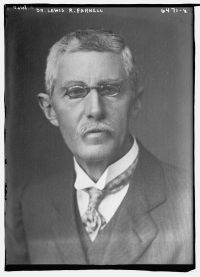
Lewis Richard Farnell

Lewis Richard Farnell

Summary

Portrait of Lewis Richard Farnell Lewis Richard Farnell Greece and Babylon (1911)

Everywhere we find proofs of a personal theism reaching far back into prehistoric times: whether it be the cult of a high god such as the Cilician divinity, called Zeus or Herakles by the later Greeks, or the Lycian “Apollo,” or a great goddess such as Ma of Comana, Cybele of Phrygia and Lydia. And now to all this testimony we can add the recently discovered monuments of a developed Minoan-Mycenaean religion with the elaborate ritual and worship of personal divinities, anthropomorphically imagined on the whole.
Source: Gutenberg

Portrait of Lewis Richard Farnell Lewis Richard Farnell Greece and Babylon (1911)

As regards the powers attributed to the divinity, we may endeavour to discern certain laws of progress or evolution in progressive societies—an evolution, perhaps, from a more material to a more spiritual conception, or, again, from a belief in divinities finite and mortal to a dogma that infinity, omniscience, and immortality are their necessary attributes. On this line of inquiry we are often confronted with the phenomenon of the death of the god or goddess, and no single fact in the history of religions is of more interest and of more weight.
Source: Gutenberg

Portrait of Lewis Richard Farnell Lewis Richard Farnell Greece and Babylon (1911)

To draw the distinction too sharply between the cultured and the uncultured strata may be a source of fallacy, especially when it is ancient Hellas that we are dealing with, where the artist was usually a man of the people and the people certainly delighted in the work of their poets, and were strangely susceptible to the healing influences of music. If Greek poetry, then, and art strove to banish the ugliest forms of the demon-world, and thereby worked with purifying and tranquillising influence on the temperament, so much the better for the Greek peasant.
Source: Gutenberg

Get perspective with Kwize: daily news enlightened by great literature