“ And turn the 17th of Tammuz for us into rejoicing and happiness. We stiffened our neck and suffered great destruction. For that, we were delivered to plunder and subjugation. See, O Lord, and rescue us from destruction. And turn the 17th of Tammuz for us into happiness and rejoicing. Give heed to us, He who dwells above. Gather our exiles from the ends of the world. Say to Zion, "Rise up". And turn the 17th of Tammuz for us to a day of salvation and comfort. ”
Tammuz
Definition and stakes
Tammuz, a deity central to Babylonian and Assyrian mythology, represents the cyclical relationship between life, death, and renewal, frequently associated with plant growth and the sun. Scholars such as Jessie Laidlay Weston and Lewis Spence emphasize his function as a symbol of nature's restorative powers, while Elizabeth A. Reed describes rituals expressing his "loss," illustrating a cult that intertwined agricultural rhythms with divine mourning.
Theophilus G. Pinches traces Tammuz’s roots to pre-Sumerian traditions, and Andrew Lang links him to wider Near Eastern mythologies, including comparisons with Adonis and Osiris. These diverse viewpoints highlight Tammuz’s lasting importance as a connection between early nature worship and the intricate spiritual systems of ancient Mesopotamia.
Quotes about “Tammuz”
Elizabeth A. Reed, Persian Literature, Ancient and Modern
“ The sacred tree having been cut and carried into the idol-temple, there came the search for Tammuz, when the devotees ran wildly about 68weeping and wailing for the lost one, [95] and cutting themselves with knives. His wife, Ishtar, descended to the lower world to search for him, and the tablets furnish another poem which seems to celebrate a temple similar to that recorded by Maimonides, in which the Babylonian gods gathered around the image of the sun-god, to lament his death. The statue of Tammuz was placed on a bier and followed by bands of mourners, crying and singing a funeral dirge. ”
 Lewis Spence,
Myths & Legends of Babylonia & Assyria
Lewis Spence,
Myths & Legends of Babylonia & Assyria
“ Both Tammuz and Ishtar were originally non-Semitic, the name of the former deity being derived from the Akkadian Dumu-zi, 'son of life,' or 'the only son,' perhaps a contraction of Dumu-zi-apsu, 'offspring of the spirit of the deep,' as Professor Sayce indicates. The 'spirit of the deep' is, of course, the water-god Ea, and Tammuz apparently typifies the sun, though he is not, as will presently be seen, a simple solar deity, but a god who unites in himself the attributes of various departmental divinities. ”
Related terms
Authors who wrote about “Tammuz”
Donald A. MackenzieJessie Laidlay WestonYosef Chaim Andrew Lang
 A. H. SayceLewis SpenceElizabeth A. Reed
 James George Frazer
 Morris JastrowTheophilus G. PinchesJessie L. Weston
 J. M. Robertson
 Archibald Henry Sayce
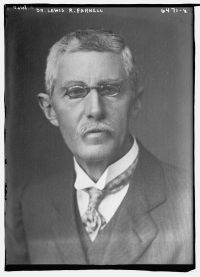 Lewis Richard FarnellG. MasperoIsya JosephAlfred Jeremias
 Margaret Horton PotterGeorge A. Barton
 Sabine Baring-Gould
Andrew LangA. H. SayceLewis SpenceElizabeth A. ReedJames George FrazerMorris JastrowTheophilus G. PinchesJessie L. WestonJ. M. RobertsonArchibald Henry SayceLewis Richard FarnellG. MasperoIsya JosephAlfred JeremiasMargaret Horton PotterGeorge A. BartonSabine Baring-Gould