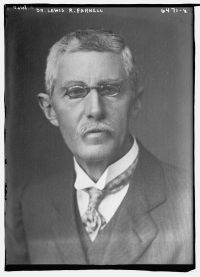
Lewis Richard Farnell

Lewis Richard Farnell

Summary

Portrait of Lewis Richard Farnell Lewis Richard Farnell Outline-history of Greek religion (1921)

A more spiritual or more mystic religion could not have produced or could not have borne with such an art. But it was the best and most satisfying expression of the best that the religious spirit of Hellenism admitted; for this polytheism had been built up by the teachers of the people, poets and artists obeying the race-instinct, not on vague conceptions of infinite Godhead ineffable for art and inexpressible in clear speech, but on vivid perceptions of concrete divine personages, distinct in form, attributes and character robust and very real.
Source: Gutenberg

Portrait of Lewis Richard Farnell Lewis Richard Farnell Outline-history of Greek religion (1921)

The Greek artist, with his miraculous cunning of hand, could deal with such types as he could not have dealt with ‘the Word’ or with the ‘Buddha.’ Nor was he merely the exponent of the highest popular imagination, but, unconsciously perhaps and in obedience to a true art-tradition, at times a reformer and in any case a creator. For us his works have this value among others that, even more than the poetic literature, they reveal to us how the people at their best imagined their deities.
Source: Gutenberg

Portrait of Lewis Richard Farnell Lewis Richard Farnell Outline-history of Greek religion (1921)

THE SOURCES AND THE EVIDENCE The foundation of a serious and scientific study of Greek religion, as distinct from the mere mythology of Hellas, may almost be said to have been an achievement of the last generation of scholars. And it is only through recent research that the Hellenic spirit, so creative and imperial in the domains of literature, art and science, can be recognised as manifesting itself not unworthily in the sphere of religion.
Source: Gutenberg

Get perspective with Kwize: daily news enlightened by great literature