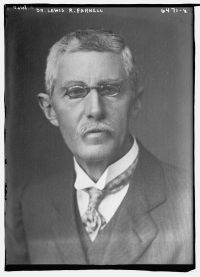
Lewis Richard Farnell

Lewis Richard Farnell

Summary

Portrait of Lewis Richard Farnell Lewis Richard Farnell The evolution of religion (1905)

Myths are often irresponsible, capricious, volatile, and flit like a vapour round the solid structure of real {27} belief and ritual. A high religion may attract low myths: some of our own are not spotless, but Christianity can ignore them. The myth that is an essential fact for the student of religion is that which enshrines some living religious idea or institution, or one which proves the survival of some ritual or faith that belonged to an older system. I may note a few of this kind which illustrate the affinities of Judaic, Christian, and pagan legend.
Source: Gutenberg

Portrait of Lewis Richard Farnell Lewis Richard Farnell The evolution of religion (1905)

Probably all this is only a revival of aboriginal practices and superstitions rooted in the Hellenic soil, a religion which the intellectualism of Homeric civilisation had happily suppressed for a time, but which asserted itself with renewed strength when that civilisation was overthrown. Yet the revival, though apparently a “set-back,” bore fair fruit for morality, law, and even religion. The history of Greek ethic must reckon as it has not yet done with the ritual of purity, and the history of Greek law with the fear of the ghost and the miasma of bloodshed.
Source: Gutenberg

Portrait of Lewis Richard Farnell Lewis Richard Farnell The evolution of religion (1905)

The soil in which it had most rankly flourished was Greek, and Greece and Anatolia were crowded with chapels consecrated to recently living men or to faded figures who were supposed to have once lived on earth, some of them perhaps actual ancestors, some imaginary personages of the epic or legendary world, some merely functional divinities of subordinate departments, like the hero of the ploughshare or the tutelary hero of the potters. This growth of polytheism had struck its roots so deeply that Christianity, in spite of its monotheistic ideal, was unable to eradicate it.
Source: Gutenberg

Get perspective with Kwize: daily news enlightened by great literature