Summary

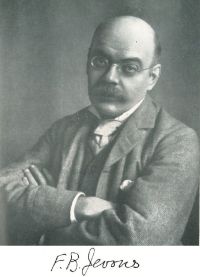
Portrait of F. B. Jevons F. B. Jevons The Idea of God in Early Religions

It is vain to pretend that prayer, even the simple petition for our daily bread, is not religious. It may perhaps be argued that prayer is not essential to religion; that it has not always formed part of religion; and that it is incompatible with that acquiescence in the will of God, and that perfect adoration of God, which is religion in its purest and most perfect sense. Whether there is in fact any incompatibility between the petition for deliverance from evil, and the aspiration that God's will may be done on earth, is a question on which we need not enter here.
Source: Gutenberg

Portrait of F. B. Jevons F. B. Jevons The Idea of God in Early Religions

If this partly true, and partly false, interpretation is what we mean by the word 'idea,' then it is the idea which is an inference from the being of our neighbour—an inference which can be checked by closer acquaintance—but we do not first have the idea of him, and then wonder whether a being, corresponding more or less to the idea, exists. If we had the idea of our fellow-beings first—before we had experience of them—if it were from the edge of the idea that we had to leap, we might reasonably doubt whether to fling ourselves into such a logical, or rather into such an illogical, abyss.
Source: Gutenberg

Portrait of F. B. Jevons F. B. Jevons The Idea of God in Early Religions

I have spoken of 'the moment of worship,' but worship is, of course, a habit: if it is not a habit, it ceases to be at all, in any effective sense. And it is a habit of the community, of the common consciousness, which is continuous through the ages, even though it slowly changes; and which, as continuous, is conservative and tenacious. Even when it has become monotheistic, it may continue to speak of the one God as 'a great god above all other gods,' in terms which are survivals of an earlier stage of belief.
Source: Gutenberg

Get perspective with Kwize: daily news enlightened by great literature