“ If society could by some supernatural power deal strict justice to all its members, who would, who could live in it? As a matter of fact—to say it once more—it is not by law alone that society lives, but by love, by the long-patient love of father or mother, of wife or husband, of friend or neighbour, which every one of us has accepted and none has fully requited. Our very hospitals are open to all who need them, to those whose suffering is due to their own negligence, or even crime, and not merely to those whose pain is undeserved. A palpable injustice, worthy of the cosmic process itself! ”
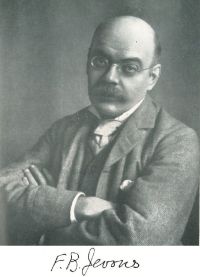
F. B. Jevons
Biographical details

Frank Byron Jevons (1858–1936) was a British polymath and academic, renowned for his interdisciplinary contributions to classics, philosophy, sociology, and comparative religion. As Principal of Hatfield College and Professor of Philosophy at Durham University, he advocated for social reform, particularly education for the working classes and women.
His major works—Evolution (1900) and An Introduction to the Study of Comparative Religion (1908)—reflect his engagement with unilineal evolution and the interaction between morality and faith. Jevons’ scholarship, distinguished by clarity and logical precision, remains influential for its integration of historical, religious, and anthropological inquiry, underscoring his legacy as a pivotal figure in late Victorian intellectual thought.
Quotes by F. B. Jevons
 F. B. Jevons,
An Introduction to the Study of Comparative Religion
F. B. Jevons,
An Introduction to the Study of Comparative Religion
“ But the time is not far distant, and may even now be come, when morality no longer requires any support from religion—and then religion becomes useless, nay! an encumbrance which must either fall off or be lopped off. If, therefore, morality can stand by itself, and all along has not merely stood by itself, but has really upheld religion, in what is morality rooted? The answer is that morality has its roots, not in the command that thou shalt love the Lord thy God with all thy heart and all thy soul, but in human solidarity, in humanity regarded as a spiritual whole. ”
“ The past is past beyond recall, but for the future hitherto there has been hope and faith, faith that what ought to be may be, even for us, hope that it will be so. But now, in place of hope and faith, we have the scientific certainty that the future of humanity is devoted to the triumph of the thing that ought not to be. The only consolation left to us is the inextinguishable, the unconquerable conviction that right is right even though it should not prevail. ”