Ship displacement

Definition and stakes

Washington Naval Treaty (1922)

“ STANDARD DISPLACEMENT The standard displacement of a ship is the displacement of the ship complete, fully manned, engined, and equipped ready for sea, including all armament and ammunition, equipment, outfit, provisions and fresh water for crew, miscellaneous stores and implements of every description that are intended to be carried in war, but without fuel or reserve feed water on board. ”
Source: Wikisource

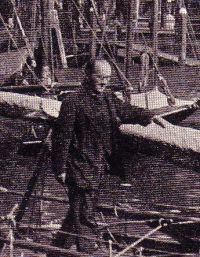
Portrait of E. Keble Chatterton E. Keble Chatterton,  Steamships and their story (1910)

“ In actual displacement, an iron ship is proportionately lighter than a ship built of wood, and by “displacement” is meant the amount of water which a vessel displaces through being allowed to float. Of course, the quantity of water which a ship displaces (or pushes to one side) depends entirely on the weight of the vessel, and is exactly equal to the weight of the ship. Thus, suppose we were to fill a dock with water up to the level of the quay and then lower down into it by means of gigantic cranes a Mauretania or Lusitania, the water would, of course, flow over on to the quays. ”
Source: Gutenberg

Sir Edward J. Reed,  Modern ships of war (1887)

“ The designer who has the larger displacement to work upon has the better opportunity of producing a more powerful ship; but it by no means follows that he will secure so good a combination of qualities as a rival obtains on a smaller displacement. And hence I cannot but dissent from the doctrine that displacement tonnage is to be accepted as a fair measure of relative fighting efficiency, or that recent English ships are necessarily unable to fight recent French ships because they are of smaller displacement. ”
Source: Gutenberg

Get perspective with Kwize: daily news enlightened by great literature