“ A person being placed in the room underneath, and applying his ear to one of the tubes at a signal given, will hear any question asked, and can immediately reply, by applying his mouth to the tube which communicates below, at the same time moving the eyes by the wire, to accompany his speech. ”
Speaking tube
Definition and stakes
The theme of “speaking tube” has been addressed by authors such as Birney C. Batcheller, William Wilson, A. Frederick Collins, Archibald Williams and John Tyndall. It is often associated with terms like telephone, radio, receiver, sound and vacuum.
Quotes about “speaking tube”
Johann Beckmann, A History of Inventions, Discoveries…
“ To communicate anything to one’s friends by means of a tube. This can be done with a tube made of earthenware, though one of lead is better, or of any other substance, but very close, that the voice may not be weakened ”
“ Sound is propagated through a confined channel of air, as for instance, a long tube, very perfectly. It is not uncommon in large establishments, where it is necessary to pass many orders to and fro, to have such tubes laid in the walls, so that words can pass through them from room to room. ”
William Wilson, The Bell System Technical Journal (1922)
“ The undoubted advantages to be derived from the use of vacuum tubes, especially in the field of wireless telephony where the output power must be modulated to conform to the intricate vibration pattern of the voice, has led to a demand for tubes capable of handling amounts of power comparable with those in use at the largest stations. The the development of such tubes was of great importance was recognized by the engineer of the Bell Telephone System in the early days of the vacuum tube art. ”
Handbook of the new Library of Congress
“ Along the front of the desk, also, is a row of twenty-four pneumatic tubes for the transmission of messages, either in cylindrical pouches, as in the case of the written applications which those desiring to draw books are required to make out, or verbally, by means of a mouth-piece with which each tube is equipped. Nine tubes go to the North Stack and nine to the South Stack, or one for every floor. ”
Allen Chapman, The Radio Boys at Ocean Point; Or…
“ I tell you, boys, we haven’t half begun to realize what the discovery of radio means to the world.“Now all this leads us back to vacuum tubes, for it’s only with them that all these things would be possible. Perhaps in the future something better yet will be invented, but they’re the best we have at present. I’m heartily in favor of you boys using a tube instead of a crystal, because it will give you vastly more enjoyment in your work. ”
Mary M. Mears, The Bird in the Box
“ She shook her head. "Well, it's a tiny affair no larger than a pea, and will so magnify sound in connection with an electric current and a telephone receiver, such as I have here, that the footsteps of a fly on a sheet of paper sound about like the tramping of an army. It's so powerful," he continued, "that if I were to place it in the end of a tube and point the tube, say, toward that island out there, any noise going on—-a wagon rattling along the road or a child naming—I should be able to hear on this side, provided I had arranged the microphone so as to shut out all intervening noises. ”
 A. Frederick Collins,
The Radio Amateur's Hand Book
A. Frederick Collins,
The Radio Amateur's Hand Book
“ Not only is the vacuum tube a detector of electric wave signals and speech and music but it can also be used to amplify them, that is, to make them stronger and, hence, louder in the telephone receiver and further its powers of amplification are so great that it will reproduce them by means of a loud speaker, just as a horn amplifies the sounds of a phonograph reproducer, until they can be heard by a room or an auditorium full of people. ”
S. F. Aaron, Radio Boys Loyalty; Or, Bill Brown Listens In
“ I’ll say this much, however, it is 64 the vacuum or audion tube detector that gives results, and the application of a loud speaker is only possible with a vacuum or audion tube. It is as easy to build a vacuum tube set as a crystal set and only a very little more expensive. So, whether you are building or buying a set, make it a good set, something that you can hear with a good many hundred miles. “Now, you can buy the parts and build a receiving set that will generally give more satisfaction than a bought set.” (Bill stepped over to the blackboard and took up a pointer.) ”
Popular Science Monthly (1875)
“ It consists of a tube about an inch in diameter internally, made of flexible spiral wire and India-rubber, and so strong and well protected as to bear the weight of a heavy man without collapsing. The tube is attached to a belt which is firmly buckled to the waist of the operator. The mouthpiece is very ingeniously contrived for holding in the mouth with extreme tenacity and the minimum of inconvenience. There is a glazed eye-protector, which also closes the nostrils. ”
Edmund Arthur Engler, Popular Science Monthly (1880)
“ Moreover, this instrument is so sensitive that it is capable of taking up the vibrations of any sound, and of varying the electric current in accordance with them, so that the sound is reproduced at a distance in an ordinary telephone which may be placed in the circuit. If the tube is placed upon a resonating-box, the delicacy is increased. The tube in such an arrangement serves as the transmitting and the telephone as the receiving instrument. Other substances may be substituted for the white silver powder with good results. ”
A. Frederick Collins,
The Radio Amateur's Hand Book
“ While oscillator tubes were being experimented with in the research laboratories of the General Electric, the Westinghouse, the Radio Corporation of America, and other big companies, all the youthful amateurs in the country had learned that by using a vacuum tube as a detector they could easily get messages 500 miles away. ”
 Sabine Baring-Gould,
An Old English Home and Its Dependencies…
(1898)
Sabine Baring-Gould,
An Old English Home and Its Dependencies…
(1898)
“ The trumpet mouths in connection with tubes that are carried into pews occupied by deaf persons have given rise to mistakes. One preacher, who was short-sighted, and who always harangued extempore, on entering the pulpit took off his spectacles, and, seeing something circular beside the desk, supposed it to be a shelf or bracket, and put the glasses on it, whereupon down shot the spectacles and blocked the tube. ”
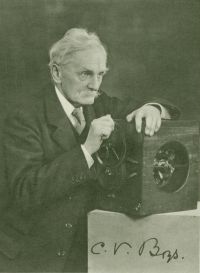 C. V. Boys,
Soap-Bubbles and the Forces Which Mould Them
C. V. Boys,
Soap-Bubbles and the Forces Which Mould Them
“ If the experimenter alone wishes to hear as well as possible when faint sounds are produced, he should carry a piece of smooth india-rubber tube about half an inch in diameter from the open end to his ear. ”
Archibald Williams, The Romance of Modern Invention
“ The transmitting apparatus is a searchlight, through the back of which run four pairs of wires connected with a telephone mouthpiece after passing through a switch and resistance-box or regulator. The receiver is a concave mirror, in the focus of which is a tapering glass bulb, half filled with carbonised filament very sensitive to heat. The tapering end of the bulb projects through the back of the mirror into an ear tube.If a message is to be transmitted the would-be speaker turns his searchlight in the direction of the person with whom he wishes to converse, and makes the proper signals. ”
Anonymous, The Telephone in America: Bell Telephone System
“ Through the years Bell Laboratories has led progress in communications and electronics. No scientific achievement has had more far-reaching effects on communications than the Laboratories’ work in the development of the vacuum tube. Bell scientists were the first to devise a practical amplifier tube which, placed at intervals in long distance lines, restored the energy of weakening voice currents, making it possible to telephone from coast to coast. ”
Allen Chapman, The Radio Boys at Mountain Pass…
“ It was the universal opinion that a great advance had been made and that the innovation had come to stay.The radio boys had been intensely interested in this new application of their favorite study, and after the sermon they went up into the loft and examined the apparatus that had been used in sending. It was a vacuum tube set with two tubes and power enough to send messages out over the whole county. ”
A. Frederick Collins,
The Radio Amateur's Hand Book
“ A loud speaker when connected with a wireless receiving set makes it possible for a room, or an auditorium, full of people, or an outdoor crowd, to hear what is being sent out by a distant station instead of being limited to a few persons listening-in with headphones. To use a loud speaker you should have a vacuum tube detector receiving set and this must be provided with a one-step amplifier at least. ”
“ A still more striking effect is obtained with this larger tube, a b, Fig. 114, 15 feet long and 4 inches wide,263 which was made for a totally different purpose. It is supported by a steady stand, s s′, and into it is lifted the tall burner, shown enlarged at B. You hear the incipient flutter: you now hear the more powerful sound. As the flame is lifted higher the action becomes more violent, until finally a storm of music issues from the tube. And now all has suddenly ceased; the reaction of its own pulses upon the flame has beaten it into extinction. ”
Various, Chambers's Journal of Popular Literature…
“ When, therefore, the human voice (or any other suitable sound) impinges through the tube against this diaphragm, the diaphragm begins to vibrate, and awakens, so to speak, electrical action in the coils of wire surrounding the poles of the magnet; not a current, but a series of undulations, something like those produced by the voice in the air around us. In short the telephone is an apparatus designed to transmit sound through a wire of indefinite length ”
Birney C. Batcheller, The Pneumatic Despatch Tube System of the Batcheller Pneumatic Tube Co
“ In operating large tubes, that is to say, tubes six or eight inches in diameter, there is an advantage in using compressed, rather than exhausted air, in the construction of the sending and receiving apparatus, especially when the tubes are very long. With an ample supply of compressed air always at hand, the air-cushions can be made shorter and more effective in bringing the carriers quickly to rest.140 With exhausted air the cushions are ineffective, and consequently must be made very long in order to stop the carrier before it strikes the closed end of the tube. ”
“ Let a simple sound be now made in the tube, consisting of 256 vibrations per second: the membrane carrying the iron will vibrate as many times, and so many pulses of induced electricity will be imposed upon the constant current, which will each act upon the receiver, and cause so many vibrations of the armature upon it; and an ear held at P will hear the sound with the same pitch as that at the sending instrument. If two or more sound-waves act simultaneously upon the membrane, its motions must correspond with such combined motions ”
Robert Routledge, Discoveries and Inventions of the Nineteenth Century
“ The tube is a mere hair-like hollow filament of glass, and the ink, which would not itself flow from a tube of so fine a bore, is squirted out by electrical repulsion when the insulated reservoir in which it is contained is electrified at the receiving station by an ordinary machine. ”
Two Gentlemen of Philadelphia, An epitome of electricity & galvanism
“ When the tube is exhausted of air, and its pointed end placed near the excited cylinder of an electrical machine, the point will appear illuminated with a star, and a weak light will be seen pervading the whole tube; but from the knobbed end of the wire, within the tube, a lucid pencil will issue, and the opposite knob will be illuminated with a star or round body of light, which, as well as the pencil of rays from the other knob, will be discernible among the other light which occupies the cavity of the tube. ”
Frederic Shoberl, Persia (1828)
“ Some use the common wooden tubes; but others, more luxurious, have one that is pliable, winding like a snake several feet in length. It is attached to the conducting tube, which being held by the servant, enables him to attend in his duty and yet keep a respectful distance in his master's rear. ”
“ These puffs would produce a note of far greater intensity than that obtained by the alternate escape and interruption of the air from a single tube. In the arrangement now before you, Fig. 19, there are nine tubes through which the air is urged—through nine apertures, therefore, puffs escape at once. On turning the whirling table, and alternately increasing and relaxing its speed, the sound rises and falls like the loud wail of a changing wind. ”
William Wilson, The Bell System Technical Journal (1922)
“ The significance of this development in the radio art cannot be overestimated. It makes available tubes in units so large that only a very few would be necessary to operate even the largest radio stations now extant, with all the attendant flexibility of operation which accompanies the sue of the vacuum tube. From the standpoint of wireless telephony the development of these high power tubes gives us the possibility of using very much greater amounts of power than have ever been readily available before. ”
Gerald Breckenridge, The Radio Boys Rescue the Lost Alaska Expedition
“ His big dream was that this tube, when used as an amplifier in conjunction with an alternator, would make trans-atlantic telephonic communication as common as cabling or wireless telegraphing. “If I only had one of my 20-kilowatt tubes now,” he mourned, “we would be able to talk not only with Mr. MacDonald’s Post but with Dawson or even Nome.” “Well, Jack,” said Frank, “it’s too bad. Just the same, let’s get busy. For, with our 50-watt oscillator tube set we will be able to communicate by telegraph up to 500 miles. And, as the Post is only 400 miles away, we can reach it easily.” ”
Clement Fezandié, Through the Earth (1898)
“ At the same moment an ominous rumbling was borne to her ears, and closely following it came a more pronounced irregularity in the working of the electric conductors which served to keep the tube from melting. Dr. Giles heard this rumbling too, and the whole truth flashed upon him in an instant. Something must have happened to the tube! ”
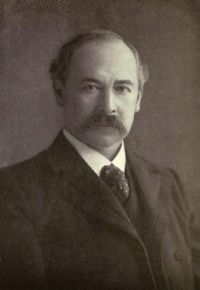 Silvanus P. Thompson,
Philipp Reis: Inventor of the Telephone
Silvanus P. Thompson,
Philipp Reis: Inventor of the Telephone
“ In this instrument the idea of the human ear is still carried out. The tin funnel, with its flaring embouchure, still represents the auditory tube and pinna. The tympanum, no longer at the very end of the tube, is strained across a circular aperture in the lid. Upon it rests the strip of platinum foil which serves as an electrode, and resting in loose contact with this lies the little angular piece of metal which Reis called the “Hämmerchen.” ”
 Sir Oliver Lodge,
Signalling across space without wires
(1900)
Sir Oliver Lodge,
Signalling across space without wires
(1900)
“ If the filings used are coarse, say turnings or borings, the tube approximates to a single coherer; if they are fine, it has a larger range of sensibility. In every case what these receivers feel are sudden jerks of current; smooth sinuous vibrations are ineffective. They seem to me to respond best to waves a few inches long, but doubtless that is determined chiefly by the dimensions of some conductor with which they happen to be associated. (Figs. 17 and 18.) Fig. 18.— Early Form of Iron Borings Tube. ”
Ernest G. Martin, Physiology: The Science of the Body
“ The tube is known as the Eustachian tube. Its walls are ordinarily collapsed, so it is not an open passage, but every time one swallows the tube is pulled open, thus allowing differences in air pressure on the two sides of the eardrum to equalize. Whenever one ascends a high hill quickly, as by train or automobile, or even in going to the top of a high building by elevator, the difference in air pressure behind and in front of the eardrum can be felt. The sensation is disagreeable, and there is definite impairment of hearing. Repeated swallowing gives relief. ”
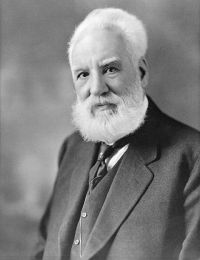 Alexander Graham Bell,
Popular Science Monthly
(1881)
Alexander Graham Bell,
Popular Science Monthly
(1881)
“ The length of the tube (K) is such that the sonorous vibrations from the receivers (F G) reach the common hearing-tube (M) in opposite phases. Under these circumstances silence is produced when the vibrations in the receivers (F G) are of equal intensity. When the intensities are unequal, a residual effect is perceived. ”
Popular Science Monthly (1875)
“ Inspirations are taken through the tube, and the respired air is discharged through a valve half-way between the belt and the mouth-piece. By drawing a long breath through the tube and removing the mouth-piece a simple sentence can be loudly spoken, care being taken not to inhale without first restoring the mouth-piece. The tube is of sufficient length to communicate by one end with the outer air. A newly-emptied vat, of 1,000 barrels capacity, was selected for the scene of the experiment. ”
Related terms
Authors who wrote about “speaking tube”
Birney C. BatchellerWilliam WilsonA. Frederick CollinsArchibald Williams John TyndallClement Fezandié
 Professor HoffmannC. V. BoysRobert Routledge
 George O. SmithTwo Gentlemen of Philadelphia
 Thomas DickVariousAllen Chapman
 Virginia WoolfAlexander Graham BellSilvanus P. ThompsonUnknownS. F. AaronEdmund Arthur Engler
A. Frederick CollinsArchibald WilliamsJohn TyndallClement FezandiéProfessor HoffmannC. V. BoysRobert RoutledgeGeorge O. SmithTwo Gentlemen of PhiladelphiaThomas DickVariousAllen ChapmanVirginia WoolfAlexander Graham BellSilvanus P. ThompsonUnknownS. F. AaronEdmund Arthur Engler