
“ The flickering candles in tin sconces against the walls, or depending in rude chandeliers of barrel-hoops from the ceiling, lit up the most astounding diversity of female costume the master had ever seen. Gowns of bygone fashions, creased and stained with packing and disuse, toilets of forgotten festivity revised with modern additions; garments in and out of season—a fur-trimmed jacket and a tulle skirt, a velvet robe under a pique sacque; fresh young faces beneath faded head-dresses, and mature and buxom charms in virgin' white. ”
Quotes about “topdressing”
Henry Jones, Oswald Barron, Stanley Cook, Thomas Joyce and W. Alison Phillips, 1911 Encyclopædia Britannica (1911)
“ Women’s dress in this 18th century is dominated by the hoop-petticoat which Sir Roger de Coverley recognizes in 1711 as a new fashion and an old one revived. A stiff bodice laced in front, a gown, with short and wide-ended sleeves, gathered up in folds above the petticoat, a laced apron and a lace cap with hanging lappets, is the dress of the century’s beginning. So the women of fashion are compared with children in go-carts, their tight-laced waists rising from vast bells of petticoats over which the gown is looped up like a drawn curtain. ”
Dion Clayton Calthrop, English Costume
“ You will find, if you look into the lady’s wardrobe, that she has other fashions than the close sleeve: she has a close sleeve as an under sleeve, with a long hanging sleeve falling from the elbow; she has ruffs at her wrist of pointed lace, more cuffs than ruffs, indeed. She does not always follow the fashion of the short Dutch waist as she has, we [Pg 336] can see, a dress with a long waist and a tapering front to the bodice. Some dresses of hers are divided in the skirts to show a barred petticoat, or a petticoat with a broad border of embroidery. ”
Various, Blackwood's Edinburgh Magazine - Volume 57…
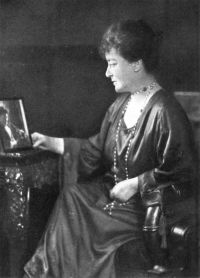
“ How much better, how much more rational, how much more becoming, such head-dresses as these, than the gay but useless ribands, feathers, and chapeaux of the one class, or the misshapen, uncomfortable, untidy-looking bonnets of the other! According to the present system, it is almost impossible to infer the rank of a lady from her external costume—many a milliner's girl has passed for a duchess before now—whereas by the adoption of articles of dress, founded on principles like those of the hood, some decisive marks of distinction might be obtained. ”
 Eliza Davis Aria,
Costume: Fanciful, Historical, and Theatrical
(1906)
Eliza Davis Aria,
Costume: Fanciful, Historical, and Theatrical
(1906)
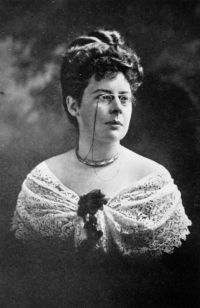
“ The over-part of the dress and the skirt beneath it were boned and wired, and tight lacing ruled in an injurious degree, though the enormous sleeves, ruffles, and skirts might well have accorded such an effect of slimness as to render stringent measures unnecessary. Dress was a magnificent affair altogether; velvet and taffeta and fine scarlet cloth were used, lace played its part bravely, and silken scarves fringed with gold and silver were thrown over the shoulders, with deep capes of satin or velvet edged with lace. ”
 Beatrice Grimshaw,
In the Strange South Seas
Beatrice Grimshaw,
In the Strange South Seas
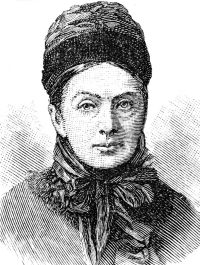
“ The trade cottons in the stores form the material of every lady’s dresses, and as for the making, common consent, not to speak of climatic conditions, votes the simplest style the best. Where every stitch of sewing in dress or blouse must be done by the person who is to wear the garment, it is astonishing how soon one grows to regard elaborate tuckings, flouncings, inlayings, with hostility, and how satisfied the eye becomes with the simpler and less “fatigued” lines of the garments fashioned by women who cannot hire a dressmaker for love or money. ”
 Isabella L. Bird,
Journeys in Persia and Kurdistan…
Isabella L. Bird,
Journeys in Persia and Kurdistan…
“ Though I knew what to expect in the costume of a woman of the upper classes, I was astonished, and should have been scandalised even had women only been present. The costume of ladies has undergone a great change in the last ninety years, and the extreme of the fashion is as lacking in delicacy as it is in comfort. ”
Samuel R. Wells, How to Behave: A Pocket Manual of Republican Etiquette…
“ Long, flowing, and even trailing skirts are beautiful and appropriate in the parlor, but in the muddy streets, draggling in the filth, and embarrassing every movement of the wearer, or in the country among the bushes and briers, they lose all their beauty and grace, because no longer fitting. The prettiest costume we have ever seen for a shopping excursion or a walk in the city, and especially for a ramble in the country, is a short dress or frock reaching to the knee, and trowsers of the common pantaloon form, but somewhat wider. ”
Henry Jones, Oswald Barron, Stanley Cook, Thomas Joyce and W. Alison Phillips, 1911 Encyclopædia Britannica (1911)
“ Year by year the modes are deliberately altered by a conclave of the great modistes whose desire is less to produce rich or beautiful garments than to make that radical alteration from loose sleeve to tight sleeve, from draped skirt to plain skirt, which will force every women to cast aside the last season’s garments and buy those of the newer device. But of modern dress it may at least be said that cheaper materials, the sewing machine and the popular fashion papers allow women of the humbler classes to dress more decently and tastefully. ”
Various, The Scrap Book, Volume 1, No. 1
“ For Women.—This should be as simple as possible. Nothing is in worse taste than to appear in the mornings, down-town, shopping, or at business, in over-elaborate costumes. They may be silk-lined through and through, of the finest materials that money can buy, but they must be simple. For business, wear a plain shirt-waist, preferably white, not of too sheer material, so that it may be easily and frequently laundered. A dark skirt, with jacket to match; a simple hat and belt harmonizing with the rest of the costume; a linen stock, or collar and tie, and dark gloves. ”
Henry Robert Samuel Dalton, Lesbia Newman (1889)
“ Her perseverance in dressing more rationally than those with whom she associated had begun to crack the wall of prevailing fashion among them, not only in the matter of costume itself, but, as a natural consequence, in the many habits with which fashion in dress is associated. Not a few women who at first made fun of her, had begun to envy her vigorous independence of character, and even to think of casting off some of their own fetters. ”
Captain David Sutherland, A Tour Up the Straits, from Gibraltar to Constantinople
“ The women, so celebrated for their beauty, are now sallow, unhealthy, and disgustingly ugly; and render themselves still more hideous by their dress, which is a kind of loose jacket, with a white cotton petticoat, that scarcely covers two thirds of their thighs, barely meeting the stocking above the knee. ”
Eliza Davis Aria,
Costume: Fanciful, Historical, and Theatrical…
(1906)
“ A plain material formed the over-skirt of many a dress which bore a striped under-skirt, tight sleeves, and a plain, tightly-fitting bodice. Cuffs and collars grew wider, the linen apron had two pockets, and there was added to costume a circular cape of dull serge. The high felt hat was adorned simply by a plain band of ribbon. During the Restoration, colour asserted itself once more, and dress was again pretty, a comendable example having a blue linen skirt with a band of fancy material round the hem, a full basque, and a linen collar, the front adorned with braid, the apron striped. ”
 Fannie Hurst,
Star-Dust: A Story of an American Girl
Fannie Hurst,
Star-Dust: A Story of an American Girl
“ She had drifted, not all unconsciously, into a certain picturesque uniformity of dress and could smile now over the large, cart-wheel hats, coarse embroideries, and short-vamp shoes; neither was she often above mentally contrasting herself in her annual seventy-five dollar suit of dark-blue serge, natty sailor hat, and impeccable blouse, with a certain coffee-colored linen with its slashings of coffee-dipped embroidery, and the blouse that twirled with yards and yards of cotton Valenciennes. ”
Eliza Potter, A Hairdresser's Experience in High Life (1859)
“ Another dress that attracted unusual attention, was a lavender silk double skirt, richly brocaded with silver snow drops, drooping in clusters upon each breadth of the upper skirt, (the under skirt being entirely plain,) the waist was high to the throat, with point d'Alencon lace collar, and sleeves trimmed with pink ribbon, enveloped in white tulle; pink ostrich feathers ornamented the hair; diamonds of rare brilliance were added to complete the toilet. Another lady wore a magnificent garnet velvet, made high in the throat, with tight sleeves to the wrist ”
Various, Blackwood's Edinburgh Magazine…
“ By the common practice and consent of all womankind, it appears that the lower portion should be loose and flowing; and that the upper should be so conformable to the contour of the body, as to show that contour to the best advantage; these must be taken as the fundamental definitions upon which all laws of female dress are to be tried. And, first of all, of the skirt; if its form is to be loose and flowing, it should be made to derive its beauty from the curves and breaks and folds which drapery, partly suspended, partly at rest on the ground, will afford. ”
Florence Mary Gardiner, The Evolution of Fashion
“ At no period in the history of costume were the styles so offensive to those with a true conception of colour and form than in the first half of the nineteenth century. We have only to turn to the sketches of Leech and contemporary artists to find bare necks and arms, conspicuous underwear, very short skirts distended by a stiffened petticoat or crinoline, white cotton stockings, low shoes fastened by a strap and single button, mushroom hats, aprons and pinafores devoid of elegance and grace, and the hair cut close to the head or arranged in rows of stiff ringlets. ”
 Sarah Stickney Ellis,
The Daughters of England
(1842)
Sarah Stickney Ellis,
The Daughters of England
(1842)
“ These remarks are applicable, in their fullest force, to every deviation which is sanctioned by fashion, from the strict and holy law of modesty and decorum. And of this most injurious tendency of fashion, how insidious is every encroachment, yet how certain its effect upon the female mind! It is no uncommon thing to hear women express the utmost abhorrence of the costume of some old portrait, who, in the course of a few years, perhaps months, are induced by fashion to adopt, with unblushing satisfaction, an equally, or more objectionable dress. ”
Various, Blackwood's Edinburgh Magazine…
“ Pass we over six or seven years, and the lady of fashion who, at their commencement, could hardly get through a moderate-sized doorway, might almost glide head-foremost through the keyhole. A thin scanty robe, clinging close to the form, a turban and a single lofty plume, a waist close up under the arms, a watch the size of a Swedish turnip, with a profusion of seals and pendants, compose the fashionable female attire of that day. ”
Manley Hopkins, Once a Week (1863)
“ One observation about milliners and modistes, and our few remarks on modern dress are finished. Why is it that when the tide of taste turns in our favour—when, after many efforts, we at last apprehend simplicity, and rejoice that a female costume rather enhances than detracts from its wearer’s natural beauty—why is it, we ask, that the flood so soon turns, and that next season the charming head-gear and the becoming sleeve have been displaced, and that something different, not so pretty, not so correct, is the only thing to wear? ”
Bertha Thomas, George Sand (1889)
“ In defence of her adoption of this strange measure, she pleads energetically the perishable nature of feminine attire in her day,—a day before double-soles or ulsters formed part of a lady's wardrobe,—its incompatibility with the incessant going to and fro which her busy life required, the exclusion of her sex from the best part of a Paris theatre, and so forth; the ineffable superiority of a costume which, economy and comfort apart, secured her equal independence with her men competitors in the race, and identical advantages as to the rapid extension of her field of observation. ”
Virginia Hughes, Peggy Finds the Theatre
“ Beautifully dressed women in furs walked side by side with trim young secretaries and vied with them for bargains at sales counters. Embarrassed men sidled past lingerie departments in search of gifts for their wives and sweethearts; short, stout women admired dresses designed for tall, slim models; elderly ladies tried on hat after hat, each one looking less suitable than the last ”
 Agnes Repplier,
Americans and Others
(1912)
Agnes Repplier,
Americans and Others
(1912)
“ Because a foul-hearted murderess [2] elected to be hanged in this material, Englishwomen refused for years to wear it, and many bales of black satin languished on the drapers' shelves,—a memorable instance of the significance which attaches itself to dress. The caprices of fashion do more than illustrate a woman's capacity or incapacity for selection. They mirror her inward refinements, and symbolize those feminine virtues and vanities which are so closely akin as to be occasionally undistinguishable. ”
 Angela Brazil,
A Popular Schoolgirl
Angela Brazil,
A Popular Schoolgirl
“ Mother, whose ambitions at first had run to a dress from town, regretfully decided that the family finances could only supply a home-made costume, and set to work with fashion book and sewing-machine to act amateur dressmaker, a thrilling experience to unaccustomed fingers, for paper patterns are sometimes difficult to understand, seams do not fit together as they ought, and the bottom hem of a skirt is the most awkward thing in the world to make hang perfectly straight. ”
Eliza Davis Aria,
Costume: Fanciful, Historical, and Theatrical
(1906)
“ Extravagance to the fantastic point pursued its outrageous way in the fifteenth century; the dresses were tightly belted at the waist, and trailed long lengths upon the floor, while the flat collars of velvet or fur pointed towards the front and were cut to display a square stomacher, and the sleeves indulged themselves with many diversions, small ruffles appearing to finish those which were tight at the wrists. ”
 Earl Lind,
The Female-Impersonators — Part 5
(1922)
Earl Lind,
The Female-Impersonators — Part 5
(1922)
“ In a physical male, cross-dressing is the instinctive wearing of feminine apparel, or, in default, of the loudest and fanciest male styles. In a physical female, it is similar adoption of masculine habiliments, or in default, of feminine attire and aspect approaching the masculine as nearly as possible: hair bobbed, stiff linen collar, a man's neck scarf, and always severely plain tailor-made waist and skirt. ”
 Alice B. Stockham,
Tokology
(1883)
Alice B. Stockham,
Tokology
(1883)
“ Trall says, “If he were asked what one agency stands at the very head of morbific influences, in causing frailty and malformation, he should answer woman’s dress.”The present movement in dress reform, or correct dress, combines art, health and utility. One of the most notable features is that each lady is free to construct her own styles, and in no wise feels bound to conform to fashion. This movement is wide-spread and seems to have a firm foothold among women of all classes. ”
“ Her thin figure in a well-fitting gown might have been pretty and temperamental, but in the faded pink blouse, and now historical grey skirt, soiled and shapeless and frayed at the edges, she was merely thin and shabby and utterly unattractive. I never saw a more hopeless look worn by any woman. ”
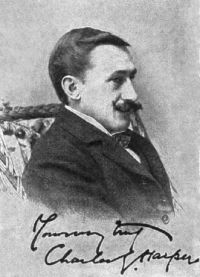 Charles G. Harper,
The Cambridge, Ely, and King's Lynn Road…
Charles G. Harper,
The Cambridge, Ely, and King's Lynn Road…
“ Sometimes she acts as carter, and it is precisely in such cases that she sheds her feminine skirts and dons the odd costume that astonishes the inquisitive stranger new to these parts, who sees, with doubt as to whether he sees aright, a creature with the boots and trousers of a man, a nondescript garment, half bodice and half coat with skirts, considerably above the knees, and a sun-bonnet on her head, working in the rick-yards, or squashing heavily through the farmyard muck. ”
Robert Smith Surtees, "Ask Mamma"; or, The Richest Commoner In England
“ The housemaid now dresses better—finer at all events—than her mistress did twenty years ago, and it is almost impossible to recognise working people when in their Sunday dresses. Gauze bonnets, Marabout feathers, lace scarfs, and silk gowns usurp the place of straw and cotton print, while lace-fringed kerchiefs are flourished by those whose parents scarcely knew what a pocket-handkerchief was. There is a medium in all things, but this mania for dress has got far beyond the bounds of either prudence or propriety; and we think the Major’s recipe for reducing it is by no means a bad one. ”
Various, The Wide World Magazine, Vol. 22…
“ The most amusing thing about it is that the upper part of the costume remains feminine—the ordinary rough bodice of the peasant woman, often in bright colours of red or blue, worn with the most nondescript cut of trousers, of the “home-made” variety. That such a costume is necessary for women who take upon themselves the work of their men-folk in such a region of the world is quite apparent to any woman who attempts to follow them at their work for even ten minutes. ”
