“ Taking 25 cars to make up a freight train, it would require fully 100 trains daily to transport the oil that now goes by pipe-line, and inasmuch as it is estimated that the oil on the average is transported overland (or, rather, under-land) 1,000 miles, it would require, approximately, 69 200,000 railroad tank cars to do the daily work in connection with the transport of oil in the United States east of the Rocky Mountains, for the average movement of tank cars is 30 miles daily, and all empty cars must be returned. ”
Train oil
Definition and stakes
Quotes about “train oil”
John J. McLaurin, Sketches in Crude-oil
“ Railroads and pipe-lines have relegated pond-freshets, oil-boats and Allegheny steamers to the rear, but they were interesting features of the petroleum-development in early days and should not be utterly forgotten.To haul oil from inland wells to shipping-points required thousands of horses. This service originated the wagon-train of the oil-country, which at its best consisted of six-thousand two-horse teams and wagons. No such transport-service was ever before seen outside of an army on a march. ”
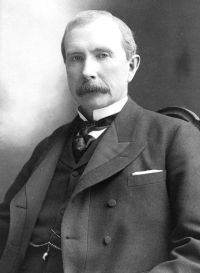
John D. Rockefeller,
Random Reminiscences of Men and Events
“ The building of the pipe-lines introduced another formidable competitor to the railroads, but as oil could be transported by pumping through pipes at a much less cost than by hauling in tank-cars in a railroad train the development of the pipe-line was inevitable. The question was simply whether the oil traffic was sufficient in volume to make the investment profitable. When pipe-lines had been built to oil fields where the wells had ceased to yield, as often happened, they were about the most useless property imaginable. ”
Arthur H. Beavan, Tube, Train, Tram, and Car; or…
“ But coal in some districts is dear, and farmers are beginning to find that oil engines are more economical, there being no loss of fuel in the sudden stopping of work during wet weather; but petrol has a nasty trick of not vaporising readily when it is frosty, and here electricity steps in with an admirable force-motif.With a dependable electro-motor, the farmer may work his self-binder all day long in the harvest-field, and at-night send it up to market with produce. ”
Hawthorne Daniel, Ships of the seven seas (1925)
“ Oil is being more and more widely burned instead of coal, because its efficiency makes it cheaper through the use of fewer men, through increased steaming ability and less weight, as well as its cleanliness (on passenger ships) and the reduction in time used in coaling.Shipping lines are very similar to railroads. A railroad train would be of no use to any one if it were owned and operated as a unit, even though it had all the tracks in a nation at its disposal. ”
Clarence Young, Jack Ranger's Western Trip; Or…
“ At noon the train arrived at the center of the Pennsylvania oil region. The evidences of the great industry were on every hand, and the sight of the tall derricks, the refineries, the storage tanks, and the pipes where natural gas was continually burning, were such interesting ones that the lads never grew tired of looking from the windows. ”
A. Russell Bond, Mechanics: The Science of Machinery
“ Stoking a large freight engine or a high speed passenger locomotive is strenuous work. Three tons of coal per hour is not an uncommon rate of consumption. The fireman on a fast express train gets little rest. To relieve him of this exhaustive work automatic stokers are now being used. These convey the coal from the tender to the fire box and [212] feed the fuel at a uniform rate. In place of solid fuel, oil is extensively used in regions where it may readily be obtained. ”
Thomas Wallace Knox,
The Boy Travellers in the Russian Empire
“ At Baku the water is pumped into reservoirs, to be used in the refineries or for irrigating the soil in the vicinity of the works, and then the steamer is ready for her load again. From Tsaritsin the oil is carried in tank-cars similar to those you have in America. I can't say exactly how many tank-cars are in use, but think the number is not much below three thousand. Twenty-five cars make an oil-train, and these oil-trains are in constant circulation all over the railways of Russia and Western Europe. ”
Various, Scientific American Supplement…
“ For a six-wheeled locomotive the capacity of the tank is 31⁄2 tons of oil—a quantity sufficient for 250 miles, with a train of 480 tons gross exclusive of engine and tender. In charging the tender tank with petroleum, it is of great importance to have strainers of wire cloth in the manhole of two different meshes, the outer one having openings, say, of 1⁄4 in., the inner, say 1⁄8 in.; these strainers are occasionally taken out and cleaned. If care be taken to prevent any solid particles from entering with the petroleum, no fouling of the spray injector is likely to occur ”
John J. McLaurin, Sketches in Crude-oil
“ A six-inch line conveys crude to the railroads and car-tanks are shipped over the Southern Pacific and Santa Fé routes. At least one of the preachers seems to be drilling “on the belt,” if a tourist’s tale of a prayer he offered be true. Here it is:“O, Lord! we pray that the excursion train going east this morning may not run off the track and kill any church-members that may be on board. Thou knowest it is bad enough to run oil-wells on Sunday, but worse to run Sunday excursions. Church-members on Sunday excursions are not in condition to die. ”
John J. McLaurin, Sketches in Crude-oil
“ At Miller Farm they constructed iron-tanks and loading-racks, which enabled two men to load a train of oil-cars in a few hours. Avery & Hedden laid a line from Shamburg to Miller Farm, establishing a station on the highest point of the Tallman farm and running the oil to the railroad by gravity. Abbott & Harley supplemented this with a branch from the Pithole line at the crossing of Cherry Run. Crude was a good price, operators prospered 320and Miller Farm became a busy place. Railroads extended to the region and pipe-lines pumped oil directly from the wells to the cars or refineries. ”
“ So far as England is concerned, the use of fuel oil has not made great headway, for the reason that, while on the one hand, the majority of our great railway systems pass through the coal-producing fields, there has, on the other hand, until recently been an absence of organization for the supply of fuel oil. The Great Eastern Railway many years ago successfully ran oil-fired locomotives. ”
Frederick Arthur Ambrose Talbot, Millions from Waste (1920)
“ The earth is even being drilled, not for petroleum, but for its huge supplies of natural gas, and the huge reservoirs thus discovered are being harnessed to the thousand wheels of industry. We even find trains fitted with cylinders carrying natural gas stored under high pressure to furnish light for the convenience of passengers, and to enable dainty meals to be cooked in the kitchens of the dining-cars.The oil refineries, upon receiving the crude petroleum, set out to recover as much paraffin as they could. ”
“ Hall, of the American International Railway Fuel Association, is responsible for the statement that, owing to the fact that the steaming capacity of the engines is materially increased, a locomotive running on fuel oil can haul a load of considerably greater tonnage and at a much increased speed than would be possible with a coal-fired engine. Many Continental railways use fuel oil rather than coal ”
Arthur Train, Tutt and Mr. Tutt (1922)
“ Now, as a matter of morals or of law the only thing that made the proposed reorganization unethical or inequitable was the single trifling fact that those responsible for it were the only ones who knew of the existence and proximity of the Amphalula vein. When a mining company, a railroad, an oil well or any other enterprise is down and out it is only fair that the majority stockholders, who are obliged to protect their investment, should have the right to call upon the rest to come forward and do their share or else drop out. ”
Ida Tarbell,
The History of the Standard Oil Company…
(1904)
“ An explanation is necessary to understand why the railroads should unite: First, to carry oil received by them through pipe-lines that had combined to maintain a given rate for pipage twenty-two cents per barrel cheaper than on oil received from pipe-lines not so combining, and Second, to further weaken the refineries remaining in Western Pennsylvania by depriving them of their geographical advantage of proximity to the crude product, to the coal used as fuel, and to the exporting ports by free transportation of crude petroleum to the ring refineries in other states. ”
William Eleroy Curtis,
Around the Black Sea
“ Long trains of tank cars stood on the sidetracks at almost every station, either loaded with oil for Batoum or empties on their way back to Baku to be refilled. One of the most important oil companies built its own pipe lines following the railway across the entire Caucasus from Baku to Batoum, but the weaker and less wealthy operators use the railway. There is an odour of petroleum almost the entire distance, chiefly because the locomotives burn that kind of fuel, but also owing to the continual leakage of the tank cars along the track. ”
William Zebina Ripley, Railroads: Rates and Regulations
“ The cost of large items like fuel will vary greatly in different parts of the country from perhaps $1.25 per ton for coal in Pennsylvania up to $7 or more on the Pacific coast. Since the recent discoveries of petroleum in Texas and California, economies have been effected upon the Southern Pacific, which by comparison with Northern Pacific, still using coal, may be of great importance. More than six-tenths of the cost of locomotive service is for fuel, so that a reduction of cost from $4 a ton to an oil equivalent at $1 per ton may aggregate a large sum. ”
Edward Hungerford, Our Railroads To-Morrow
“ The fuel saving in 650 miles of just an ordinary busy single-tracked main-line railroad in a twelvemonth—259,000 tons of coal and 31,700,000 gallons of fuel-oil, according to its careful estimates for a single typical year—is considerable. ”
Mosiah Hall, Parent and Child Volume III., Child Study and Training
“ Coal hurries our great locomotives and long trains of merchandise and carries men and women across this continent without any great amount of human labor. The engineer and the brakeman do not get behind and push those great palace cars of ours; it is Nature which drives the train as if it were sport. Man guides and directs the water pouring down our hillsides, turning wheels of countless factories. A few ounces of gasoline send the automobile down the street, polluting the air and endangering our lives. The power of Nature is absolutely irresistible and unlimited ”
John J. McLaurin, Sketches in Crude-oil
“ Making but the two products, Valve and Signal-Oils, catering to no other than railroad-trade, studying carefully the demands of the service, keeping in touch with the latest developments of locomotive-engineering and thoroughly acquainted with the properties of all petroleum in Pennsylvania, the company may well believe that, granted the possession of equal natural abilities with competitors, under the circumstances it is entitled to lead all others in the production of these two grades of oils for railroad-use. ”
American Oil Company, Historical Tours in and about Boston
“ This drive runs along the beautiful Charles River on which the Massachusetts Institute of Technology and Harvard University boat crews train. As we roll along the drive, we come to the famous Massachusetts Institute of Technology on our right. From this school have graduated many of our best technical men. On our left as we drive along, we see Harvard Bridge, the Tech Boat House and the Weld Boat House. Across the Charles, we see the Harvard Business School, while on our right we begin to pass the “houses” of Harvard College. ”
John J. McLaurin, Sketches in Crude-oil
“ A short stop at Miller Farm, a whiff of refinery-smells and in five minutes Shaffer is reached. The board-station is on the right hand, landings on the left form a semi-circle hundreds of feet in length, freight-cars jam the double track and warehouses dot the bank. The flat-about thirty rods wide-contains the mushroom-town, bristling with the undiluted essence of petroleum-activity. Three-hundred teamsters are unloading barrels of oil from wagons dragged by patient, abused horses and mules through miles of greasy, clayey mud. Everything reeks with oil. ”
Various, Scientific American Supplement…
“ The Pennsylvania Railroad made some very thorough experiments on the use of petroleum in their locomotives, and while the results obtained are reported to have been satisfactory, it was the opinion of those having the experiments in charge that the demand for the Pennsylvania Railroad alone, were it to change its locomotives from coal to oil, would consume all the surplus and send up the price of oil to a figure that would compel a return to coal. ”
Clarence Walker Barron, The Mexican Problem (1917)
“ Of course the expected railroad development in the oil line cannot take place during the war time, when the American oil reserves are being drawn down two million barrels a month. Nevertheless, oil-burning locomotives are operating in twenty-one States on fifty-three roads, and on thirty-two thousand miles of road, and consuming forty-two million barrels of oil per annum. ”
by the United States House of Representatives, Sense of House Regarding Transportation Security Administration
“ In other words, we are saying to the American people who want to use these mass transit systems as well as use their own automobiles, that the very source that provides the energy for those modes of transportation, that is oil and natural gas, we are going to deny 28.5 billion barrels of the oil and 207.9 trillion cubic feet of this natural gas. ”
Mary Huston Gregory, Checking the Waste: A Study in Conservation
“ The principal uses of petroleum are for burning as crude oil in furnaces and under boilers, particularly in locomotives. The refined products have various uses. Probably the most important is the lubricating oil. This is necessary in the development of all kinds of power. At least one-half pint of lubricating oil is used for every ton of coal consumed for power. All engines, all street and steam railways, steamships, sewing-machines, clocks, watches, and automobiles, in fact all operating machinery requires its use ”
Ida Tarbell,
The History of the Standard Oil Company…
(1904)
“ If the Transit Company ran all the railroad's percentage it would get eight cents a barrel for the service, $20,800, and it would pay the railroad $104,000 less $20,800, or $83,200. The pipe-line probably never ran the whole amount. More or less refined oil—naphtha, benzine, and other petroleum products—would necessarily go by rail. Large sums were paid monthly by the National Transit, however, to the railroad. Mr. Rockefeller seems to have been paying the Pennsylvania Railroad this money not to compete with him as an oil carrier. ”
Charles DeLano Hine,
Letters from an old railway official…
(1904)
“ With a lot of money tied up in supplies at central or division storehouses our service often suffers, even accidents occur for want of a lantern globe, or a few gallons of oil. The average local freight crew has no more compunctions in replenishing the caboose from a can of oil consigned to a country agent than did the slave in taking chickens. It all belongs to the company, Massa’s chicken, massa’s niggah. Some roads are now distributing oil to sections and to small stations from a box car fitted with inside tanks and self-registering pumps, a very economical arrangement. ”
Thomas Wallace Knox,
The Boy Travellers in the Russian Empire
“ The Baku petroleum is utilized not only for making kerosene, but for the manufacture of lubricating oils and for liquid fuel for steam-ship, railway, and other purposes. The oil refuse is burned on the steamer, and railways; for the last two or three years it has been employed by the Tsaritsin-Griazi Railway [Pg 417] [Pg 418] Company in its locomotives, where it has completely taken the place of coal. It is the only fuel used by the Trans-Caucasian railway from Baku to Batoum and Poti, and wherever it has been tried in competition with coal brought from great distances, it has been adopted. ”
Ida Tarbell,
The History of the Standard Oil Company…
(1904)
“ For every evil they had a remedy. They were not afraid even of the railroads, and loudly declared that if the discriminations were not stopped they would build a railroad of their own. Indeed, the evils in the oil business in 1871, far from being a discouragement, rather added to the interest. They had never known anything but struggle—with conquest—and twelve years of it was far from cooling their ardour for a fair fight. ”