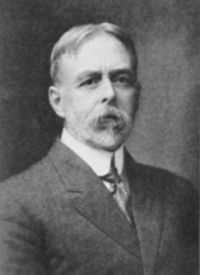
Albert Perry Brigham

Albert Perry Brigham

Summary

Portrait of Albert Perry Brigham Albert Perry Brigham Popular Science Monthly (1909)

It is plain that the whole circle of conservation problems applies here, not only by directly increasing food, as in irrigation, but in cheapening the cost of transportation, in saving land by forest conservation and in utilizing power of every kind to the full, thus releasing time and energy for the free use of opportunity and the complete employment of all our resources. Thus a well ordered civilization would sustain the greatest number at good standards, as a well-managed household may maintain a large family on a lesser sum than is required by a neighboring small household.
Source: Wikisource

Portrait of Albert Perry Brigham Albert Perry Brigham Popular Science Monthly (1909)

Not only are people kept alive, but they are made more productive workers and reasonably, it would seem, may become more prolific as well as better conditioned. Whatever our views of population or progress, it would hardly be prudent to disagree with Mr. Mackaye's proposition that it is not so important to get nitrogen into the soil and raise more food as to make right use of the food we have. We should, he thinks, avoid undue increase of our population, raise our wealth per capita, and not "cause two unhappy human beings to live where one lived before."
Source: Wikisource

Portrait of Albert Perry Brigham Albert Perry Brigham Popular Science Monthly (1909)

With such an enormous population, we, like England, could not feed half our mouths, and should have to exchange other products for food. But other lands might not have the surplus in those days, to send to us. And our underground resources might be seriously reduced, if not exhausted, and we could not produce the exchange values. We thus see how fascinating and how futile is the hundred million tendency. Let us divide our total by three, and arrive at a population which we might hope to feed from our own soil, a little under 250,000,000.
Source: Wikisource

Get perspective with Kwize: daily news enlightened by great literature