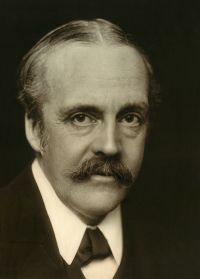
Arthur James Balfour

Arthur James Balfour

Summary

Portrait of Arthur James Balfour Arthur James Balfour Theism and Humanism

We might live without care and die without pain; nature, tamed to our desires, might pour every luxury into our lap; and, with no material wish unsatisfied, we might contemplate at our ease the inevitable, if distant, extinction of all the life, feeling, thought, and effort whose reality is admitted by a naturalistic creed.
But how should we be advanced? What interest would then be left in the story of the human race from its sordid beginnings to its ineffectual end? Poets and thinkers of old dimly pictured a controlling Fate to which even the Olympian gods were subject.
Source: Gutenberg

Portrait of Arthur James Balfour Arthur James Balfour Theism and Humanism

It could always be hoped that human efforts would leave behind them some enduring traces, which, however slowly, might accumulate without end. But hopes like these are possible no more. The wider is the sweep of our contemplative vision the more clearly do we see that the rôle of man, if limited to an earthly stage, is meaningless and futile;—that, however it be played, in the end it “signifies nothing.” Will any one assert that universal history can maintain its interest undimmed if steeped in the atmosphere of a creed like this?
Source: Gutenberg

Portrait of Arthur James Balfour Arthur James Balfour Theism and Humanism

The mere existence of natural laws is not, as it seems to me, a sufficient basis for the argument; we require also that these laws should combine to subserve an end. Were the universe, for example, like a huge impervious reservoir of some simple gas, where nothing rested but nothing changed, where amid all the hurry and bustle of colliding atoms no new thing was ever born, nor any old thing ever perished, we might find in it admirable illustrations of natural law, but no hints, so far as I can see, of purpose or design.
Source: Gutenberg

Get perspective with Kwize: daily news enlightened by great literature