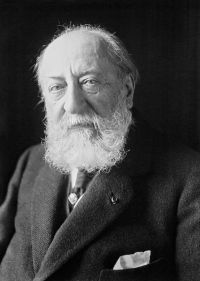
Camille Saint-Saëns

Camille Saint-Saëns

Summary

Portrait of Camille Saint-Saëns Camille Saint-Saëns Musical Memories (1919)

In this time of anarchy in art, when all he had to do to conciliate the hostile critics was to array himself with the fauves, Massenet set an example of impeccable writing. He knew how to combine modernism with respect for tradition, and he did this at a time when all he had to do was to trample tradition under foot and be proclaimed a genius. Master of his trade as few have ever been, alive to all its difficulties, possessing the most subtle secrets of its technique, he despised the contortions and exaggerations which simple minds confound with the science of music.
Source: Gutenberg

Portrait of Camille Saint-Saëns Camille Saint-Saëns Musical Memories (1919)

The man who gets his work hung in the Sâlon is not the one who puts on his canvas delicate touches in harmonious tones, but he who juxtaposes vermillion and Veronese green. The man with a “developed taste” is not the one who knows how to get new and unexpected results by passing from one key to another, as the great Richard did in Die Meistersinger, but rather the man who abandons all keys and piles up dissonances which he neither introduces nor concludes and who, as a result, grunts his way through music as a pig through a flower garden.
Source: Gutenberg

Portrait of Camille Saint-Saëns Camille Saint-Saëns Musical Memories (1919)

This uncle was an artist, but he was, nevertheless, passionately fond of music. He had even built with his own hands a concert organ on which he used to play. My mother used to sit between his knees and, while he amused himself by running his fingers through her splendid black hair, he would talk to her about art, music, painting—beauty in every form. So she got it into her head that if she ever had sons of her own, the first should be a musician, the second a painter, and the third a sculptor.
Source: Gutenberg

Get perspective with Kwize: daily news enlightened by great literature