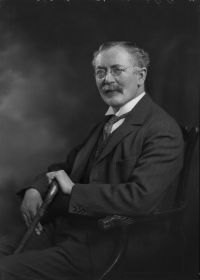
E. E. Fournier d'Albe

E. E. Fournier d'Albe

Summary

Portrait of E. E. Fournier d'Albe E. E. Fournier d'Albe Quo Vadimus? (1925)

If there is a still farther advance in the life of the earth, what sort of direction can it take? Will a new race have arisen, as much above humanity as man is above the arboreal ape? Or will the further differentiation of man have come to a definite end, and progress be confined to an ever-increasing richness of intellectual, artistic, and emotional life? If there is any progress at all, it must be by effort, and the question could be answered with fair probability, if we could find an incentive to effort after the earth is entirely subdued.
Source: Gutenberg

Portrait of E. E. Fournier d'Albe E. E. Fournier d'Albe Quo Vadimus? (1925)

The rivalry among nations makes for progress, but its most active manifestations may produce a serious set-back of long duration, involving irreparable loss.
So long as peace and goodwill do not prevail among individual men it is absurd to expect them to prevail among a collection of beasts of prey such as we have in the nations of the world. Yet it is obviously desirable that the human population of the globe should advance as one man. There is one thing, and one thing only, which can unite humanity into one closely-knit organism, and that is an external enemy.
Source: Gutenberg

Portrait of E. E. Fournier d'Albe E. E. Fournier d'Albe Quo Vadimus? (1925)

Portions of the interior of the earth reclaimed and made habitable; all machinery and sources of power wisely distributed and made instantly available for all legitimate purposes. The earth’s surface and the rippling ether in which it swims made into a vast playground of human thought and emotion, and all mankind throbbing in unison to every great thought.
The Earth will have become a sentient being.—It will be as closely unified and organized as the human individual himself. Mankind will be the “grey matter” of its brain.
Source: Gutenberg

Get perspective with Kwize: daily news enlightened by great literature