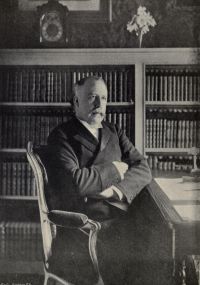
George William Erskine Russell

George William Erskine Russell

Summary

Portrait of George William Erskine Russell George William Erskine Russell Matthew Arnold

As our idea of perfection widens beyond the narrow limits to which the over-rigour of Hebraising has tended to confine it, we shall yet come again to Hebraism for that devout energy in embracing our ideal, which alone can give to man the happiness of doing what he knows. "If ye know these things, happy are ye if ye do them!"—the last word for human infirmity will always be that. For this word, reiterated with a power now sublime, now affecting, but always admirable, our race will, as long as the world lasts, return to Hebraism."
Source: Gutenberg

Portrait of George William Erskine Russell George William Erskine Russell Matthew Arnold

Neither makes man too much a god,
Nor God too much a man.
Wordsworth thought it a boon to "feel that we are greater than we know": Arnold thought it a misfortune. Wordsworth drew from the shadowy impressions of the past the most splendid intimations of the future. Against such vain imaginings Arnold set, in prose, the "inexorable sentence" in which Butler warned us to eschew pleasant self-deception; and, in verse, the persistent question—
Say, what blinds us, that we claim the glory
Of possessing powers not our share?
He rebuked
Wishes unworthy of a man full-grown.
Source: Gutenberg

Portrait of George William Erskine Russell George William Erskine Russell Matthew Arnold

Stress must be laid upon those last words; for Religion, according to its full and catholic ideal, is the perfection and consecration of man's whole nature, intellectual and physical, as well as moral and spiritual. All that is lovely, splendid, moving, heroic, even enjoyable, in human life—all health and vigour and beauty and cleverness and charm—all nature and all art, all science and all literature—are among the good and perfect gifts which come down from the Father of Lights.
Source: Gutenberg

Get perspective with Kwize: daily news enlightened by great literature