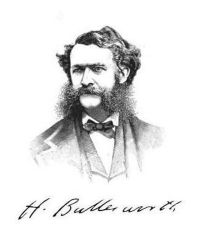
Hezekiah Butterworth

Hezekiah Butterworth

Summary

Portrait of Hezekiah Butterworth Hezekiah Butterworth,  Popular Science Monthly (1872)

“ There are moments in human experience that repay the toils and struggles of a lifetime. Such were those of Galileo when he raised the newly-made telescope to the heavens; such were those of Rittenhouse, when, a century after the discovery of Horrox, he saw the shadow of Venus again crossing the disk of the sun; and such were those that the boy-astronomer himself felt as he watched the dark spot—the mighty shadow of a planet in the far abyss of space almost imperceptibly stealing across the circumference of the reflected circle on the paper. ”
Source: Wikisource

Portrait of Hezekiah Butterworth Hezekiah Butterworth,  Popular Science Monthly (1872)

“ Often at night, as the boy Horrox stood before moonrise, gazing at the stars, and saw Venus—the Lucifer and Hesperus of the old classic poets—burning with a clear, steady flame, and casting a dim shadow over the vernal and midsummer fields, the thought would come to him that perhaps he, first among all the dwellers on the face of the earth, might see the planet, like a celestial messenger, darkening the solar centre. ”
Source: Wikisource

Portrait of Hezekiah Butterworth Hezekiah Butterworth,  Popular Science Monthly (1873)

“ What a stretch of the imagination does it require to cover such an appalling calamity! Cities were reduced to towns; towns to hamlets. The work of the husbandman ceased. The dead were unburied, and lay in the fields rotting in the sun. People stayed in their own houses, often half clothed and half famished, waiting for the destroyer to come.
In the year 1664 a similar visitation of the plague came upon London. The disease was perhaps not as swift and violent as had been the black death three hundred years before, but it was of the same general character.
”
Source: Wikisource

Get perspective with Kwize: daily news enlightened by great literature