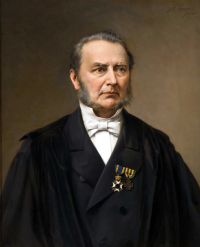
Johannes Henricus Scholten

Johannes Henricus Scholten

Summary

Portrait of Johannes Henricus Scholten Johannes Henricus Scholten A Comparative View of Religions

In this stage, man's needs are as yet very limited and exclusively confined to the material world. Still too little developed intellectually to worship the divine in nature and her powers, he thinks he sees the divinity which he seeks in every unknown object which strikes his senses, or which his imagination calls up. In this stage, religion has no higher character than that of caprice and of love of the mysterious and marvelous, mixed with fear and a slavish adoration of the divine.
Source: Gutenberg

Portrait of Johannes Henricus Scholten Johannes Henricus Scholten A Comparative View of Religions

In him religion appeared as the power of self-sacrificing love, which fears not even death, and to which dying is not the losing of life, but the development of life. In distinction from other religions, in which either God and man are strangers to each other, and opposed to each other, or man's personality is, as it were, sunk in God, Christianity is the religion by which man, in the full enjoyment of individual development, and with the sense of his own strength, lives in the consciousness of the most entire dependence upon God.
Source: Gutenberg

Portrait of Johannes Henricus Scholten Johannes Henricus Scholten A Comparative View of Religions

This Brahma, before whose power even the gods must yield, was gradually exalted by the Brahmins to the highest deity, to whom, under the name of Brahma, the old Veda divinities were subordinated. Brahma is no god of the people, but a god of the priests; not the lord of nature, but the abstract and impersonal Being, out of whom nature and her phenomena emanate. From Brahma the priest derives his authority; and the system of caste, by which the priesthood is raised to the first rank, its origin. The worship of Brahma consists in doing penance and in abstinence.
Source: Gutenberg

Get perspective with Kwize: daily news enlightened by great literature