Summary

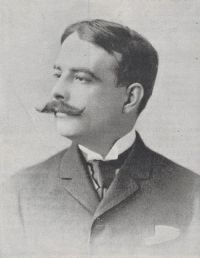
Portrait of Edgar Saltus Edgar Saltus The Lords of the Ghostland: A History of the Ideal

Meanwhile, the revelation completed and proclaimed, Zarathrustra died as miraculously as he was born, foretelling, as he went, the coming of a messiah, his own son, Coshyos—the delayed fruit of an immaculate hymen that is not to be fecund until the end of time—but who, at the consummation of the ages, will rejuvenate the world, affranchise it from death, vanquish Ahriman, terminate the struggle between good and evil, purify hell and fill it full with glory. Then the dead shall rise and immortality be universal.
Source: Gutenberg

Portrait of Edgar Saltus Edgar Saltus The Lords of the Ghostland: A History of the Ideal

In the strophes of the epic the earth was a flat and stationary parallelogram. About the earth, and uniquely for its benefit, sun, moon and stars paraded. Above was a deity one or multiple. Below were places of vivid discomfort. To the latter, or to the former, the soul of man proceeded. There were no other resorts. Creation had its limits.
Poets younger yet more gray have presented a different conception. In the glare of a million million of suns they have sent the earth spinning like a midge. Beyond the uttermost horizon they have strewn other systems, other worlds; beyond the latter, more.
Source: Gutenberg

Portrait of Edgar Saltus Edgar Saltus The Lords of the Ghostland: A History of the Ideal

To be absorbed, to be Brahm, to be God, is an ambition, certainly vertiginous yet as surely divine. But to succeed, consciousness of success must be lost. A mortal cannot attain divinity until annihilation is complete. To become God nothing must be left of man. To loose, then, every bond, to be freed from every tie, to retire from finite things, to mount to and sink in the immutable, to see Death die, was and is the Hindu ideal.
Source: Gutenberg

Get perspective with Kwize: daily news enlightened by great literature