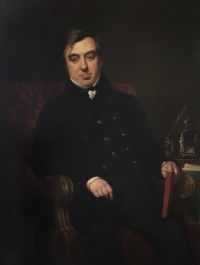
John Ayrton Paris

John Ayrton Paris

Summary

Portrait of John Ayrton Paris John Ayrton Paris Pharmacologia

But the most absurd and preposterous hypothesis that has disgraced the annals of medicine, and bestowed medicinal reputation upon substances of no intrinsic worth, is that of the Doctrine of Signatures, as it has been called, which is no less than a belief that every natural substance which possesses any medicinal virtue, indicates by an obvious and well-marked external character, the disease for which it is a remedy, or the object for which it should be employed!
Source: Gutenberg

Portrait of John Ayrton Paris John Ayrton Paris Pharmacologia

Surely an unprejudiced judge would prefer the evidence of sight, as furnished by the arsenical tests, to that of smell, as afforded in the last experiment. No one will attempt to deny that it is the duty of the medical practitioner who is called upon to decide so important a question as the presence of arsenic, to prosecute by experiment every point which admits the least doubt; he should also remember that in a criminal case, he has not only to satisfy his own conscience, but that he is bound, as far as he is able, to convince the public mind of the accuracy and truth of his researches
Source: Gutenberg

Portrait of John Ayrton Paris John Ayrton Paris Pharmacologia

From what has been said, it is very evident that the mere chemist can have no pretensions to the art of composing or discriminating remedies; whenever he arraigns the scientific propriety of our Prescriptions, in direct contradiction to the deductions of true medical experience,—whenever he forsakes his laboratory for the bed-side, he forfeits all his claims to our respect, and his title to our confidence. It is amusing to see the ridiculous errors into which the chemist falls, when he turns physician
Source: Gutenberg

Get perspective with Kwize: daily news enlightened by great literature