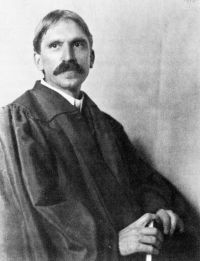
John Dewey

John Dewey

Summary

Portrait of John Dewey John Dewey Democracy and Education (1916)

How shall we secure breadth of outlook without sacrificing efficiency of execution? How shall we secure the diversity of interests, without paying the price of isolation? How shall the individual be rendered executive in his intelligence instead of at the cost of his intelligence? How shall art, science, and politics reinforce one another in an enriched temper of mind instead of constituting ends pursued at one another's expense? How can the interests of life and the studies which enforce them enrich the common experience of men instead of dividing men from one another?
Source: Gutenberg

Portrait of John Dewey John Dewey Democracy and Education (1916)

To produce or to make is to alter something; to consume is to alter. All the obnoxious characters of change and diversity thus attach themselves to doing while knowing is as permanent as its object. To know, to grasp a thing intellectually or theoretically, is to be out of the region of vicissitude, chance, and diversity. Truth has no lack; it is untouched by the perturbations of the world of sense. It deals with the eternal and the universal. And the world of experience can be brought under control, can be steadied and ordered, only through subjection to its law of reason.
Source: Gutenberg

Portrait of John Dewey John Dewey Democracy and Education (1916)

Our first question is to define the nature of an aim so far as it falls within an activity, instead of being furnished from without. We approach the definition by a contrast of mere results with ends. Any exhibition of energy has results. The wind blows about the sands of the desert; the position of the grains is changed. Here is a result, an effect, but not an end. For there is nothing in the outcome which completes or fulfills what went before it. There is mere spatial redistribution. One state of affairs is just as good as any other.
Source: Wikisource

Get perspective with Kwize: daily news enlightened by great literature