Summary

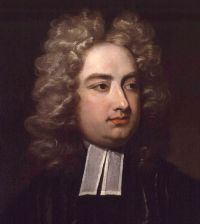
Portrait of Jonathan Swift Jonathan Swift A Letter of Advice to a Young Poet

I say our poetry of late has been altogether disengaged from the narrow notions of virtue and piety, because it has been found by experience of our professors, that the smallest quantity of religion, like a single drop of malt liquor in claret, will muddy and discompose the brightest poetical genius.
Religion supposes heaven and hell, the word of God, and sacraments, and twenty other circumstances, which, taken seriously, are a wonderful check to wit and humour, and such as a true poet cannot possibly give in to, with a saving to his poetical licence
Source: Wikisource

Portrait of Jonathan Swift Jonathan Swift A Letter of Advice to a Young Poet

For, to speak my private opinion, I am for every man’s working upon his own materials, and producing only what he can find within himself, which is commonly a better stock than the owner knows it to be. I think flowers of wit ought to spring, as those in a garden do, from their own root and stem, without foreign assistance. I would have a man’s wit rather like a fountain, that feeds itself invisibly, than a river, that is supplied by several streams from abroad.
Source: Wikisource

Portrait of Jonathan Swift Jonathan Swift A Letter of Advice to a Young Poet

Do not many men write well in common account, who have nothing of that principle? Many are too wise to be poets, and others too much poets to be wise. Must a man, forsooth, be no less than a philosopher, to be a poet, when it is plain, that some of the greatest idiots of the age, are our prettiest performers that way? And for this, I appeal to the judgment and observation of mankind.
Source: Wikisource

Get perspective with Kwize: daily news enlightened by great literature