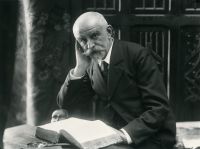
Joris-Karl Huysmans

Joris-Karl Huysmans

Summary

Portrait of Joris-Karl Huysmans Joris-Karl Huysmans The Cathedral — Chapter II

He, with the innocent gaze, the pure eyes of a girl at her first Communion, has the sometimes bitter mouth of an old man; she is proud of feature and humble of heart; they both, though by different outward signs and acts, achieve the same result, an identical semblance of paternal indulgence and mature goodness."
And Durtal had gone again and again to see them. His reception was always the same; Madame Bavoil greeted him with the invariable formula: "Here is our friend," while the priest's eyes smiled as he grasped his hand.
Source: Wikisource

Portrait of Joris-Karl Huysmans Joris-Karl Huysmans The Cathedral — Chapter II

Durtal, like Edgar Poe's unhappy sufferer, listened with horror to the rustle of steps on the stairs, the piteous weeping behind the doors.
And yet these ghosts of departed crimes were no more than indefinite shapes; they never consolidated nor took a definite form. The most persistent miscreant of them all, which had tormented him so long, the sin of the flesh, at last was silenced, and left him in peace. La Trappe had rooted up the stock of those debaucheries.
Source: Wikisource

Portrait of Joris-Karl Huysmans Joris-Karl Huysmans The Cathedral — Chapter II

Durtal admitted when he was alone, "a positive fact that the capital is unprofitable to me. I never see anybody now, and shall be reduced to still more utter solitude when these friends are gone. I shall, for all purposes, be quite as well off at Chartres; I can study at my ease amid peaceful surroundings, within reach of a cathedral of far greater interest than Notre Dame de Paris. And besides—besides—there is another question of which the Abbé Gévresin says nothing, but which disturbs me greatly.
Source: Wikisource

Get perspective with Kwize: daily news enlightened by great literature