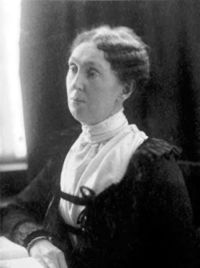
Lucia True Ames Mead

Lucia True Ames Mead

Summary

Portrait of Lucia True Ames Mead Lucia True Ames Mead Milton's England

The interior is well-preserved; it has a nave with two aisles and a chancel, and in the porch is an old Norman arch. Upon the wall at the rear are wooden tablets which record curious bequests of small annuities for monthly doles of bread to needy people.
Never since those five joyous years at Horton has any English poet blessed the world with verse of such rare loveliness and perfection as fell from the pen of Milton during this time, when spirit, heart, and mind were in attune. The world’s clamour had not broken in upon his peace.
Source: Gutenberg

Portrait of Lucia True Ames Mead Lucia True Ames Mead Milton's England

If the visitor waits after service, he may see in the pastor’s room the portrait of John a Lasco, to whom all the congregation point back with pride, as the first and greatest preacher in their history; and the courteous pastor may point out many things of interest that would escape the casual observer. Standing at the front of the church, beside the little tower at the left, whose beautiful spire no longer rises aloft, one finds himself in the heart of the modern business world, relentless, pushing, loving neither beauty nor the sacredness of age.
Source: Gutenberg

Portrait of Lucia True Ames Mead Lucia True Ames Mead Milton's England

Suffice to say that when we first hear of London it was a little hamlet on a hill of perhaps one hundred feet in height, lying between two ranges of higher hills. At the north rose what we now call Highgate and Hampstead, about 450 feet high, and to the south, beyond the marshes and the Thames and a broad shallow lagoon, whose little islands once marked the site of Southwark, rose the Surrey hills, from one of which in our day the Crystal Palace gleams. Men with stone weapons slew antlered deer upon the little marshy island of Thorney, now Westminster.
Source: Gutenberg

Get perspective with Kwize: daily news enlightened by great literature