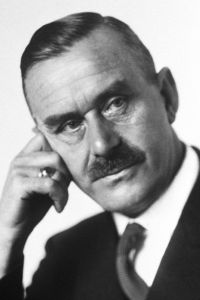
Thomas Mann

Thomas Mann

Summary

Portrait of Thomas Mann Thomas Mann The War and the Future (1944)

You perceive, Ladies and Gentlemen, that I do not visualize as ideal for humanity, a socialism in which the idea of equality completely outweighs that of freedom. So I hardly can be regarded as a champion of communism. Nevertheless, I cannot help feeling that the panic fear of the Western world of the term communism, this fear by which the fascists have so long maintained themselves, is somewhat superstitions and childish and one of the greatest follies of our epoch. Communism is today die bogeyman of the bourgeoisie, exactly as social democracy was in Germany in 1880.
Source: Wikisource

Portrait of Thomas Mann Thomas Mann The War and the Future (1944)

The German people should not be prevented but should be helped to shatter forever the domination of these groups; to put through the already overdue agrarian reform, in short, to bring about the real, the honest, the purifying revolution which alone can rehabilitate Germany in the eyes of the world, of history, and in its own eyes, and open for her a path into the future—for this future, for the new world of unity and cooperation for which we hope the German spirit is by no means historically unprepared and unfit.
Source: Wikisource

Portrait of Thomas Mann Thomas Mann The War and the Future (1944)

It is the complex of ideas of freedom and progress, of humanitarianism, of civilization—in short, the claim of reason to dominate the dynamics of nature, of instinct, of blood, of the unconscious, the primitive spontaneity of life. Now it is by no means natural for the artist, for any human being who stands in any relationship to the creative, to be eternally talking of reason like some learned ass.
Source: Wikisource

Get perspective with Kwize: daily news enlightened by great literature