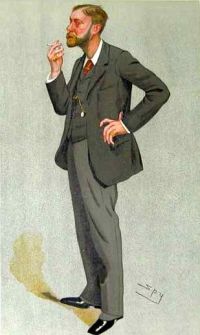
Walter Herries Pollock

Walter Herries Pollock

Summary

Portrait of Walter Herries Pollock Walter Herries Pollock 1911 Encyclopædia Britannica (1911)

But Beatrix, upon whom so much hinges, is an unpleasing character, although one understands fully why men were captivated by her insolent beauty and brilliancy; and there is some truth in Thackeray's own saying, that “Esmond was a prig.” Apart from this, the story is, like the illusion of a past time in the narrative, so complete in all its details, so harmoniously worked out, that there is little room for criticism. As to Esmond's marriage with the lady whom he has served and loved as a boy, that is a matter for individual judgment.
Source: Wikisource

Portrait of Walter Herries Pollock Walter Herries Pollock 1911 Encyclopædia Britannica (1911)

A man of greater strength and with equal belief in his own genius might have gone on appealing to the public until he compelled them to hear him. Musset gave up the attempt in disgust, and waited until the public were eager to hear him without any invitation on his part. In the case of his finest plays this did not happen until after his death; but long before that he was fully recognized as a poet of the first rank and as an extraordinary master of character and language in prose writing.
Source: Wikisource

Portrait of Walter Herries Pollock Walter Herries Pollock 1911 Encyclopædia Britannica (1911)

Vanity Fair was followed by Pendennis, Esmond and The Newcomes, which appeared respectively in 1850, 1852 and 1854. It might be more easy to pick holes critically in Pendennis than in Vanity Fair. Pendennis himself, after his boyish passion and university escapades, has disagreeable touches of flabbiness and worldliness; and the important episode of his relations with Fanny Bolton, which Thackeray could never have treated otherwise than delicately, is so lightly and tersely handled that it is a little vague even to those who read between the lines.
Source: Wikisource

Get perspective with Kwize: daily news enlightened by great literature