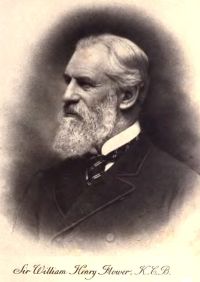
William Henry Flower

William Henry Flower

Summary

Portrait of William Henry Flower William Henry Flower,  Popular Science Monthly (1885)

“ Scarcely anywhere in the animal kingdom do we see so many cases of the persistence of rudimentary and apparently useless organs, those marvelous and suggestive phenomena which at one time seemed hopeless enigmas, causing despair to those who tried to unravel their meaning, but now eagerly welcomed as beacons of true light, casting illuminating beams upon the dark paths through which the organism has traveled on its way to reach the goal of its present condition of existence. ”
Source: Wikisource

Portrait of William Henry Flower William Henry Flower,  Popular Science Monthly (1880)

“ Only one thing is needed to aggravate the evil effect of a pointed toe, and that is the absurdly high and narrow heel so often seen now on ladies' boots, which throws the whole foot into an unnatural position in walking, produces diseases well known to all surgeons in large practice, and makes the nearest approach yet effected by any European nation to the Chinese custom which we generally speak of with surprise and reprobation. And yet this fashion appears just now on the increase among people who boast of the highest civilization to which the world has yet attained. ”
Source: Wikisource

Portrait of William Henry Flower William Henry Flower,  Popular Science Monthly (1880)

“ Old age has little terror in the eyes of a Thlinkeet belle; for larger lip-blocks are introduced as years advance, and each enlargement adds to the lady's social status, if not to her facial charms. When the block is withdrawn, the lip drops down upon the chin like a piece of leather, displaying the teeth, and presenting altogether a ghastly spectacle. The privilege of wearing this ornament is not extended to female slaves."
In this method of adornment the native Americans are, however, rivaled, if not eclipsed, by the negroes of the heart of Africa.
”
Source: Wikisource

Get perspective with Kwize: daily news enlightened by great literature