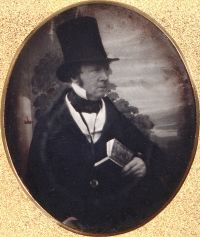
William Henry Fox Talbot

William Henry Fox Talbot

Summary

Portrait of William Henry Fox Talbot William Henry Fox Talbot The Pencil of Nature

We have sufficient authority in the Dutch school of art, for taking as subjects of representation scenes of daily and familiar occurrence. A painter's eye will often be arrested where ordinary people see nothing remarkable. A casual gleam of sunshine, or a shadow thrown across his path, a time-withered oak, or a moss-covered stone may awaken a train of thoughts and feelings, and picturesque imaginings.
Source: Gutenberg

Portrait of William Henry Fox Talbot William Henry Fox Talbot The Pencil of Nature

PLATE X. THE HAYSTACK. PLATE X. THE HAYSTACK. One advantage of the discovery of the Photographic Art will be, that it will enable us to introduce into our pictures a multitude of minute details which add to the truth and reality of the representation, but which no artist would take the trouble to copy faithfully from nature.
Contenting himself with a general effect, he would probably deem it beneath his genius to copy every accident of light and shade
Source: Gutenberg

Portrait of William Henry Fox Talbot William Henry Fox Talbot The Pencil of Nature

Those ancient courts and quadrangles and cloisters look so beautiful so tranquil and so solemn at the close of a summer's evening, that the spectator almost thinks he gazes upon a city of former ages, deserted, but not in ruins: abandoned by man, but spared by Time. No other cities in Great Britain awake feelings at all similar. In other towns you hear at all times the busy hum of passing crowds, intent on traffic or on pleasure—but Oxford in the summer season seems the dwelling of the Genius of Repose.
Source: Gutenberg

Get perspective with Kwize: daily news enlightened by great literature