“ O royal Harmachis, let not the luxury and beauty of Alexandria poison thy sense; for in their deadly air, Faith perishes, and Religion cannot spread her heavenly wings. When the hour comes for thee to rule, Harmachis, cast down this accursed city and, as thy fathers did, set up thy throne in the white walls of Memphis. For I tell thee that, for Egypt, Alexandria is but a splendid gate of ruin, and, while it endures, all nations of the earth shall march through it, to the plunder of the land, and all false Faiths shall nestle in it and breed the overthrow of Egypt’s Gods. ”
Alexandria, Egypt
Definition and stakes
Quotes about “Alexandria, Egypt”
Lyndon Orr, Famous Affinities of History: The Romance of Devotion…
“ The orders of a king cannot give enduring greatness to a city; but Alexander's keen eye and marvelous brain saw at once that the site of Alexandria was such that a great commercial community planted there would live and flourish throughout out succeeding ages. He was right; for within a century this new capital of Egypt leaped to the forefront among the exchanges of the world's commerce, while everything that art could do was lavished on its embellishment. ”
A. S. Rappoport, History of Egypt From 330 B.C. To the Present Time…
“ The harbour was crowded with masts and strange prows and uncouth sails, and the quays always busy with loading and unloading; while in the streets might be seen men of all languages and all dresses, copper-coloured Egyptians, swarthy Jews, lively, bustling Greeks, and haughty Italians, with Asiatics from the neighbouring coasts of Syria and Cilicia, and even dark Ethiopians, painted Arabs, Bactrians, Scythians, Persians, and Indians, all gay with their national costumes. Alexandria was a spot in which Europe met Asia, and each wondered at the strangeness of the other. ”
A. S. Rappoport, History of Egypt From 330 B.C. To the Present Time…
“ The trade down the Nile was larger than it had ever been before; the coasting trade on the Mediterranean was new; the people were rich and happy; justice was administered to the Egyptians according to their own laws, and to the Greeks of Alexandria according to the Macedonian laws: the navy commanded the whole of the eastern half of the Mediterranean; the schools and library had risen to a great height upon the wise plans of Ptolemy Soter; in every point of view Alexandria was the chief city in the world. ”
A. S. Rappoport, History of Egypt From 330 B.C. To the Present Time…
“ Alexandria was a cosmopolitan city as well as Rome, hardly inferior to the Italian capital in the number of its inhabitants, far superior to it in stirring commercial spirit, in skill of handicraft, in taste for science and art: in the citizens there was a lively sense of their own national importance, and, if there was no political sentiment, there was at any rate a turbulent spirit, which induced them to indulge in their street riots regularly and heartily. ”
G. Maspero, History of Egypt, Chaldæa, Syria…
“ Finding that the ancient capitals of the country—Thebes, Sais, and even Memphis itself—occupied positions which were no longer suited to the exigencies of the times, he founded opposite to the island of Pharos, in the township of Eakotis, a city to which he gave his own name. The rapid growth of the prosperity of Alexandria showed how happy the founder had been in the choice of its site: in less than half a century from the date of its foundation, it had eclipsed all the other capitals of the Eastern Mediterranean, and had become the centre of African Hellenism. ”
E. M. Forster,
Alexandria: A History and a Guide
“ It is a dynasty much censored by historians, but the Egyptians, who lived under it, were more tolerant. For it had one element of greatness: it did represent the complex country that it ruled. In Upper Egypt it carried on the tradition of the Pharaohs: on the coast it was Hellenistic and in touch with Mediterranean culture. After its extinction, the vigour of Alexandria turns inwards. ”
E. M. Forster,
Alexandria: A History and a Guide
“ Ages ago, before there was civilization in Egypt, or the delta of the Nile had been formed, the whole of the country as far south as Cairo lay under the sea. The shores of this sea were a limestone desert. The coastline was smooth as a rule, but at the north-west corner an extraordinary spur jutted out from the main mass. It was not more than a mile wide, but many miles long. Its base is not far from the modern Bahig. Alexandria is built half-way down it, and its tip is the headland of Aboukir. On each side of it there used to be deep salt water. ”
William Muir,
The Caliphate: Its Rise, Decline and Fall…
“ Alexandria was thus a European, rather than an Egyptian, city.Egypt disaffected towards Byzantine rule.It was otherwise with the rich valley beyond. Emerging from the luxurious city, the traveller dropped at once from the pinnacle of civilisation to the dreary wastes of Monasticism, and the depths of poverty and squalor. Egypt was then, as ever, the servant of nations. The overflowing produce of well-watered fields served but to feed the great cities of the empire. And the people of the soil, ground down by exaction and oppression, were ever ready to rise against their rulers. ”
The Great Events by Famous Historians…
“ Alexandria now lay before them, the metropolis of wealthy Egypt, the emporium of the East, a place strongly fortified, stored with all the munitions of war, open by sea to all kinds of supplies and reinforcements, and garrisoned by Greeks, aggregated from various quarters, who here were to make the last stand for their Egyptian empire. It would seem that nothing short of an enthusiasm bordering on madness could have led Amru and his host on an enterprise against this powerful city. ”
Emma Roberts, Notes of an Overland Journey Through France and Egypt to Bombay
“ Alexandria, from the sea, presents a very imposing appearance; long lines of handsome buildings, apparently of white stone, relieved by green Venetian blinds, afford evidence of increasing prosperity, and a wish to imitate the style of European cities. There is nothing, however, in the landing-place worthy of the approach to a place of importance; a confused crowd of camels, donkeys, and their drivers, congregated amidst heaps of rubbish, awaited us upon reaching the shore. ”
Arthur E. P. Brome Weigall, The Life and Times of Cleopatra…
“ The Greeks, Levantines, and Jews, who now, as in ancient days, form a very large part of the population of Alexandria, would shed bitter tears of gloomy foreboding were they called upon to penetrate into the Egypt which the tourists and the officials know and love. The middle-class Egyptians of Alexandria are rarely tempted to enter Egypt proper, and even those who have inherited a few acres of land in the interior are often unwilling to visit their property. ”
A. S. Rappoport, History of Egypt From 330 B.C. To the Present Time…
“ Peculiarities of character often descend unchanged in a nation for many centuries; and, after fourteen hundred years of the same slavery, the same stripes from the lash of the tax-gatherer still used to be the boast of the Egyptian peasant. Cyrene was already a desert; the only cities of note in Upper Egypt were Koptos, Hermopolis, and Antinoopolis; but Alexandria was still the queen of cities, though the large quarter called the Bruchium had not been rebuilt; and the Serapeum, with its library of seven hundred thousand volumes, was, after the capitol of Rome, the chief building in the world. ”
Frank G. Carpenter,
Cairo to Kisumu
(1923)
“ Alexandria has become commercial, money making, and fortune hunting. The rise and fall of stocks, the boom in real estate, and the modern methods of getting something for nothing are its chief subjects of conversation, and the whole population is after the elusive piastre and the Egyptian pound as earnestly as the American is chasing the nickel and the dollar.The city grows because it is at the sea-gate to Egypt and the Sudan. It waxes fat on the trade of the Nile valley and takes toll of every cent’s worth of goods that comes in and goes out. ”
The historians' history of the world in twenty-five volumes…
“ If we had no other example of the keenness of his judgment, the fact that he built Alexandria would alone furnish sufficient evidence; he discovered the point which was destined, for fifteen hundred years, to form the link between Egypt, Europe, and Asia. It is impossible not to concede to him the praise of a great general. ”
Alexandre Dumas,
My Memoirs, Vol. I, 1802 to 1821
“ We have seen how badly the campaign had opened and how much the troops had already undergone since they left Alexandria. The Egypt that they had seen from afar, as a large emerald green riband unrolled in the midst of the desert, no longer appeared in its ancient fertility, as the granary of the world, but in its modern poverty, its shifting populations, its ruined and deserted villages. ”
Mildred Duff, The Bible in its Making: The most Wonderful Book in the World
“ About a hundred years before the days of Antiochus (of whom we read in our last chapter) a company of Jews were living in Alexandria, then a rich and beautiful city, with its stately palaces and temples of white marble, its beautiful gardens, and groves of graceful palm-trees. After the death of Alexander, the Greek kings of Egypt delighted to live in the new city, and in the old Greek books we can yet read of the splendid processions and festivals held in its streets year by year. ”
E. M. Forster,
Alexandria: A History and a Guide
“ ROSETTA. Rosetta and Alexandria are rivals; when one rises the other declines. Rosetta, situated on the Nile, would have dominated but for an overwhelming drawback: she has, and can have, no sea-harbour, because the coast in this part of Egypt is mere delta; the limestone ridges that created the two harbours of Alexandria do not continue eastward of Aboukir. Alexandria required organising by human science, but once organised she was irresistible. It is only in an unscientific age that Rosetta has been important. ”
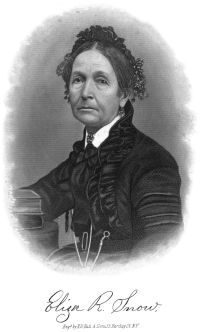
Eliza Roxcy Snow,
Biography and family record of Lorenzo Snow…
(1846)
“ We were pleased with our visit in Alexandria, and with our Hotel de 1'Europe, which nearly equals the first-class hotels in America. Pompey's Pillar, Cleopatra's Needle, the Catacombs, Museum of Antiquities, etc., received a due share of our attention. But little improvement is at present being made in Alexandria, compared with that of Cairo it seems merely of importance as a maritime city. In traveling in Egypt along the delta of the Nile, wherever its waters can reach by overflow or irrigation, the soil is remarkably rich, fertile and productive. ”
E. M. Forster,
Alexandria: A History and a Guide
“ Alexandria was cut off from the entire river system of Egypt, and could not flourish until it was restored; she has always required the double nourishment of fresh water and salt. (ii) There was also a change in the outline of the city: the dyke Heptastadion, built by the Ptolemies to connect the mainland with the island of Pharos, fell into ruin and became a backbone along which a broad spit of land accreted; and so Pharos turned from an island into a peninsula—the present Ras-el-Tin. ”
E. M. Forster,
Alexandria: A History and a Guide
“ It offers an education on English Public School lines to residents in Egypt, whatever their creed or race, and was much approved by Lord Cromer, who founded a scholarship here.167The coast walk from Alexandria to Ramleh is rarely taken but is charming—low crumbly cliffs, sandy beaches, flat rocks, and vestiges of ancient houses and tombs that help one to realise how the whole site of the city has sunk. There is no road east of Silsileh. The scheme for a grandiose “Corniche” drive has fortunately failed, and the scenery has escaped the standardised dulness that environs most big towns. ”
John Lord, Beacon Lights of History, Volume 03…
“ Nor is it probable that any of the peculiarities of the ancient Egyptian kings marked the dynasty of the Ptolemies. No purely Egyptian customs lingered in the palaces of Alexandria. The old deities of Isis and Osiris gave place to the worship of Jupiter, Minerva, and Venus. The wonders of pristine Egypt were confined to Memphis and Thebes and the dilapidated cities of the Nile. The mysteries of the antique Egyptian temples were no more known to the learned and mercantile citizen of Alexandria than they are to us. ”
“ Alexandria was a Greek city, and it became at once one of the most important commercial centers in all those seas. Greek and Roman travelers found now a language spoken in Egypt which they could understand, and philosophers and scholars could gratify the curiosity which they had so long felt, in respect to the institutions, and monuments, and wonderful physical characteristics of the country, with safety and pleasure. ”
A. S. Rappoport, History of Egypt From 330 B.C. To the Present Time…
“ Instead of trying to govern against the will of the people, to thwart or overlook their wishes and feelings, his utmost aim was to guide them, and to make Alexandria a more agreeable place of settlement than the cities of Asia Minor and Syria, for the thousands who were then pouring out of Greece on the check given to its trading industry by the overthrow of its freedom. Though every thinking man might have seen that the new government, when it gained shape and strength, would be a military despotism ”
E. M. Forster,
Alexandria: A History and a Guide
“ After the exploits of Athanasius the Patriarchate of Alexandria became very powerful. In theory Egypt belonged to the Emperor, who sent a Prefect and a garrison from Constantinople; in practise it was ruled by the Patriarch and his army of monks. The monks had not been important so long as each lived alone, but by the 4th cent., they had gathered into formidable communities, whence they would occasionally make raids on civilisation like the Bedouins to-day. One of these communities was only nine miles from Alexandria (the “Ennaton”) , others lay further west, in the Mariout desert ”
Julian, Letters — 47. To the Alexandrians
“ The forefathers of the genuine Hebrews were the slaves of the Egyptians long ago, but in these days, men of Alexandria, you who conquered the Egyptians — for your founder was the conqueror of Egypt — submit yourselves, despite your sacred traditions, in willing slavery to men who have set at naught the teachings of their ancestors. You have then no recollection of those happy days of old when all Egypt held communion with the gods and we enjoyed many benefits therefrom. ”
Delphian Society, The World's Progress, Vol. 01…
“ Although few spend much time in Alexandria, all visitors to Egypt devote as many days or weeks as may be possible to Cairo. From there one may visit the great Pyramids, going by train if limited in point of time; going by donkey or camel if fond of following historic customs. Here, too, one starts upon the trip up the Nile, without which any visit to Egypt would be incomplete. The bazaars afford much entertainment for the sojourner in Cairo. Even those who for some reason have made this city their abode for a protracted time never tire of the street scenes or the bazaars. ”
Various, Harper's Young People, August 22…
“ Its cities, temples, palaces, farms, and gardens were the wonder of the ancient historians.To-day Egypt is an impoverished country, distracted by civil war. Alexandria, once one of the most magnificent cities of the world, lies in ashes, and the people throughout the land are suffering all the horrors of famine amidst their plundered and ruined homes. Long ages of mis-rule and ignorance have brought the fruitful and prosperous land to this terrible condition. In the days of Joseph the armies of Egypt might have withstood the world. ”
E. M. Forster,
Alexandria: A History and a Guide
“ A kingdom, comparable in extent to the Ptolemaic, had come into existence with Alexandria as its centre, and it seemed that the dreams of Napoleon would be realised by this Albanian adventurer, and that the English would be cut off from India. England took alarm. And suddenly the empire of Mohammed Ali fell. Syria revolted (1840) , supported by a British fleet, and soon the English admiral, Sir Charles Napier, was at Alexandria, and compelled the Viceroy to confine himself to Egypt. ”
Maurice H. Harris,
A Thousand Years of Jewish History
“ In no country outside of Greece itself was the Greek spirit so completely diffused as in Egypt. Alexandria, its new capital, displacing Athens as the intellectual centre of the world, was second in importance only to Rome. While the Greek civilization at its worst was tinctured with an enervated orientalism and had much in it debasing, yet the Greek spirit at its best also found its way to Alexandria, and its influence was intellectually broadening and elevating on the Jews resident there. ”