“ The Castle or Tower of Montfichet was in the middle of this piece of wall, and Baynard’s Castle was at the south end of it. The Tower of Montfichet passed into the Fitzwalter family, who also owned the soke beside it. Now, when the first enmity broke out between John and Fitzwalter, all the castles and houses of the latter were dismantled and destroyed by the King’s command. In 1276 the Dominicans begged permission to occupy a piece of ground lying between the wall and the river Fleet. Lord Fitzwalter gave the Friars the site of Castle Baynard and of Montfichet. ”
Baynard's Castle
Definition and stakes
Quotes about “Baynard's Castle”
Walter Besant,
Mediæval London, Volume 1: Historical & Social
“ This castle stood at the angle in the junction of Thames and Fleet. The second Baynard’s Castle, erected by the Duke of Gloucester, was some little distance to the east, also on the bank of the river.The leader of the Barons was this Robert FitzWalter, “Marshal of the Army of God and of Holy Church.” He was Castellain of London, Chief Banneret of the City, Baron of Dunmow, owner of Baynard’s Castle, and of a soke which now forms the parish of St. Andrew by the Wardrobe. As Castellain and Banneret it was his duty to direct the execution of traitors by drowning in the Thames. ”
Anonymous, Cassell's History of England, Vol…
“ On the 19th the Lord Treasurer and Lord Privy Seal, the Earls of Arundel, Shrewsbury, and Pembroke, Sir Thomas Cheney, and Sir John Mason, left the Tower, on the plea that it was necessary to levy forces, and to receive the French ambassador, and that Baynard's Castle, the residence of the Earl of Pembroke, was a much more convenient place for these purposes. As they professed to be actuated by zeal for the cause of his daughter, Suffolk, a very weak person, was easily duped. No sooner had they reached Baynard's Castle than they unanimously declared for Queen Mary. ”

“ Its history extends from the Norman Conquest to the Great Fire—exactly six hundred years; and during the whole of this long period it was a great palace. First it was built by one Baynard, follower of William. It was forfeited in A.D. 1111, and given to Robert Fitzwalter, son of Richard, Earl of Clare, in whose family the office of Castellan and Standard-bearer to the City of London became hereditary. His descendant, Robert, in revenge for private injuries, took part with the Barons against King John, for which the King ordered Baynard's Castle to be destroyed. ”
Leigh Hunt,
The Town: Its Memorable Characters and Events
“ Shakspeare has given this scene with an exact conformity, in all the matters of fact, to the narratives of the old chroniclers; the crafty Protector, it will be remembered, being made to present himself in the gallery above, supported by a bishop on each side, while Buckingham, the lord mayor, the aldermen, and the citizens, occupy the court of the castle below. Baynard's Castle was once more rebuilt in 1487, by Henry VII., with a view to its answering better the purpose of a royal palace ”
“ The Tower was the Court and king's residence; with Baynard's Castle, in Thames Street; the magnificent Palace of the Savoy, the Monastery of the Knights Hospitallers, in Clerkenwell, and many another noble edifice lay in ruins, demolished by the Wat Tyler insurgents; the city was crowded with monasteries and churches; and the streets presented a mingled crowd of nobles, monks, friars, priests, and merchant burghers. ”
“ Having thus disposed of the Barons, Viscounts, and Earls Fitzwalter, it becomes us to inquire into the subsequent history of the old Norman castle, which, flinging its shadow over the then silvery Thames, was the home of the Castellans of London. We have no record of what the Castle of Ralph Baynard was like, but may presume that it was in the usual Norman style, heavy and ungainly, and in its general features not unlike that given in Aggas's Map, temp. Elizabeth, as it appeared after its restoration in the 15th century. ”
Sidney Lee, Dictionary of National Biography… (1887)
“ She was at Hertford Castle with James I of Scotland as her guest at Christmas 1423, and in the following year Parliament granted her Baynard's Castle as her permanent home. She tried to compose the quarrel between the Dukes of Bedford and Gloucester in the same year, and accompanied her child in grand procession to St. ”
William Hone,
The Every-day Book and Table Book…
“ P.S.—Since writing the above, my friend F. C. N. suggests to me, that there was a baron Fitzwalter in John’s reign, proprietor of Castle Baynard, whose daughter Matilda John saw at a tourney, and being smitten with her charms, proposed to her father for her as his mistress, (precisely the events connected with Maid Marian;) and being refused, he attacked Castle Baynard, and ultimately destroyed it. ”
Georg Brandes,
William Shakespeare: A Critical Study
“ But it is he himself who is overreached. Elizabeth has only made a show of acquiescence in order immediately after to offer her daughter to his mortal foe.The second unforgetable passage is the Baynard's Castle scene in the third act. Richard has cleared away all obstacles on his path to the throne. His elder brother Clarence is murdered—drowned in a butt of wine. Edward's young sons are presently to be strangled in prison. Hastings has just been hurried to the scaffold without trial or form of law. ”
Lucy Foster Madison, In Doublet and Hose: A Story for Girls
“ That sombre and dungeon like stronghold is Baynard’s 124 castle. To our left is Westminster, and yon beautiful palace is Whitehall. It is known of all men how it reverted to the crown at the fall of Wolsey. The queen’s father adorned it in its present manner. There stands Somerset house, and yonder is Crosby. On the bankside in Southwark are the theatres and Paris gardens where are the bear pits. Look about thee, Francis. On every building, almost on every stone is writ the history of our forbears. On all those walls are traces of Roman, Briton, Anglo-Saxon and Norman. ”
Various, The Knickerbocker, or New-York Monthly Magazine…
“ His guide-book will tell him of grotesque rocks upon lonely heaths where Druids may have worshipped; and of Bayham Abbey, with its mouldering walls and ‘antiquary ivy,’ which still attests amidst its ruins the luxury and wealth of its ancient masters. He may look in one direction over the broad lands and towering spires of Eridge Castle, or turning in another, soon lose amidst the recollections of Penshurst and in the homage which the heart renders to departed virtue, all sense of the vexatious forms and frivolous though perhaps inseparable distinctions of modern society. ”
Sabine Baring-Gould,
Castles and Cave Dwellings of Europe
(1911)
“ The cave at the angle was walled up and furnished with doorway and windows.Near where the Célé flows into the Lot is the little town of Cabrerets. Here the precipice of fawn-coloured limestone overhangs like a wave, curling and about to break. On a ledge under it, and above the river and the road and the houses, is the Devil's Castle, built by Perducat d'Albret and Bertrand de Besserat. The latter held it from 1380 to 1390, but then, at the entreaty of the neighbourhood, the Seigneur Hebraud de Saint-Sulpice at the head of levies laid siege to the castle and took it. ”
William Cullen Bryant,
Poetical Works of William Cullen Bryant
“ I have gazed upon thee coldly, all lovely as thou art, But the wish to walk thy pastures now stirs my inmost heart." He hears a sound of timbrels, and suddenly appear A troop of ruddy damsels and herdsmen drawing near: They reach the castle greensward, and gayly dance across; The white sleeves flit and glimmer, the wreaths and ribbons toss. The youngest of the maidens, slim as a spray of spring, She takes the young count's fingers, and draws him to the ring; They fling upon his forehead a crown of mountain flowers, "And ho, young Count of Greiers! this morning thou art ours!" ”
Sidney Heath, Bournemouth, Poole & Christchurch
“ The masonry of the walls is exceedingly rough and solid, for in the days when they were erected men built for shelter and protection, and not with the idea of providing themselves with beautiful houses to live in. The keep was made a certain height, not as a crowning feature in the landscape, but so that from its top the warder could see for many miles the glitter of a lance, or the dust raised by a troop of horsemen. One of the greatest charms of the rough, solid walls of a Norman castle is that they are so honest and straightforward, and tell their story so plainly. ”
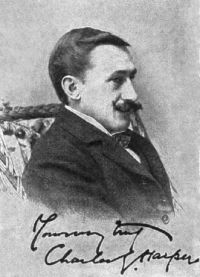
Charles G. Harper,
The Hastings Road and the "Happy Springs of Tunbridge"
“ Ever since the historic period, and doubtless long before the era of recorded things began, there existed a castle, or a fortified post, on this lofty cliff-top, where the shattered ruins of Hastings Castle still stand, few and almost formless—the long superannuated warden of the town that has grown so great and has now absolutely no defences against the foreign foe. ”
E. V. Lucas,
Highways and Byways in Sussex
“ The crumbling masonry was assisted in its decay by no siege or bombardment; the castle has been never the scene of human struggle. Visitors, therefore, must take pleasure chiefly in the curiosities collected in the museum and in the views from the roof. A few little rooms hold the treasures amassed by the Archæological Society; amassed, it may be said, with little difficulty, for the soil of the district is fertile in relics. From Ringmer come rusty shield bosses and the mouldering skull of an Anglo-Saxon; from the old Lewes gaol come a lock and a key strong enough to hold Jack Sheppard ”
Thomas Dugdale, Curiosities of Great Britain: England and Wales Delineated Vol…
“ Notwithstanding which it is now demolished, and all this glory lyeth in the dust, buried in its own ruins; there being nothing standing but a few broken walls, which seem to mourn their own approaching funerals." The walls are formed of slate, and appear to be rapidly decaying. The grounds round the castle consist of steep eminences, covered with oak and other trees. Even in the court, and remains of the fortress itself, trees of nearly a century's growth are flourishing in luxuriance, and compose, with the shrubs thickly scattered within the area, a scene highly beautiful. ”
S. Baring-Gould, Cliff Castles and Cave Dwellings of Europe
“ There are two very remarkable castles at Brengues; both were fortified by Perducat and Besserat. One hangs like a swallow's nest under the eaves of the overhanging rock, and is now wholly inaccessible, so much so that it is in perfect preservation. The river flows far below, and a talus of rubble runs up to the foot of the cliff, along which talus, on a narrow terrace, is a path. This path was defended both above and below the castle by gates that were battlemented and to which guard-rooms were attached. The pensile castle is not large. ”
Various, Graham's Magazine, Vol. XLI, No…
“ Probably its like would be sought in vain in Europe. Such another series of towers, and spires, and long and high walls, terraces, battlements, stair-cases, and dungeons, was never brought together by the hand of man. The castle was constructed by order of a certain Count of Anjou, named Foulques Nera, to become—long after his valorous fame had passed away, or had merged into the reputation of an ogre—a ponderous plaything. ”
John G. Edgar, Runnymede and Lincoln Fair: A Story of the Great Charter
“ Rochester Castle—the stately ruins of which, hard by the Medway, still attest its ancient grandeur, and recall the days when it stood in feudal pride, guarded by moat, and rampart, and lofty battlements—was deemed a place of immense importance; and Robert Fitzwalter and his confederates had intrusted it to the keeping of William Albini, Earl of Arundel, a great noble whose family had long maintained feudal state at Castle Rising, in Norfolk, and whose ancestor had acquired Arundel with the hand of Adelicia of Louvaine, the young widow of Henry Beauclerc. ”
Mark Twain,
The Innocents Abroad
“ Two hours later we reached the foot of a tall isolated mountain, which is crowned by the crumbling castle of Banias, the stateliest ruin of that kind on earth, no doubt. It is a thousand feet long and two hundred wide, all of the most symmetrical, and at the same time the most ponderous masonry. The massive towers and bastions are more than thirty feet high, and have been sixty. From the mountain’s peak its broken turrets rise above the groves of ancient oaks and olives, and look wonderfully picturesque. It is of such high antiquity that no man knows who built it or when it was built. ”
S. Baring-Gould, An Old English Home and Its Dependencies
“ On the Continent, however, till the eighteenth century, the type of fortress prevailed; the angle towers became turrets, but were indispensable wherever a gentleman had a château. As to the English noble or squire, his only tower was the dove-cot, and the holes in it not for muskets and crossbows, but for the peaceful pigeon to fly in and out.The pedigree of a castle is this:The stronghold in France in Merovingian days consisted of an adaptation of the Roman camp. It was an earthwork with a stockade on top, enclosing a level tract on the top of a hill, if a suitable hill could be found ”
J. G. Lockhart, Memoirs of the Life of Sir Walter Scott…
“ The land, in general, seems well cultivated and enclosed—but in some places the enclosures seem too small, and the ridges too crooked, for proper farming. We pass two gentlemen's seats, called White Castle and Red Castle; the last a large good-looking mansion, with trees, and a pretty vale sloping upwards from the sea. As we approach the termination of the Lough, the ground becomes more rocky and barren, and the cultivation interrupted by impracticable patches, which have been necessarily abandoned. Come in view of Green Castle, a large ruinous castle, said to have belonged to the MacWilliams. ”
Louisa Stuart Costello,
Béarn and the Pyrenees
“ The wail of a whole nation tells that that anticipated future may not come! A cloud has again gathered over the valley of the Gave, and a sad pause—the pause of blighted hopes—has chilled the expectations in which Béarn had ventured to indulge.But the castle is not, even now, neglected: the architects are still there; workmen are still busy, chiseling and planing; the beautiful arabesques and reliefs are coming forth to view, restored with all their original delicacy: the ceilings are glowing with fresh gilding, the walls are bright with fresh tapestry, and the rooms are newly floored. ”
A. M. Williamson,
My Friend the Chauffeur
“ Clouds and mountains were all reflected too, and it seemed as if one might take one's choice between the real world and the dream world.Maida and Beechy had already been for a walk with Sir Ralph and Mr. Barrymore, who had taken them up by a labyrinth of wooded paths to an old ruined castle which they described as crowning the head of the promontory. It had been built by the Romans, and in the Middle Ages was the stronghold of brigands, who captured beautiful ladies and terrorized the whole country. ”
Charles S. Olcott, The Country of Sir Walter Scott
“ It is no longer a single ruined wall, but the imposing front of a vast structure, well placed for defence, once strong in war but now beautiful in peace. Barnard Baliol, whose father was one of the followers of William the Conqueror, founded the castle in the beginning of the twelfth century. He was the grandfather of John Baliol, who contested with Robert Bruce the claim to the Scottish crown. The original castle or fortress covered an extensive area of over six acres, most of which is now given over to sheep-raising or to the cultivation of fruit trees. ”
George Thomas Clark, Mediæval Military Architecture in England…
“ Outside the walled area the ground falls slightly, and there are traces at about 30 yards’ distance, towards the south, of a ditch and internal bank protecting this, by nature, the weakest side. The valley towards the east is occupied by one of the brooks which flows a few feet only from and below the wall. There is no trace of any second or outer circle of masonry, so that probably the castle was composed of a single ring wall, possibly set with turrets, but if so, of no great size. ”
Fürst von Hermann Pückler-Muskau, Tour in England, Ireland, and France…
“ On the highest point of the ruin is an iron machine like a kibble, which serves as a beacon. A large tar-barrel is placed in it and set on fire. It burns like a flaming torch the night through. The Castle stands on a projecting rock, which rises to the height of a hundred and fifty or two hundred feet perpendicular from the sea. Around the Castle its summit is like a bowling-green. ”