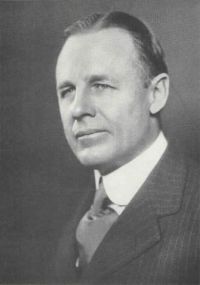
Boeing

Definition and stakes

Eugene E. Wilson,  Slipstream: the autobiography of an air craftsman (1950)

“ Bill Boeing, founder of the Boeing Airplane Company, and a successful operator in lumber and real estate, had drawn his airplane-company staff from versatile young graduates of the aeronautical-engineering course of the University of Washington and had picked some good ones. Foremost among these were Claire Egtvedt, his chief engineer, and Phil Johnson, his factory manager. Bill, a pilot himself, had opened an air line between Seattle and Victoria, using a couple of Boeing-built flying boats under the management of Eddie Hubbard. ”
Source: Gutenberg

Jim Ray,  The Story of American Aviation

“ While the DC-2 was coming into prominence in the air transport field, Boeing engineers had gone on with their idea of a two-engined plane and had built an all-metal bomber for the Army.
In building the two-engined, all-metal B-9, Boeing engineers learned how to build another plane with a more peaceful purpose. This ship was the famous Boeing 247-D commercial transport plane. The 247-D was an all-metal, low-wing monoplane, powered with two 550-horsepower Pratt & Whitney Wasp radial engines. It had a top speed of 200 miles per hour and a cruising speed of 180 miles per hour.
”
Source: Gutenberg

Jim Ray,  The Story of American Aviation

“ A big plane must have two engines, one of which could keep the plane flying if the other failed. Boeing went to work with this in mind.
Near Los Angeles, the young man who had been dreaming of big commercial transport planes since the Wright Brothers’ trials at Fort Meyer, also was thinking of two-engined transports that could fly on one engine. From the time Donald Douglas’ World Cruisers had circled the globe, his aircraft had grown larger and larger. His orders, however, were for Army, Navy, and Coast Guard planes; not for great commercial airliners.
”
Source: Gutenberg

Get perspective with Kwize: daily news enlightened by great literature