“ As already indicated, Erechtheus is one of the oldest names in Attic mythology. According to Hesiod, his daughter Creüsa married Xuthus, son of Hellen and brother of Æolus and Dorus, the heads of the Æolian and Dorian branches of the Hellenic race; and, through his grandsons, Achæus and Ion, Erechtheus became the progenitor of the Achæans and Ionians. Homer again tells us that Erechtheus was worshipped in the temple of Athena (Il. ii. 549-551) , and we learn from Pausanias that sacrifices were offered to him on the altar of Poseidon, by command of the oracle. ”
Erechtheus
Definition and stakes
Erechtheus, a foundational figure in Attic mythology, embodies the intertwined realms of divine and human legacy, serving as a king, hero, and deity in Athenian tradition. Homer portrays him as earth-born and nurtured by Athena, while Euripides depicts him as a venerated ancestor whose lineage forms the basis of Athenian identity.
Plutarch and Grote emphasize his symbolic unification of political and religious power, noting his role in founding the Erechtheium temple and the merging of divine and human governance in Greek historiography. These varied perspectives highlight Erechtheus’s lasting importance as a center of myth, worship, and the origins of Athenian civilization.
Quotes about “Erechtheus”
 George Grote,
History of Greece, Volume 01 (of 12…
George Grote,
History of Greece, Volume 01 (of 12…
“ After the death of Pandiôn, Erechtheus succeeded to the kingdom, and his brother, Butês, became priest of Poseidôn Erichthonius, a function which his descendants ever afterwards exercised, the Butadæ or Eteobutadæ. Erechtheus seems to appear in three characters in the fabulous history of Athens—as a god, [p. 198] Poseidôn Erechtheus [470] —as a hero, Erechtheus, son of the Earth—and now, as a king, son of Pandiôn: so much did the ideas of divine and human rule become confounded and blended together in the imagination of the Greeks in reviewing their early times. ”
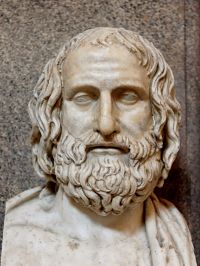 Euripides,
The Plays of Euripides
(1910)
Euripides,
The Plays of Euripides
(1910)
“ Aged retainer of my father Erechtheus while yet he lived and saw the light of day, mount to the god's prophetic shrine that thou mayst share my gladness, if haply Loxias, great king, vouchsafe an answer touching my hopes of offspring; for sweet it is to share with friends prosperity, and sweet likewise to see a friendly face if any ill betide,—which God forbid! As thou of yore didst tend my sire, so now, thy mistress though I am, I take his place in tending thee. ”