Erie Railroad
Definition and stakes
The Erie Railroad, a crucial 19th-century American railway, linked New York City to Lake Erie and later expanded westward to Chicago, transforming the economic landscape of New York’s Southern Tier. Authors such as John Moody emphasized its advancement and the discussions surrounding canals versus railroads, while Mark Twain made remarks about its safety record.
Thomas Curtis Clarke pointed out the railroad’s challenges in overcoming artificial boundaries, underscoring its role in bridging regional divides. The Erie’s legacy persists in today’s rail systems, with its historic routes now forming part of Norfolk Southern’s infrastructure, illustrating its lasting impact on transportation and regional growth.
Quotes about “Erie Railroad”
John Moody, The Railroad Builders: A Chronicle of the Welding of the States
“ It was not until 1836, when work was begun on the Erie Railroad, that a plan was adopted for a single line reaching several hundred miles from an obvious point, such as New York, to an obvious destination, such as Lake Erie. Even then a few farsighted men could foresee the day when the railroad train would cross the plains and the Rockies and link the Atlantic and the Pacific. Yet, in 1850 nearly all the railroads in the United States lay east of the Mississippi River, and all of them, even when they were physically mere extensions of one another, were separately owned and separately managed. ”
The History of Orange County New York
“ The streets were frequently blocked for hours with farmers' loaded wagons. The completion of the Erie canal diverted the most of this trade, and later the Delaware and Hudson canal cut off another source of wealth. Then the construction of the Erie Railroad from Goshen to Piermont, and its subsequent extension in other directions, finished the old transportation business of Newburgh, and it has taken many years to bring about the present prosperity, with railroads extending from many directions, large and varied manufactures, superior public institutions and other conditions to correspond. ”
John Moody, The Railroad Builders: A Chronicle of the Welding of the States
“ But the idea still held sway over the minds of many people; and the great benefits brought to the Mohawk Valley and surrounding country by the Erie Canal led the southern counties to demand a transportation route which would work similar wonders in that region. This growing sentiment finally persuaded the Legislature to charter in April, 1832, the New York and Erie Railroad Company, and to give it authority to construct a line and to regulate its own charges for transportation. ”
Various, The International Magazine, Volume 4…
“ Here and there is to be found an exception, however, to this rule; portions of the Erie railroad, and the whole of the Hudson River, as well as that along the Rhine, necessarily possessing the advantage of sharing in the sublimity and grace through which they pass. Time will, of course, remedy the defects of the whole arrangement; and a new front will be presented, as it may be, to the traveller throughout the civilized world. Whether human ingenuity will yet succeed in inventing substitutes for the smoke and other unpleasant appliances of a railroad train, remains to be seen ”
John Moody, The Railroad Builders: A Chronicle of the Welding of the States
“ The champions of artificial waterways would point in contrast to the beautiful packet boats on the Erie Canal, with their fine sleeping rooms, their restaurants, their spacious decks on which the fine ladies and gentlemen congregated every warm summer day, and would insist that such kind of travel was far more comfortable than it could ever be on railroads. To all these pleas the advocates of the railroad had one unassailable argument—its infinitely greater speed. ”
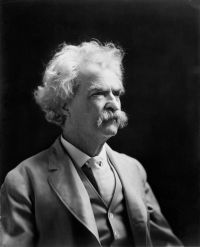 Mark Twain,
The Entire Project Gutenberg Works of Mark Twain
Mark Twain,
The Entire Project Gutenberg Works of Mark Twain
“ The Erie railroad kills 23 to 46; the other 845 railroads kill an average of one-third of a man each; and the rest of that million, amounting in the aggregate to that appalling figure of 987,631 corpses, die naturally in their beds!You will excuse me from taking any more chances on those beds. The railroads are good enough for me. ”
John Moody, The Railroad Builders: A Chronicle of the Welding of the States
“ The canal, it was urged, was not an experiment; it had been tested and not found wanting; already the great achievement of De Witt Clinton in completing the Erie Canal had made New York City the metropolis of the western world. The railroad, it was asserted, was just as emphatically an experiment; no one could tell whether it could ever succeed; why, therefore, pour money and effort into this new form of transportation when the other was a demonstrated success? It was a simple matter to find fault with the railroad; it has always been its fate to arouse the opposition of the farmers. ”
William Nowlin, The Bark Covered House
“ I said if the cars ran through our native place, we could go back there without crossing Lake Erie, the thought of which chilled me every time I spoke to mother about going back to make a visit. Time sped on, days, months, and some years had passed, since the first of the Michigan Central Railroad was built, and the cars running east and west loaded with passengers and freight, when one morning I heard a strange noise. ”
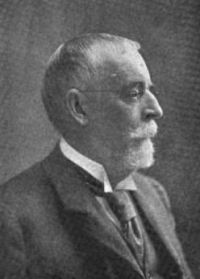 Thomas Curtis Clarke,
The American Railway: Its Construction…
Thomas Curtis Clarke,
The American Railway: Its Construction…
“ It is hard for us to realize that our business ideas were ever thus confined by artificial boundaries; but if we wish proof, we have only to look at the original location of the Erie Railway from Piermont to Dunkirk. Both were unnatural and undesirable terminal points; but people were willing to submit to inconvenience and to actual loss in order that the railroad might run as far as the New York State limits would allow, and not one whit farther. Similar instances can be found in other States. Hard as it is to understand, there seems to have been a positive jealousy of interstate traffic. ”
Edward Hungerford, The Modern Railroad
“ The American resents too much being done for him; he is instinctively jealous of his individuality.Away back in the long-ago the Erie created a railroad town at Susquehanna in the extreme north part of Pennsylvania. It built shops there and soon after repeated the experiment at Hornellsville in the southwestern part of New York State. The Baltimore & Ohio Railroad similarly developed Cumberland, Maryland; and the Lake Shore, Elkhart, Ind. These are few of many instances where a great railroad shop has served to develop a sizable town. ”
John Moody, The Railroad Builders: A Chronicle of the Welding of the States
“ The establishment of five great railroads extending continuously from the Atlantic seaboard to Chicago and the West was perhaps the most remarkable economic development of the ten or fifteen years succeeding the war. By 1875 these five great trunk lines, the New York Central, the Pennsylvania, the Erie, the Baltimore and Ohio, and the Grand Trunk, had connected their scattered units and established complete through systems. ”
John Morison Copeland, The Trail of the Swinging Lanterns
“ Warman, engineer, Denver reporter, publicist and successful writer of railroading prose and verse—once with “G.T.R.” advertising department—died in Chicago this date.1914, July 24—A century of locomotive use was appropriately celebrated when a 410 ton “Centipede” engine of the Erie Railroad pulled 250 loaded cars, weighing 21,000 tons, a distance of 40 miles at 15 miles per hour. HANDY ANDY“Can you run an engine,” said the yardmaster to Martin Maguire?“Can I run an engine,” sniffed the bold Hibernian; “there’s nothing I’d rather do than run a lokeymootive all day long. Huh! ”
C. G. Hine, Woodside, the North End of Newark…
“ The Erie had leased the Paterson, Newark & New York Railroad, which was opened in 1868 and connected with the Newark & Hudson Railroad to Jersey City, also leased to the Erie. This promised blessing was slow in coming, for at least three years elapsed before the New York connection was made, and in the meantime those whose business called them to the greater city must take the occasional horse car or walk to the D., L. & W. (which in those days stood for “Delay, Linger and Wait”) .The Erie has ever been to a Woodsider as a red rag to a bull. ”
Edward Hungerford, Our Railroads To-Morrow
“ Some of the roads, beginning with the Erie, have gone so far as to rent their repair-shops at division points for operation by privately organized corporations. In fact the Erie has gone so far as to follow this practice for its track maintenance in certain instances. A private corporation is bound neither by the national agreements of the Railroad Administration or by the rulings of the Railroad Labor Board out at Chicago. It can buy its labor in the open market and at the prevailing market prices—and at the present moment at obvious savings. ”
Edward Hungerford, The Modern Railroad
“ But when the railroad began to stretch itself and to be a thing of reaches, it was found advisable to run trains at night in order to make quick communication between distant points. Travelling at night in the crude coaches of the early railroads was an abominable thing, and before the forties the old Cumberland Valley Railroad was operating some crude sort of sleeping-cars. Within another decade there was much experimenting of this sort. Old-timers on the Erie still remember the sleeping-cars that were built on that road soon after the close of the Civil War. ”
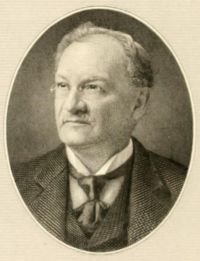 Joel Cook,
America, Volume 4 (of 6)
Joel Cook,
America, Volume 4 (of 6)
“ The Erie Railway, coming 367 eastward by a wild and lonely route across the Allegheny ranges, goes down the pretty Canisteo Valley to Hornellsville, a purely railroad town of twelve thousand people, which has grown up around the shops and stations. ”
John Moody, The Railroad Builders: A Chronicle of the Welding of the States
“ Canals might indeed linger for a time as feeders, even, as in the case of the Erie and a few others, as more or less important transportation routes, but every one now realized that the railroad was to be the great agency which would give plausibility to the industrial organization of the United States and develop its great territory. ”
Edward Hungerford, The Story of the Rome, Watertown…
“ That, in itself, was a real job. For years the D. L. & W. had terminated at Great Bend, a few miles east of Binghamton, and had used trackage rights upon the Erie from there West, not only into the Buffalo [Pg 135] gateway, but also to reach its branch-line properties into Utica, Rome, Syracuse and Ithaca. Sloan finally had quarreled with the Erie—it was a way he ofttimes had. And, for once at least, had made a bold strategic move through to the far end of the Empire State.To build so many miles of railroad one must have rail. ”
Charles Francis Adams, Notes on Railroad Accidents
“ A collision very similar to that at Camphill occurred upon the Erie railway at a point about 20 miles west of Port Jervis on the afternoon of July 15, 1864. The train in this case consisted of eighteen cars, in which were some 850 Confederate soldiers on their way under guard to the prisoner's camp at Elmira. ”
Various, Chambers's Edinburgh Journal, No…
“ The trains go very fast, but it is a superb road, and very safe, as the servants of the company, with their flags and lanterns, line the road the whole distance. They have twenty trains a day. The Erie Railway is also finished from New York to Lake Erie ”
Edward Hungerford, The Modern Railroad
“ Culverts have been laid for each small run or kill or creek; the bridge-builders along the new line finish their work and cart off their kits; the day comes when there is an unbroken railroad from one end of the new line to the other. It links new rails and new towns; its localities produce for new markets, commerce from strange quarters pours down upon the land that has known it not. Passenger trains begin regular operation, the fresh-painted depots are brilliant in their newness, the shriek of the locomotive sounds where it has never before sounded. ”
William Francis Bailey, The Story of the First Trans-Continental Railroad
“ On shot the locomotive, like an arrow from the bow, the men throwing over the ties until the train was well nigh unloaded, when just as they were close to the curve by which the train arrives at the station, they saw the dreaded cars strike a tie, or something equally of service, and with a desperate plunge rush down the embankment, some fifteen feet, to the little valley, and creek below. ”
Samuel Irenæus Prime, The Alhambra and the Kremlin: The South and the North of Europe
“ All the passengers are requested to walk. In single file we march over the bridge, and then await the train. It comes across, lightened of its load, slowly and safely. It is quite likely that in America the engineer would have put on all steam, and dashed across in a second, or, if not, he would have gone down a hundred feet, into a frightful chasm, and the verdict, if any were sought, would have been, “nobody to blame.” Fret as we do about the railroad management in Europe, it is safer and surer than ours. ”
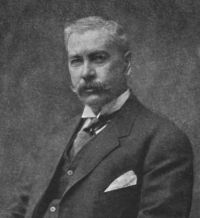 Cy Warman,
The Express Messenger, and Other Tales of the Rail
(1897)
Cy Warman,
The Express Messenger, and Other Tales of the Rail
(1897)
“ Engine the 107 was not rebuilt for a long time and was never again employed in passenger service. The foreman in one of the repair shops wrote to Philadelphia and learned that the 109 was completed on Thursday and the 107 on Friday. As I said a while ago, railroad employees are not superstitious,—they will all tell you so,—much less railway officers; but it is a fact to-day that a new locomotive or a locomotive that has been rebuilt is never taken out on the Denver and Rio Grande on Friday. ”
William Francis Bailey, The Story of the First Trans-Continental Railroad
“ At the time he was writing, 1835, there were seven hundred and ninety-seven miles of railroads in operation in the United States. Passenger coaches were patterned after the old stage coach, the track iron straps on wooden stringers, yet here he was outlining what today is an accomplished fact. A railroad with stone ballast from Chicago to the South Pass (Granger, Wyo.) one branch diverging from there to the mouth of the Columbia, (Portland, Ore.,) the other to California, (San Francisco and Los Angeles, Cal.,) traversed by trains comprised of sleeping cars, dining cars and buffet cars. ”
D. Dalziel, A Parody on Patience
“ HOHOKUS, ERIE RAILWAY.The scenery along the entire line of the New York, Lake Erie and Western R.R. (formerly Erie Railway) has a world-wide reputation for beauty. The line itself possesses unequaled facilities for transit of through passengers over its steel rail double track, in Pullman Hotel, Sleeping and Drawing-room Coaches, equipped with Miller Platform Buffer and Westinghouse Automatic Air Brake. It is a booming route for New York and other eastern cities. Try it.JNO. N. ABBOTT, W. H. HURLBURT, General Passenger Agent, New York. Gen'l Western Passenger Agent, Chicago. ”
Edward Hungerford, Our Railroads To-Morrow
“ One of the most important of the eight railroads entering New York from the west, from a freight traffic point of view, at least, is the Erie. Despite a fearful heritage of financial obligations incurred during its maladministration of half a century ago, it is a remarkably progressive property in its operating methods. Poverty and the consequent need for extreme [Pg 230] economy have forced it into many ingenious and highly practical operating kinks. ”
Willis Fletcher Johnson, "My country, 'tis of thee!"
“ Any man who should have told these pioneers of the railway world that the United States would possess in the year 1889 a hundred and sixty thousand miles of railroad, enough to belt the world seven times at the Equator, would have been regarded as a lunatic. ”
Edward Hungerford, The Modern Railroad
“ The third division is the Junction shops, where the new locomotives are built; 1,800 men are employed within it, and there men take the new castings and forgings (most of the castings coming up from the giant foundries that we have just noticed) , and from them they create that almost human thing, the railroad locomotive. When the [Pg 396] locomotive emerges from that shop it takes its turn upon the testing-table, the mechanical experts place their final stamp of approval upon it, and at last it goes out from the shop, under its own steam, to perform the great work for which it was created. ”
Edward Hungerford, The Modern Railroad
“ The familiar Maryland, which is operated jointly by the New Haven and the Pennsylvania systems upon this route, will receive an entire passenger train of ordinary length, excepting, of course, the locomotive, upon her great deck, which is, in reality, a miniature railroad yard, equipped with two long parallel tracks that can be quickly attached to the ferry-bridges at Port Morris and Jersey City. The trip, with the loading and unloading of the train, is accomplished, under favorable weather conditions, in about an hour. ”
 Alice Morse Earle,
Stage-coach and Tavern Days
Alice Morse Earle,
Stage-coach and Tavern Days
“ The first railway in America was the Quincy Railroad, or the “Experiment” Railroad, built to carry stones to Bunker Hill Monument. A tavern-pitcher, commemorative of this Quincy road, is shown here. Two views of the Baltimore and Ohio Railroad, printed on plates and platters in rich dark blue, are familiar to china collectors. One shows a stationary engine at the top of a hill with a number of little freight cars at a very singular angle going down a steep grade. The other displays a primitive locomotive with coachlike passenger cars.All the first rail-cars were run by horse-power. ”
Related terms
Authors who wrote about “Erie Railroad”
 Frank ParsonsThomas Curtis ClarkeCharles Francis AdamsJohn Morison CopelandD. DalzielAlbert W. Harris
 Charles De Lano HineMary EltingWilliam Francis Bailey
 John Marshall HarlanWillis Fletcher JohnsonVarious
 Henry David ThoreauMark Twain
 Holman DayWilliam NowlinSara Ware Bassett
 Archibald Clavering Gunter