“ My father Eurytus, as I have said, was the king of archers; for no man could draw an arrow with so unerring aim as he, and no man could send it straight to the mark with a more deadly force. Every thought of his waking hours was upon his bow, and he aspired to excel even the archery of Artemis and Apollo. At length he sent a challenge into every city of Hellas: 'Whosoever will excel Eurytus in shooting with the bow and arrows, let him come to Œchalia, and try his skill. ”
Quotes about “Eurytus”
Homer,
The Odyssey of Homer, with the Hymns…
(1853)
“ Philoctetes indeed alone excelled me with the bow, amongst the people of the Trojans, where we Greeks used our bows. But of the others I say that I am far the best, as many as are now mortals eating food upon the earth. But I am not willing to contend with former men, neither with Hercules, nor Eurytus the Œchalian, who contended even with the immortals about bows: therefore mighty Eurytus died immediately, nor did he attain to old age in his palace; for Apollo, wrath with him, slew him, because he challenged him to a contest of archery. ”
W. E. Gladstone,
Studies on Homer and the Homeric Age…
“ But the name Eurytus was one current among the descendants of Actor [838] , for a descendant of Actor who bore it is named in the Catalogue a little below: and this latter Eurytus was an Epean chief: and the descendants of Actor are found in the Epean or Elian army of the Eleventh Book. (xi. 709, 739.) Again, they are found in Thessaly or Phthiotis, for when Mercury had deflowered Polymele, the daughter of Phylas a Thessalian, Echecles, a descendant of Actor, married her; and yet again, they are found near Aspledon [839] and the Minyeian Orchomenos, between Bœotia and Phocis [840] . ”
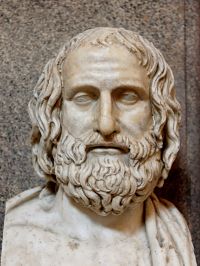
Euripides,
The Tragedies of Euripides — Orestes
(1898)
“ Orestes. Thy mother thou slew'st not, as I—woe's me? Pylades. I shared thy deed, thy sufferings must I share. Orestes. Restore thee to thy sire; die not with me.1075 Thou hast a city,—none to me is left,— A father's home, a haven wide of wealth. Thou canst not wed this maiden evil-starred Whom I for friendship's sake betrothed to thee. Yet take thee another bride and rear thee sons:1080 The looked-for tie 'twixt thee and me is not. Now, O dear name of my companionship, Farewell!—not this for us, perchance for thee: For us, the dead, is no glad faring-well! ”
Euripides,
Electra
(1913)
“ Orestes. Thy mother stays Unmoved 'mid all thy wrong? Electra. A lover weighs More than a child in any woman's heart. Orestes. But what end seeks Aegisthus, by such art Of shame? Electra. To make mine unborn children low And weak, even as my husband. Orestes. Lest there grow From thee the avenger? Electra. Such his purpose is: For which may I requite him! Orestes. And of this Thy virgin life—Aegisthus knows it? Electra. Nay, We speak it not. It cometh not his way. Orestes. These women hear us. Are they friends to thee? Electra. ”
Euripides,
The Tragedies of Euripides — Orestes
(1898)
“ Orestes! Life, not death, had been thy due.1030 Orestes. Ah, by the Gods, I pray, unman me not, Nor bring to tears by mention of our woes. Electra. We die! I cannot but bemoan our fate. All mortals grieve for precious life foregone. Orestes. This is our day of doom: the noose must coil1035 About our necks, or our hands grasp the sword. Electra. Brother, thou slay me, that no Argive slay, With outrage foul to Agamemnon's child. Orestes. Suffice the mother's blood: I will not slay thee. Die in what wise thou wilt by thine own hand.1040 Electra. ”
Euripides,
The Tragedies of Euripides — Electra
(1896)
“ The spring is from yon cot. I at the dawn Will drive my team afield and sow the glebe. None idle—though his lips aye prate of Gods— 80 Can gather without toil a livelihood. [Exeunt Peasant and Electra. Enter Orestes and Pylades. Orestes. Pylades, foremost thee of men I count In loyalty, love, and friendship unto me. Sole of Orestes' friends, thou honouredst me In this my plight, wronged foully by Aegisthus, 85 Who, with my utter-baneful mother, slew My sire. At Phœbus' oracle-hest [2] I come To Argos' soil, none privy thereunto, To pay my father's murderers murder-wage. ”
Euripides,
The Tragedies of Euripides — Orestes
(1898)
“ Hears this, who lies 'neath earth, that over thee675 His spirit hovers: what I say he saith. This, urged with tears, moans, pleas of misery, Have I said, and have claimed my life of thee, Seeking what all men seek, not I alone. Chorus. I too beseech thee, woman though I am,680 To succour those in need: thou hast the power. Menelaus. Orestes, verily I reverence thee, And fain would help thee bear thy load of ills. Yea, duty bids that, where God gives the power, Kinsmen should one another's burdens bear,685 Even unto death, or slaying of their foes. ”
Euripides,
The Tragedies of Euripides — Orestes
(1898)
“ Electra. Dearest, who bear'st a name desirable1045 And sweet on sister's lips!—one soul with mine! Orestes. Ah, thou wilt melt me! Fain would I reply With arms of love! Wretch, wherefore shame I now? Ah, sister-bosom, dear embrace to me! In children's stead, instead of wedded arms,1050 This farewell to the hapless is vouchsafed. Electra (sighs) . Oh might the selfsame sword, if this may be, Slay us, one coffin cedar-wrought receive! Orestes. Most sweet were this: yet, how forlorn of friends Thou seest are we, who cannot claim one tomb!1055 Electra. ”
Euripides,
The Tragedies of Euripides — Electra
(1896)
“ Howbeit this man, being full of loyalty to the mighty dead and reverence for blood royal, behaved himself to her as to a queen, so that she continued virgin in his house all the days of her adversity. Now when Orestes was grown to man, he journeyed with Pylades his friend to Argos, to seek out his sister, and to devise how he might avenge his father, since by the oracle of Apollo he was commanded so to do. ”
Euripides,
Electra
(1913)
“ She is fighting tremulously, with all her flagging strength, against the thing she longs for. The whole point of the scene requires that one ray of hope after another should be shown to Electra, and that she should passionately, blindly, reject them all. That is what Euripides wanted the signs for. But why, it may be asked, did he adopt Aeschylus' signs, and even his peculiar word? Because, whether invented by Aeschylus or not, these signs were a canonical part of the story by the time Euripides wrote. Every one who knew the story of Orestes' return at all, knew of the hair and the footprint. ”
Euripides,
The Plays of Euripides
(1910)
“ A generous scheme is thine, but impossible. 'Tis not in quest of thee yon king comes marching hither; what would Eurystheus gain by the death of one so old? Nay, 'tis these children's blood he wants. For there is danger to a foe in the youthful scions of a noble race, whose memory dwells upon their father's wrongs; all this Eurystheus must foresee. But if thou hast any scheme besides, that better suits the time, be ready with it, for, since I heard that oracle, I am at a loss and full of fear. ”
Euripides,
The Tragedies of Euripides — Orestes
(1898)
“ Orestes. Pylades, sharer in my mother's blood. Menelaus. And by what phantom-shapes thus art thou plagued? Orestes. Methought I saw three maidens like to night. Menelaus. I know of whom thou speak'st, but will not name. Orestes. They are Dread Ones: wise art thou to name them not.410 Menelaus. Do these by blood of kindred madden thee? Orestes. Woe for their haunting feet that dog me aye! Menelaus. For dread deeds sufferings dread—not strange is this. Orestes. Yet can I cast my burden of affliction— Menelaus. ”
Euripides,
The Tragedies of Euripides, Volume I
“ For since their father was removed from the earth, first Eurystheus wished to kill me, but I escaped; and my country indeed is no more, but my life is saved, and I wander in exile, migrating from one city to another. For, in addition to my other ills, Eurystheus has chosen to insult me with this insult; sending heralds whenever on earth he learns we are settled, he demands us, and drives us out of the land; alleging the city of Argos, one not paltry either to be friends with or to make an enemy, and himself too prospering as he is ”
Dorothy Mills, The book of the ancient Greeks (1925)
“ In the Electra and in Iphigenia in Tauris, [32] Euripides deals with the familiar tragedy of Orestes, pursued by the Furies after the murder of his mother, and in the Alcestis he tells the old tale of how a noble woman was willing to sacrifice her life for that of a selfish husband, and of how she was brought back from the gates of Hades by Heracles. The strength of Euripides lies in his wonderful portrayal of character. He judges his characters by the standards of the men and women of his own day and not by those of the gods and heroes, and he is a merciless critic. ”
Euripides,
The Tragedies of Euripides — Orestes
(1898)
“ Phrygian. Everywhere shall wise men better love to cling to life than die. Orestes. Didst thou not to Menelaus shout the rescue-cry but now?1510 Phrygian. Nay, O nay!—but for thine helping cried I:—worthier art thou. Orestes. Answer—did the child of Tyndareus by righteous sentence fall? Phrygian. Righteous—wholly righteous—though she had three throats to die withal. Orestes. Dastard, 'tis thy tongue but truckles: in thine heart thou think'st not so. Phrygian. Should she not, who Hellas laid, and Phrygia's folk, in ruin low?1515 Orestes. ”
Euripides,
The Tragedies of Euripides — Orestes
(1898)
“ Orestes. Pardoned art thou.1525 Phrygian. Kindly dost thou say. Orestes. Varlet, mine intent may change!— Phrygian. Thou utterest now an evil note! [Exit. Orestes. Fool! to think that I would brook with blood to stain me from thy throat, Who art neither woman, neither found the ranks of men among! Forth the palace I but came to curb the clamour of thy tongue, For that swiftly roused is Argos if the rescue-cry she hear.1530 Menelaus—set him once at sword-length—nothing do I fear. Hence with him, [41] with golden locks whose pride about his shoulders falls! ”
Euripides,
The Tragedies of Euripides — Orestes
(1898)
“ Pylades. That I helped thee slay thy mother, this he names an impious thing. Orestes. Woe is me! the anguish of mine anguish unto thee must cling! Pylades. I am not a Menelaus: these afflictions must I bear. Orestes. Fear'st thou not lest Argos doom thee with my deed my death to share?770 Pylades. I belong not unto them to punish, but to Phocis-land. Orestes. Fearful is the people's rage, when evil men its course command. Pylades. Nay, but when they take them honest chiefs, they counsel honest rede. Orestes. Come, let thou and I commune— [22] Pylades. ”
Euripides,
The Plays of Euripides
(1910)
“ But they have come hither, either because they perceived some folly in thee, or, in their perplexity, staking all on one risky throw to win or lose; for surely they do not suppose that thou, if so thou hast thy senses still, and only thou, in all the breadth of Hellas they have traversed, wilt pity their foolish troubles. Come now, put argument against argument: what will be thy gain, suppose thou admit them to thy land, or let us take them hence? From us these benefits are thine to win: this city can secure as friends Argos, with its far-reaching arm, and Eurystheus' might complete ”
Euripides,
The Tragedies of Euripides, Volume I
“ Give me up to the Argives instead of them, O king, and so neither run any risk yourself, and let the children be saved for me; I must not love my own life, let it go; and above all, Eurystheus would like taking me, the ally of Hercules, to insult me; for he is a froward man; and the wise should pray to have enmity with a wise man, not with an ignorant disposition, for in that case one, even if unfortunate, may meet with much respect. ”
Euripides,
The Tragedies of Euripides, Volume I
“ CHOR. Depart thou; and do not you touch him, O king!COP. I go; for the struggle of a single hand is powerless. But I will come, bringing hither many a brazen spear of Argive war; and ten thousand shield-bearers await me, and Eurystheus, the king himself, as general. And he waits, expecting news from hence, on the extreme confines of Alcathus; and, having heard of your insolence, he will make himself too well known to you, and to the citizens, and to this land, and to the trees; for in vain should we have so much youth in Argos, if we did not chastise you. ”
Euripides,
The Tragedies of Euripides — Orestes
(1898)
“ Nay, nay, this task is mine no less than thine. Since we shall surely die, debate we now How Menelaus too may share our woe. Orestes. Dear friend, would I could look on this, and die!1100 Pylades. Hearken to me, and that sword-stroke defer. Orestes. I wait, if so I avenge me on my foe. Pylades (pointing to Chorus) . Speak low!—I put in women little trust. Orestes. Fear not for these: all here be friends to us. Pylades. Slay Helen—Menelaus' bitter grief!1105 Orestes. ”
Euripides,
The Tragedies of Euripides — Orestes
(1898)
“ Then, if Menelaus, lest his daughter die,1195 Will save thee, seeing Helen fallen in blood, Yield to her sire's embrace the maiden's form. But if, controlling not his furious mood, He seek to slay thee, pierce the maid's neck through. I ween, though swelling be his port at first,1200 His wrath at last shall cool. Nor brave nor stout By nature is he. This I find for us The bulwark of deliverance. I have said. Orestes. O thou who hast the spirit of a man, Albeit in body woman manifest, [36] 1205 How worthier far art thou to live than die! Such woman, Pylades, shalt thou, alas! ”
Euripides,
The Tragedies of Euripides — Electra
(1896)
“ How?—hath ruth seized thee, seeing thy mother's form? Orestes. Woe! How can I slay her—her that nursed, that bare me? Electra. Even as she thy father slew and mine. 970 Orestes. O Phœbus, folly exceeding was thine hest— Electra. Nay, where Apollo erreth, who is wise? Orestes. Who against nature bad'st me slay my mother! Electra. How art thou harmed, avenging thine own sire? Orestes. Arraigned for a mother's murder—pure ere this! 975 Electra. Yet impious, if thou succour not thy sire. Orestes. My mother for her blood must I requite. [32] Electra. ”
Euripides,
The Tragedies of Euripides — Iphigeneia in Taurica
(1898)
“ I deem it is, Orestes, as must thou. Orestes. And the altar, overdripped with Hellene blood? Pylades. Blood-russet are its rims in any wise. Orestes. And 'neath them seest thou hung the spoils arow? Pylades. Yea, trophies of the strangers who have died.75 But needs must we glance round with heedful eyes. Orestes. Phœbus, why is thy word again my snare, When I have slain my mother, and avenged My sire? From tired Fiends Fiends take up the chase, And exiled drive me, outcast from my land,80 In many a wild race doubling to and fro. ”
Euripides,
The Tragedies of Euripides — Electra
(1896)
“ Electra. Then seek my mother, and my message tell. Old Man. Yea, it shall seem the utterance of thy lips. Electra (to Orestes) . Now to thy work. Thou drewest first blood-lot. [18] Orestes. I will set forth if any guide appear. Old Man. Even I will speed thee thither nothing loth. 670 Orestes. [19] My fathers' God, Zeus, smiter of my foes, Pity us: pitiful our wrongs have been. Electra. Ah, pity them whose lineage is of thee! Orestes. Queen of Mycenæ's altars, Hera, help! Grant to us victory, if we claim the right. 675 Electra. ”
Padraic Colum,
The Adventures of Odysseus and The Tales of Troy
“ All assented to the King's words, and Euryalus went to Odysseus and said, 'Stranger, if I have spoken aught that offended thee, may the storm winds snatch it and bear it away. May the gods grant that thou shalt see thy wife and come to thine own country. Too long hast thou endured afflictions away from thy friends.'So saying, Euryalus gave Odysseus a sword of bronze with a silver hilt and a sheath of ivory. Odysseus took it and said, 'And to you, my friend, may the gods grant all happiness, and mayst thou never miss the sword that thou hast given me. ”
Gilbert Murray,
Euripides and His Age
(1913)
“ They fly to their spears. But Telephus has snatched up the baby prince, Orestes, from his cradle and stands at bay; if one of his enemies moves the child shall die. Eventually they accept his terms and make peace with him. A fine melodrama, one would guess, and a move in the direction of realism—a direction which Euripides only followed within certain strict limits. But we find two marks of Euripides the philosopher. The beggar who pleads for reasonable justice towards the national enemy strikes a note which Euripides himself often had to sound afterwards. ”