“ The largest stock exchange of the world is that of London. It is not only the centre of the English market for stocks and securities but, like the Bank of England, it is linked internationally with nearly all the financial centres of the world. Almost every reputable security is marketable in London, either through the ordinary channels provided by arbitrage dealers, who buy in the cheaper and sell in the dearer markets, or through the agency of trusts and investment concerns. The magnitude and extent of the financial resources of the London Stock Exchange are enormous. ”
London Stock Exchange
Definition and stakes
The London Stock Exchange (LSE), founded in 1801, serves as a global financial center based in the City of London, celebrated for its historical importance and substantial market capitalization. Writers like John Timbs praised its unmatched reliability in international finance, while Charles Duguid observed its modest appearance concealing its immense impact.
Otto H. Kahn underscored its function as a worldwide securities market, connecting economies across the globe. The LSE’s development—from trading in coffee houses to becoming a regulated entity—demonstrates its lasting flexibility, reinforcing its role as a fundamental pillar of global capital movements.
Quotes about “London Stock Exchange”
John Timbs,
Knowledge for the Time
“ Yet, it is an established fact, that, abroad and at home, all parties having large financial operations, approach the London Stock Exchange with more confidence than any other money-market in the world. ”
Charles Duguid, The Stock Exchange
“ THE MARKET-PLACE The market-place, where the dealing in this mass of securities is carried on, is by no means of imposing appearance from the exterior point of view. Of all the Stock Exchanges, Bourses, and Bolsas throughout the country and the world, the London Stock Exchange makes, perhaps, the least exterior show. The tourist often seeks it in vain, and thousands of Londoners pass it every day without knowing that behind the suites of offices, with their Portland-stone walls relieved by granite, is hidden the mighty market-place. ”
Benjamin M. Anderson, The Value of Money
“ The multiplicity of items dealt in gives stability to that business which deals with all—the banking business. The London Stock Exchange is no provincial affair, easily demoralized by an adverse rate decision! ”
Otto H. Kahn,
The New York Stock Exchange and Public Opinion
“ One of the reasons for London's financial world position is that its American opportunity for foreign tradeStock Exchange affords a market for all kinds of securities of all kinds of countries. The English Stock Broker's outlook and general or detailed information range over the entire inhabited globe. It is largely through him that the investing or speculative public is kept advised as to opportunities for placing funds in foreign countries. He is an active and valuable force in gathering and spreading information and in enlisting British capital on its world-wide mission. ”
William C. Van Antwerp, The Stock Exchange from Within
“ One important respect in which the London Stock Exchange differs from all others—American, Continental, or Provincial—is the division of its members into two classes, jobbers and brokers, a division that appears to be as old as the Exchange itself. As to which of these classes it is better to belong there are differences of opinion, but the wise men in the business seem to be a unit in recommending a few years’ experience as a broker to be followed by the business of the jobber. ”
John Maynard Keynes,
The General Theory of Employment…
(1936)
“ That the sins of the London Stock Exchange are less than those of Wall Street may be due, not so much to differences in national character, as to the fact that to the average Englishman Throgmorton Street is, compared with Wall Street to the average American, inaccessible and very expensive. ”
William C. Van Antwerp, The Stock Exchange from Within
“ From this it will be seen that a man who wants to become a member of the London Stock Exchange without first serving an apprenticeship of four years as clerk must pay for his entrance fee 500 guineas, his shares £570, his nomination £40, and his annual dues 40 guineas, or a total of about £1150, of which £570, the price of his shares, yields him a return in Stock Exchange dividends. ”
E. Phillips Oppenheim,
Mr. Grex of Monte Carlo
“ Several thousands of our merchants are in business there, and prospering. Several hundreds of our shrewdest men of affairs are making fortunes upon the London Stock Exchange. Therefore, we do not wish to conquer England. Commercially, that conquest is already affected. I want you, Monsieur Douaille, to absolutely understand this, because it may affect your views. ”
William C. Van Antwerp, The Stock Exchange from Within
“ He avoids this loss by instructing a jobber to contango or carry-over the securities until the following account day. On the other hand, if the broker is certain that his client has purchased his securities for a long pull on a margin basis, he will often pay for the stock himself, transfer it to his own name, and willingly submit to the government tax, knowing that he can recover the outlay from the handsome rate of interest charged the client.Another vital point of difference between the London and the New York Stock Exchange lies in the nature and volume of the business done. ”
of the Bank of England John Francis, Chronicles and characters of the stock exchange (1850)
“ He immediately took the omnium to other brokers, represented to them an urgent necessity for money, sold it, and having been paid checks for the amount, immediately presented them to the bankers on whom they were drawn, and received the amount in cash. He then went to all whom he knew, or would trust him, borrowed money on the security of his own checks,—a common practice on the Stock Exchange,—with remarkable boldness, remained in London until near the hour when he knew his own draught would be presented and refused, and then left, laden alike with gold and a guilty conscience. ”
William C. Van Antwerp, The Stock Exchange from Within
“ With these examples before them, members of Exchanges everywhere must realize that if it lies within their power to discountenance and350 discourage foolhardy ventures into speculation by persons ill-equipped to undertake them it is their plain duty to do so. The London Stock Exchange’s system of fortnightly settlements clearly does not aim at this highly desirable object as well as the method of daily settlements employed in New York, for it requires no student to see that by postponing the settlement risks will be incurred that would be impossible if a reckoning were called for each day. ”
Chester Arthur Phillips, Readings in Money and Banking
“ The funds that they so use obviously have an important effect upon the marketability and price of securities in London. On the first day of every settlement it is usual to see rates quoted as those at which the banks are lending to their stock exchange clients for the financing of speculative commitments. ”
Franklin Escher, Elements of Foreign Exchange: A Foreign Exchange Primer
“ Under the stimulus of some favorable development, for instance, which becomes known here only after the Stock Exchanges abroad are closed for the day, the New York market closes buoyant. The chances are that the receipt of the news abroad over night will make the London market open up strong in the morning. To buy stock right at the closing of the market here for the purpose of selling it out next morning in London at the opening is an operation not without risk, but one which is likely to make money. ”
Henry Warren, Banks and Their Customers
“ There is no occasion to let the banker see the move.In London and the great cities a large proportion of the deposits at interest, especially during periods of depression, would represent capital temporarily withdrawn from trade, and awaiting either more profitable investment or an increased demand and rising prices. It is this accumulation of idle capital that tempts the company-promoter from his lair, and sometimes results in a Stock Exchange boom, whilst it always produces an increased demand for the so-called gilt-edged variety of securities and a consequent rise in their price. ”
Chester Arthur Phillips, Readings in Money and Banking
“ It is impossible to exaggerate the importance of the functions which the bill brokers discharge in the London money market. They are only about twenty in number, including three joint stock companies. One or two of the brokers work on commission, as your brokers do, but the majority are really dealers in bills. That is, they buy or discount, and sell, or rediscount, bills of exchange. ”
Jack London,
War of the Classes
(1905)
“ In 1899 it had increased to 815,000,000 pounds,--an increase of 1200 per cent in the volume of trade.For nearly one hundred years England has been producing surplus value. She has been producing far more than she consumes, and this excess has swelled the volume of her capital. This capital has been invested in her enterprises at home and abroad, and in her shipping. In 1898 the Stock Exchange estimated British capital invested abroad at 1,900,000,000 pounds. But hand in hand with her foreign investments have grown her adverse balances of trade. ”
Arthur Crump, The Theory of Stock Exchange Speculation
“ In London all options are made at about the current market price, and the premium paid varies with the character of the stock and length of time, while in New York puts, calls, or spreads are generally so much above or below the market price, and the premium consequently much smaller than at London. ”
Harold Frederic,
The Market-Place
“ You see, this extraordinary development of dealing in our shares on the Stock Exchange has occupied my entire attention. There has been no time for arranging the machinery of operations on our property in Mexico. It's still there; it's all right. But for the time being, the operations in London are so much more important. We should have nothing to tell our shareholders, if we brought them together, except that their one-pound shares are worth fifteen pounds, and they know that already. ”
William C. Van Antwerp, The Stock Exchange from Within
“ The Bank of England had only just been called into existence, and, in fact, there were no bankers, no brokers, and no Stock Exchange in the modern sense of the word. A man who wished to invest, without personally employing his capital, had practically no choice but to buy property and let it out at a rent, or lend his money on mortgage. Bank of England Stock or National Debt had just begun to be a political speculation for the moneyed Whigs in London. Merchant venturers might risk a large sum in a joint-stock voyage. ”
Osbert John Radcliffe Howarth, Thomas Allan Ingram, and Henry Benjamin Wheatley, 1911 Encyclopædia Britannica, Volume 16… (1911)
“ The majority of the banks are members of the Clearing House, Post Office Court, where a daily exchange of drafts representing millions of pounds sterling is effected. The Royal Mint is on Tower Hill. The Stock Exchange is in Capel Court, and numbers of brokers have their offices in the vicinity of the Royal Exchange and the Bank of England. Manufactures and Retail Trade.—No part of London can be pointed out as essentially a manufacturing quarter, and there is a strong tendency for manufacturing firms to establish their factories outside the metropolis. ”
William C. Van Antwerp, The Stock Exchange from Within
“ A word should be said about the methods of London stockbrokers in carrying stocks for their customers, because this also is quite different from the practice in New York. Here the strongest houses rarely loan stocks, unless attracted by355 unusual rates of interest; in London it is the common practice of even the best houses to carry-over, or as we term it, loan, a great part of the commitments entered into during the account. ”
Stanley Portal Hyatt,
People of Position
“ In London, it is only foreigners and green-fruit brokers and such like doubtful people, with neither self-respect nor position to maintain, who break the City's law. Stockbrokers are, of course, men apart from the rest. [Pg 31] They draw most of their customers from a class which knows nothing of business; and must therefore be humoured; moreover, a little eccentricity, a lightheartedness, verging at times on the clownish, is useful, for, if duly reported, it procures the Stock Exchange a free advertisement in the Press. ”
Chester Arthur Phillips, Readings in Money and Banking
“ Besides the money that they habitually borrow for short periods from bankers, the discount houses also have considerable amounts placed on deposit with them by other lenders, some of which they employ, especially in times when the volume of bills is comparatively small, by loans to the Stock Exchange for financing the speculative commitments of the public, and by holding or carrying securities of a reasonably liquid character. They also take some part in the underwriting of new loans and in the general financial business of the London market. ”
Franklin Escher, Elements of Foreign Exchange: A Foreign Exchange Primer
“ The chance to buy a hundred shares of some stock, in London, for instance, and to sell it out at the same time in New York, at one-eighth or one-quarter more, is what the arbitrageurs are constantly on the lookout for. With the proper facilities, an expert, in the course of the hour during which the London and New York Stock Exchanges are simultaneously in session, is often able to put through a number of profitable trades. ”
Walter Thornbury, Old and New London, Volume I
“ The system of business at the Stock Exchange is thus described by an accomplished writer on the subject: "Bargains are made in the presence of a third person. The terms are simply entered in a pocket-book, but are checked the next day; and the jobber's clerk (also a member of the house) pays or receives the money, and sees that the securities are correct. There are but three or four dealers in Exchequer bills. Most members of the Stock Exchange keep their money in convertible securities, so that it can be changed from hand to hand almost at a moment's notice. ”
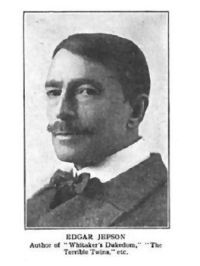
Edgar Jepson,
The Garden at No. 19 — Chapter
(1910)
“ I found that Tegean Corporations were occupying a good deal of the attention of the Stock Exchange. They had already reached twenty-six, and were still rising. All the flutterers in London were taking a flutter. I gave instructions to my stock broker to sell my thousand if they sank to twenty-four, and went back to my work, proudly conscious that my two hundred and eleven pounds were at any rate four hundred and fifty. At half-past three my broker telephoned me that the shares were at thirty-four shillings and advised me to sell. ”
Franklin Escher, Elements of Foreign Exchange: A Foreign Exchange Primer
“ And, as a matter of fact, many an operation in the international stocks is based upon judgment as to what the action of the exchange market portends. Similarly—the other way around—exchange managers very frequently operate in exchange on the strength of what they judge or know is going to happen in the market for the international stocks. With the exchange market sensitive to developments, knowledge that there is to be heavy selling in some quarter of the stock market, from abroad, is almost equivalent to knowledge of a coming sharp rise in exchange on London. ”
William C. Van Antwerp, The Stock Exchange from Within
“ The danger of the London fortnightly settlement system lies not in the deferred delivery of securities, but in the fortnightly settlement of “differences.” A London broker may be actually bankrupt, yet if he is desperate or unscrupulous, knowing that his differences will not have to be settled for a fortnight, he may plunge into speculative risks fraught with the utmost danger. If the market goes his way he is saved; if it goes against him, he is still no more than bankrupt. ”
of Exeter F.S.A. William Cotton, Everybody's Guide to Money Matters
“ There are numerous outside brokers (that is, brokers who are not members of the Stock Exchange) in London and all over the country. In every profession there are some doubtful members, and stock- broking has its fair share, but with ordinary vigilance on the part of their customers, well- established brokers will carry out their com- missions faithfully and reasonably. ”
Walter Thornbury, Old and New London, Volume I
“ The directors of a railway company, instead of locking up their money, send the £12,000 or £14,000 a week to a broker, to be lent on proper securities. Persons who pay large duties to Government at fixed periods, lend the sums for a week or two. A person intending to lay out his capital in mortgage or real property, lends out the sum till he meets with a suitable offer. The great bankers lend their surplus cash on the Stock Exchange. A jobber, at the close of the day, will lend his money at 1 per cent., rather than not employ it at all. ”
William C. Van Antwerp, The Stock Exchange from Within
“ One reason for this is that in London customers buy their stocks outright more frequently than is done here. Scalping small profits is not practised on anything like the New York scale. Most of the stocks dealt in do not pass from hand to hand like American stocks, but must have a transfer form with the name and address of the buyer and seller attached to the certificate. ”
William C. Van Antwerp, The Stock Exchange from Within
“ It is a fact recognized by all economists that the larger the number of dealers and the freer the competitive bidding, the more accurate the resultant price and the nearer its approach to true value; hence it would seem to follow that in this highly desirable attainment the New York system is superior to that of London. The same comment applies to the market for inactive securities. In London, notwithstanding the quotations printed in the Official List, the public has no assurance that jobbers can be found to deal at those prices, or at prices approaching them. ”