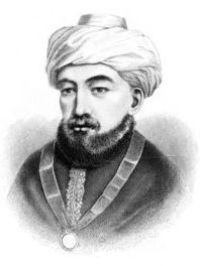
Moses Mendelssohn

Definition and stakes

Stanley A. Cook, John H. A. Hart and Israel Abrahams,  1911 Encyclopædia Britannica (1911)

“ Moses Mendelssohn, both by his career and by his propaganda, for ever put an end to these conditions; he more than any other man. Born in the ghetto of Dessau, he was not of the ghetto. At the age of fourteen he found his way to Berlin, where Frederick the Great, inspired by the spirit of Voltaire, held the maxim that “to oppress the Jews never brought prosperity to any government.” Mendelssohn became a warm friend of Lessing, the hero of whose drama Nathan the Wise was drawn from the Dessau Jew. ”
Source: Wikisource

Herbert F. Peyser,  Mendelssohn and Certain Masterworks

“ In this way Moses Mendelssohn when in 1762 he took to wife Fromet, daughter of Abraham Gugenheim, of Hamburg, acquired twenty life-sized china apes which had been found unsaleable. Much later the apes became valued family heirlooms.
The domestic happiness and tranquility he had never known in his youth were at last to be the philosopher’s portion. Moses and Fromet had a considerable family, though only six of the children—three sons and three daughters—survived to maturity. Moses himself died in Berlin at 57. Longevity, as it proved, was not to be a trait of the Mendelssohns.
”
Source: Gutenberg

Lady Katie Magnus,  Outlines of Jewish History from B.C. 586 to C.E. 1885

“ It was scarcely a safe branch of learning, for the poor oppressed Jews of that period were so afraid of any encroachment on their Judaism, that not only was the study of the Law their favourite study, but any other was looked upon with jealous fear, and even in some cases prohibited by authority. But Moses Mendelssohn had no selfish object in his overmastering desire for knowledge. He meant to be a good Jew and a good German citizen at one and the same time, and to show his people how that could be done. ”
Source: Gutenberg

Get perspective with Kwize: daily news enlightened by great literature