“ A Barb with a burning icicle tip’d, Torn from the frore beard of the Northern Star That stares on the shuddering pyramids Of crumbling Arctic ice. With his Arrow he smote her and cried, ‘Come not here! Not here will I bear thee. This is My world— The world of Death where Beauty dies, And I, I Death am god.’ She sobbing arose, and sobbing sank; And would have perish’d, but Love that way Fell like a flame, and supported her And warm’d her dying hands; And said to him, ‘Fool, the touch of thy barb Is poison that I can poison with Love ”
Barb
Definition and stakes
The theme of “barb” has been addressed by authors such as William Pycraft and James Paton, Henry James, Angus B. Reach, Alfred Bate Richards and J. C. Snaith. It is often associated with terms like barber, arrow, feather, dog and barbel.
Quotes about “barb”
Angus B. Reach, Leonard Lindsay ; (1877)
“ When the weapon is flung, the barb alone sinks into the creature’s flesh, the staff coming unloosed from the iron, and the line rapidly unwinding from the bobwood, as the stricken creature dives in its agony and fear. ”
Alfred Bate Richards, Cromwell: A Drama, in Five Acts
“ Principle forbids; and this heart is blighted.Barb. Plighted, or not, I want none of it. What nonsense the man talks!Will. This beard—what think you of it?Barb. That it is red.Will. Yet 'tis not for you.Barb. I would humbly desire so.Will. Do you know, lively rustic, that the beard of Mars, the god of war, is auburnly inclined? It is much affected by the ladies of the south.Barb. I would they had it then, for it is an abhorr'd thing here.Will. What a rank prude is woman, thus to disguise her inclination. They call thee Barbara—Bab! restrain not thy fancy. ”
J. C. Snaith, Henry Northcote (1906)
“ In his direst mood, in his straitest hour, when life blew barb after barb into his skin, he felt that to possess her was to keep a talisman in his spirit which could unweave the knots in the conspiracies of fate. ”
Henry James, Lady Barbarina, The Siege of London…
“ When one was strong one wasn’t fidgety, and a union with a species of calm goddess would of course be a source of repose. Lady Barb was a calm, was an even calmer goddess still, and he had a much more intimate view of her divinity than on the day he had led her to the altar; but I’m not sure he felt either as firm or as easy.“How do you know what people are?” he said in a moment. “You’ve seen so few; you’re perpetually denying yourself. If you should leave New York to-morrow you’d know wonderfully little about it.” ”
Henry Fairfield Osborn, Men of the Old Stone Age: Their Environment…
“ The barb does not suddenly appear like an inventive mutation, but it very slowly evolves as its usefulness is demonstrated in practice. The shaft is very rarely perforated at the base for the attachment of a line ”
Henry James, Lady Barbarina, The Siege of London…
“ I felt in short sure of Lady Barb, and I think there is no question about her, or about the depth of root she might strike in American soil, that I shouldn’t have been ready on the spot to answer. Such is the luck of the conception that imposes itself en bloc—or such at least the artist’s luck in face of it; such certainly, to begin with and “subjectively” speaking, is the great advantage of a character all of a piece: immediacy of representation, the best omens for felicity, then so honourably await it. ”
E. Stenhouse, An Introduction to Nature-study
“ The barbules on one side of each barb (the side furthest from the quill) are seen to carry tiny hooks; while the barbules of the other side of the barb are furnished with flanges. The hooked barbules of one barb cross the flanged barbules of the next and interlock with them; so that relatively great force is required to pull the barbs apart and destroy the continuity of the web. The quill-feathers of the tail, and the coverts, have webs of similar structure. Fig. 184.—Structure of a Feather. ”
 William Taplin,
The Sporting Dictionary, and Rural Repository…
William Taplin,
The Sporting Dictionary, and Rural Repository…
“ Those arriving under such distinction, are to be considered the true MOUNTAIN BARB, the pedigree of whose blood has been recorded with as much tenacity and care as the genealogy of our most ancient nobility. Barbs (as they are called) are to be found in the possession of many people of fashion and fortune in England, but they are in general of inferior degree, and thought to be only the common horses of the country from whence they came: such there are at all times to be obtained through the intervening medium of Provence and Languedoc in France ”
 Ernest Thompson Seton,
Wild Animals I Have Known
Ernest Thompson Seton,
Wild Animals I Have Known
“ The barb-wire trick takes a deal of nerve and the best of legs. It was long before Rag ventured to play it, but as he came to his full powers it became one of his favorites. "It's fine play for those who can do it," said Molly. "First you lead off your dog on a straightaway and warm him up a bit by nearly letting him catch you. Then keeping just one hop ahead, you lead him at a long slant full tilt into a breast-high barb-wire. I've seen many a dog and fox crippled, and one big hound killed outright this way. But I've also seen more than one rabbit lose his life in trying it." ”
 Mark Twain,
Following the Equator: A Journey Around the World…
Mark Twain,
Following the Equator: A Journey Around the World…
“ A native about twenty-five years of age once applied to me, as a doctor, to extract the wooden barb of a spear, which, during a fight in the bush some four months previously, had entered his chest, just missing the heart, and penetrated the viscera to a considerable depth. The spear had been cut off, leaving the barb behind, which continued to force its way by muscular action gradually toward the back ”
 John Gilmer Speed,
The Horse in America
John Gilmer Speed,
The Horse in America
“ The Arab and Barb, I have said, are the foundation in blood of all the great types from the Percheron to the Thoroughbred. To be sure, other and dissimilar blood was used in the beginning of the making of all the types, but there was such crossing and recrossing, such grading up by a selection of mates, that the blood became similar, and the rule: “Like begets like,” being constantly followed a type becomes established. ”
 Robert W. Service,
Rhymes of a Rolling Stone
Robert W. Service,
Rhymes of a Rolling Stone
“ We crawled down to the river bank and feeble folk were we, That Julie Claire from God-knows-where, and Barb-wire Bill and me. From shore to shore we heard the roar the heaving ice-floes make, And loud we laughed, and launched our raft, and followed in their wake. The river swept and seethed and leapt, and caught us in its stride; And on we hurled amid a world that crashed on every side. With sullen din the banks caved in; the shore-ice lanced the stream; The naked floes like spooks arose, all jiggling and agleam. ”
“ Just the color of a barberry,But it comes from my heart. Do you love barberries?In the autumnWhen the sun’s desireTouches them to a glory of crimson and gold?I love them best then.There is something splendid about them:They are not afraidOf being warm and glad and bold;They flush joyously,Like a cheek under a lover’s kiss;They bleed cruellyLike a dagger wound in the breast;They flame up madly for their little hour,Knowing they must die. ”
Albert Barrère, Argot and Slang
“ Quand l’état d’ivresse est complet, la barbe est simple; elle est indigne quand le sujet tombe sous la table, cas extrêmement rare. Il est certains “poivreaux” qui commettent la grave imprudence de “promener leur barbe” à l’atelier; presque tous deviennent alors “pallasseurs,” surtout ceux qui sont taciturnes à l’état sec.—Boutmy.“Prendre une barbe” is “to quad out” in the slang of English printers. Prendre la mesure du cul avec le pied (obsolete) , to bring one’s foot in violent contact with another’s posteriors. ”
 William Gilmore Simms,
The Lily and the Totem; or, The Huguenots in Florida
William Gilmore Simms,
The Lily and the Totem; or, The Huguenots in Florida
“ Then he spoke to me, saying, in his own language,—which, by this time, I could understand,—Barbu,—this was the name which had been given me because of my beard—Barbu, it is not fit that one with such limbs and skill as thou hast, should labor still in the occupation of the women. Get thee a spear, such as will suit thy grasp, and there are bows and arrows for thy choice,—make thee satisfied with sufficient provision, and get thee ready to go against mine enemies. Thou shalt have to tear the flesh of a strong man! ”
E. J. Banfield, The Confessions of a Beachcomber
“ I have never known one of these barbs to break or come loose, so adept are the blacks in securing them. The point is about 6 inches long, and on the barbless end is tightly wound successive layers of fibrous bark, until its size is adjusted to the socket in the haft. Above the swathing of bark a strong line is made fast ”
Emily J. Jenkinson, Barbara Lynn: A Tale of the Dales and Fells
“ Barbara's keen eyes—keen as an eagle's to scan the broad fellside—noted the air of decay which had settled upon it, the thicket of brambles among the chimneys, and how a pine, growing out of the rocks, encroached upon the doorway. ”
Sir E. A. Wallis Budge, The Literature of the Ancient Egyptians
“ The barber shaveth until far into the night, he only resteth when he eateth. He goeth from one street to another looking for work. He breaketh his arms to fill his belly, and, like the bees, he eateth his own labour. ”
 Jean-Henri Fabre,
Our Humble Helpers: Familiar Talks on the Domestic Animals
(1918)
Jean-Henri Fabre,
Our Humble Helpers: Familiar Talks on the Domestic Animals
(1918)
“ Who among you does not know the barbet with its big round head, full of good will, its large drooping ears, short legs, squat body, long, fine and curly hair, almost like wool, which has given it the name of sheep dog? When half-shorn, as it is in the summer, it is still more comely. The hind quarters are naked and show the rosy skin; the fore part of the body is covered with a thick mane as white as cotton wool. A coquettish tuft finishes off the tail, elegant ruffles adorn the legs, the muzzle bears a mustache and small beard, which latter perhaps accounts for its name of barbet. ”
Charles Wareing Endell Bardsley, English Surnames: Their Sources and Significations
“ Here, therefore, we see one more explanation of the plentifulness of our ‘Barbers,’ ‘Barbours,’ ‘Barbors,’ and more uncouth-seeming ‘Barbars.’ The old records give us an equal or even greater variety in such registrations as ‘John le Barber,’ ‘Richard le Barbour,’ ‘Nicholas le Barbur,’ ‘Thomas le Barbitonsor,’ or ‘Ralph Tonsor;’ [393] while feminine skill in operating upon the chins of our forefathers is commemorated in such an entry as ‘Matilda la Barbaresse.’ It is just possible, however, that she kept an apprentice, although such things are still to be seen, I believe, as women-shavers. ”
W. H. Maxwell, The Field Book: or, Sports and pastimes of the United Kingdom
“ The head of the barbel is smooth, the nostrils are near the eyes; it has a leather mouth, which is placed below; on each corner is a single beard, and another on each side of the nose; the shape is long, round, and handsome; the dorsal fin is armed with a remarkably strong spine, sharply serrated; with which it can inflict a severe wound on the uncautious handler, and do much damage to the net. The side fin is straight; the scales are not large, and of a pale gold colour, edged with black; the belly white, the tail is a little bifurcated, and of a deep purple. ”
 John Evans,
The Ancient Stone Implements, Weapons…
(1897)
John Evans,
The Ancient Stone Implements, Weapons…
(1897)
“ Occasionally the notch between the barbs is square, and the ends of the barbs worked at an angle of about 45°, like Fig. 319, without the central stem. In some rare instances the barbs curve outwards at the points, giving an ogee form to the sides. In others the barbs curve inwards. In many, the sides are delicately serrated, and in most the workmanship is admirable. What appear to be lance-heads are sometimes notched on either side near the base, like the common North American form, and like those already mentioned as occurring occasionally in France. ”
J. G. Wood, Story of the Bible Animals
“ The native hunter finds out the place and conceals himself by digging a hole in the sand near the spot where the animal usually lies. On its arrival at the accustomed spot the hunter darts his harpoon or spear with all his force, for, in order that its stroke may be successful, the iron should penetrate to a depth of at least four inches, in order that the barb may be fixed firmly in the flesh. ”
“ It was Sunday morning, and father, he was working away at his bench—not that it ever seemed to make him any happier to work, only he was more miserable if he didn't,—and I had crept up to the churchyard to lean against the wall and listen to the psalms being sung inside, when, looking down the village street, I saw Barber's shop open, and out came young Barber himself. Oh, if God forgets any one in His mercy, it will be him and his like! ”
Various, Punch, or the London Charivari…
“ Barbe, as a literary man and critic, always professed a desire to live in a quiet neighbourhood. Therefore, as I approached his house, on the almost inaccessible slopes of Campden Hill, I was amazed to see a large and increasing crowd assembled in the vicinity. Pushing my way through, I saw that St. Barbe's windows were broken, glass was in a weak minority in the panes, and, what was more singular, the breakage seemed to be done from within! Objects were flying out into the garden, and those objects were books. I had the curiosity and agility to catch a few as they fell, and to pick others up. ”
 Fredrika Bremer,
Life in the Old World
(1860)
Fredrika Bremer,
Life in the Old World
(1860)
“ Their priests were called Barbes, [1] from the word Barba, which, in their language, is used to indicate an elderly, venerable man, and which is used at the present day for the oldest person in the congregations, and principally for elderly and esteemed men. “Bou soir Barba,” said Louise Appia, when, during our rambles in the valley, we met an elderly peasant. ”
“ Once in a burst of confidence a barber told me one of the trade secrets of his profession—he said that among barbers every face fell into one of three classes, it being either a square, a round or a squirrel. ”
Sir Charles G. D. Roberts, Barbara Ladd
“ By contrast it seemed dark, but the air was of a wonderful transparency, and Barbara's eyes, opening wide in delicious awe, saw everything more distinctly than in the open. She whispered to the yellow birch, the paper birch, the beech, the maple, and the chestnut, each by name lovingly, as she slipped past their soaring trunks, knowing them by the texture and the features of their bark though their leaves hung far overhead. Her paddle dipped without noise, lest the mysteries of the forest conclave should be disturbed by her intrusion. ”
William Allan Reed, Negritos of Zambales
“ When the animal is struck the point leaves the shaft, unwinding a long woven coil with which the two are fastened together. The barbs prevent the point from tearing out of the flesh and the dangling shaft catches on the underbrush and serves to retard the animal’s flight. ”
James W. Cambron, Handbook of Alabama Archaeology…
“ Where shoulder barbs are present they may be expanded. Blade edges are usually straight, but may be incurvate or excurvate and may be serrated. They are always beveled on one edge of each face. Distal ends are acute. The hafting area is corner notched, with deep narrow notches that average about 4 mm. wide at the blade edge, 2 or 3 mm. wide at the bottom of the notch, and about 6 mm. deep along the stem edge. The expanded stem usually has straight side edges, and the basal edge is always excurvate, thinned, and ground. ”
 Noah Webster,
Webster's Unabridged Dictionary…
Noah Webster,
Webster's Unabridged Dictionary…
“ Paps, or little projections, of the mucous membrane, which mark the opening of the submaxillary glands under the tongue in horses and cattle. The name is mostly applied when the barbs are inflamed and swollen. [Written also barbel and barble.] 4. The point that stands backward in an arrow, fishhook, etc., to prevent it from being easily extracted. Hence: Anything which stands out with a sharp point obliquely or crosswise to something else. 1⁄2Having two barbs or points. ”
Sir Charles G. D. Roberts, Barbara Ladd
“ Barbara loved strength, so long as delicacy saved it from coarseness. The boy was in his shirt sleeves, which were of spotless cambric, and Barbara noted, with approbation, the ample ruffles turned back, for convenience, from his sinewy brown hands. She observed that his brown, long-fronted, flowered vest was of silk, and his lighter brown small-clothes of a fine cloth worn only by the gentry; that his stockings were of black silk, and his shoes, drenched most of the time in the water that lapped over the raft, were adorned with large buckles of silver. ”
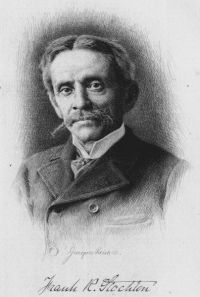 Frank R. Stockton,
The lady, or the tiger? and other stories
(1897)
Frank R. Stockton,
The lady, or the tiger? and other stories
(1897)
“ I was walking homeward one afternoon about this time, when I met Barbel,—a man I had known well in my early literary career. He was now about fifty years of age, but looked older. His hair and beard were quite gray; and his clothes, which were of the same general hue, gave me the idea that they, like his hair, had originally been black. Age is very hard on a man's external appointments. Barbel had an air of having been to let for a long time, and quite out of repair. ”
