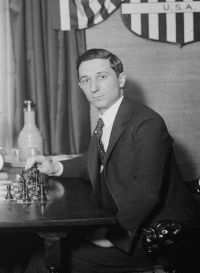
“ A second consideration is the fact that the advancing pawn itself becomes a target for an assault in which the opponent, moving up a pawn on the next file, brings his Rooks into play, or in which he sacrifices a piece for the advanced pawn and the one that protects it, thus robbing the King of the protection he sought to obtain in castling. ”
Castling
Definition and stakes
Castling is a fundamental chess maneuver involving the king and a rook, allowing the king to move two squares toward the rook while the rook leaps over it. This move, essential for safeguarding the king and activating the rook, is regulated by strict conditions, such as clear paths and the requirement that neither piece has moved before.
Authors like Edward Lasker highlighted its strategic importance, pointing out how castling protects the king while enhancing rook activity. Howard Staunton’s writings emphasized its tactical subtleties, while the 1911 Encyclopædia Britannica outlined its procedural details. Although literary figures like Richard Le Gallienne employed "castle" metaphorically, the chess concept continues to be a cornerstone of the game’s strategy, merging practical need with symbolic defense.
Quotes about “castling”
1911 Encyclopædia Britannica, Volume 6… (1911)
“ When a king is not in check, but his owner has no move left save such as would place the king in check, it is “stalemate,” and the game is drawn. “Castling.” This is a special move permitted to the king once only in the game. It is performed in combination with either rook, the king being moved two squares laterally, while the rook towards which he is moved (which must not have previously moved from its square) is placed next him on the other side; the king must be touched first. ”
1911 Encyclopædia Britannica, Volume 6… (1911)
“ The rook, knight and bishop on the right of the king are known as King’s rook, King’s knight, and King’s bishop; the other three as Queen’s rook, Queen’s knight, and Queen’s bishop. Briefly described, the powers of the various pieces and of the pawns are as follows. The king may move in any direction, only one square at a time, except in castling. Two kings can never be on adjacent squares. The queen moves in any direction square or diagonal, whether forward or backward. There is no limit to her range over vacant squares; an opponent she may take; a piece of her own colour stops her. ”