The central nervous system (CNS), consisting of the brain, spinal cord, and meninges, functions as the primary processor and coordinator of bodily activities in vertebrates. It combines sensory information and triggers motor responses, serving as a central point for neural communication. Authors such as John Hughlings Jackson emphasized its hierarchical organization, discussing damage at its "top" or "bottom," while Ernest G.
Martin outlined favored neural routes and connections. Francis M. Walters focused on reflex actions facilitated by the spinal cord, and Sherrington highlighted the CNS’s role as a meeting place for neurons. These viewpoints together confirm the CNS as the anatomical and functional center regulating vertebrate physiology.
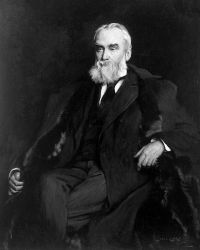 John Hughlings Jackson,
Popular Science Monthly
(1884)
John Hughlings Jackson,
Popular Science Monthly
(1884)