Diffraction grating

Definition and stakes

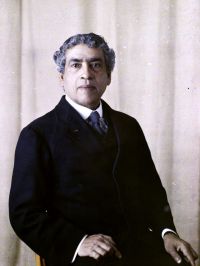
John William Strutt,  1911 Encyclopædia Britannica (1911)

“ In such a case the system of bands is achromatic, and the heterogeneity of the light is no obstacle to the formation of visible bands of high order.
These requirements are very easily met by the use of Lloyd’s mirrors, and of a diffraction grating (see Diffraction) with which to form a spectrum. White light enters the dark room through a slit in the window-shutter, and falls in succession upon a grating and an achromatic lens, so as to form a real diffraction spectrum, or rather a series of such, in the focal plane.
”
Source: Wikisource

1911 Encyclopædia Britannica, Volume 8… (1911)

“ If it were possible to introduce at every part of the aperture of the grating an arbitrary retardation, all the light might be concentrated in any desired spectrum. By supposing the retardation to vary uniformly and continuously we fall upon the case of an ordinary prism: but there is then no diffraction spectrum in the usual sense. To obtain such it would be necessary that the retardation should gradually alter by a wave-length in passing over any element of the grating, and then fall back to its previous value, thus springing suddenly over a wave-length (Phil. Mag., 1874, 47, p. 193) . ”
Source: Wikisource

1911 Encyclopædia Britannica, Volume 8… (1911)

“ If we now suppose half the grating cut away, so as to leave 1000 lines in half an inch, the dispersion will not be altered, while the brightness and resolving power are halved.
There is clearly no theoretical limit to the resolving power of gratings, even in spectra of given order. But it is possible that, as suggested by Rowland, [2] the structure of natural spectra may be too coarse to give opportunity for resolving powers much higher than those now in use.
”
Source: Wikisource

Get perspective with Kwize: daily news enlightened by great literature