Double bass

Definition and stakes

1911 Encyclopædia Britannica, Volume 8… (1911)

“ The technical capabilities of the double bass are necessarily somewhat more limited than those of the violoncello. Quick passages, though possible, are seldom written for it; they cannot sound clear owing to the time required for the strings to vibrate. An excellent effect is produced by what is known as the intermittent tremolo: owing to the elasticity of the bow, it rebounds several times on the strings when a single blow is sharply struck, forming a series of short tremolos. The double bass is the foundation of the whole orchestra and therefore of great importance ”

Source: Wikisource

A Dictionary of Music and Musicians (1900)

“ If the violin is the leader of the orchestra, the double bass is its foundation. To it is given the lowest part, on which both harmony and melody rest. The English term 'double bass' has probably been applied to the instrument because it often doubles in the lower octave the bass of the harmony, given to the bass voice, the violoncello, the bassoon, or some other instrument. ”
Source: Wikisource

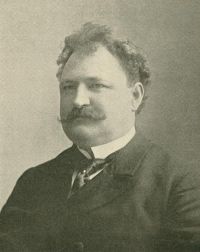
Portrait of André Pirro André Pirro,  Johann Sebastian Bach: The Organist and His Works for the Organ

“ The basso continuo of certain organists, who have fallen asleep over their pedals, soon becomes an intolerable nuisance for the audience. We should go wild at a performance of a symphony in which the double-basses played uninterruptedly from the first note to the last. Plain-song itself, thus interpreted, loses its eloquence; although the apparent monotony of its design, closely confined within the limits of an octave, would, above all, seem to be better adapted than any other form of music to a continuous bass. ”
Source: Gutenberg

Get perspective with Kwize: daily news enlightened by great literature