Tuba

Definition and stakes

Esther Singleton,  The orchestra and its instruments (1917)

“ The bass tuba, like every other instrument, had a direct ancestor. In some families the new generations are nobler and more refined than their ancestors. This is the case with the tuba. As he belongs to the group of horns and trombones, with even a slight relationship to the organ in his deep rolling voice with more velvet in it than even the organ possesses, the tuba might not care to be reminded that his parent is the ophicleide and that he came down in a straight line of ancestry from the rather commonplace and blatant Cornet Family. ”
Source: Gutenberg

Philip H. Goepp,  Symphonies and Their Meaning; Third Series…

“ In the brilliant medley there is ever a new figure we had not perceived. So when the tune has been told, trumpets and horns begin with what seems almost the main air, and the former voices sound like mere heralds. Finally the deep trombones and tuba enter with a sonorous call. Yet the first rapid trip of all has the main legend.
As the quicker figures gradually retire, a change of pace appears, to the tramp of funeral. Yet the initial and incident strains are of the former text. Out of it weaves the new, slower melody:
Throughout, the old shrill call sounds in soft lament.
”
Source: Gutenberg

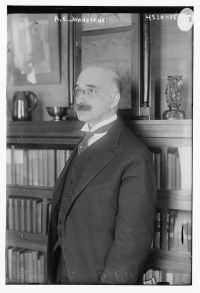
Portrait of Arthur Edward Johnstone Arthur Edward Johnstone,  Instruments of the Modern Symphony Orchestra… (1917)

“ N.Y. Philharmonic Orchestra
The tuba is the double bass of the brass section of the orchestra. It differs essentially from the trumpet in that its tube is conical and not cylindrical—that is to say. it gradually widens from mouthpiece to bell. The tuba is usually provided with four valves, the fourth of which gives the instrument an extended and valuable downward range.
Prior to its introduction into the orchestra by Wagner the tuba was used only in military bands.
”
Source: Wikisource

Get perspective with Kwize: daily news enlightened by great literature