Equilateral triangle

Definition and stakes

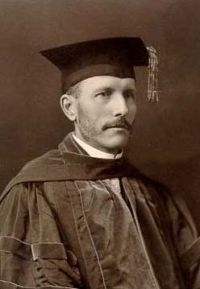
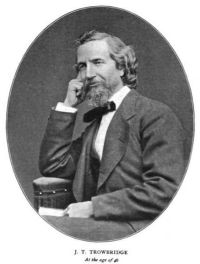
Portrait of J. T. Trowbridge J. T. Trowbridge,  The Young Surveyor; Or, Jack on the Prairies

“ Then, with my compass at E, I sight another line at an angle of sixty degrees from my last. I am making what is called an equilateral triangle; that is, a triangle with equal sides and equal angles. Each angle must measure sixty degrees. With two angles and one side, we can always get the other two sides; and the other angle will be where those two sides meet. They will meet at C. Now, since the sides are of equal length, the distance from D to C is the same as from D to E,—that is, four rods and thirty links, just the distance we wish to go; C, then, is the place for your corner stake. ”
Source: Gutenberg

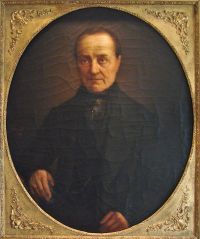
Portrait of John Casey John Casey,  The First Six Books of the Elements of Euclid

“ On a given finite right line (AB) to construct an equilateral triangle.
Sol.—With A as centre, and AB as radius, describe the circle BCD (Post. iii.) . With B as centre, and BA as radius, describe the circle ACE, cutting the former circle in C. Join CA, CB (Post. i.) . Then ABC is the equilateral triangle required.
Dem.—Because A is the centre of the circle BCD, AC is equal to AB (Def. xxxii.) . Again, because B is the centre of the circle ACE, BC is equal to BA. Hence we have proved.
But things which are equal to the same are equal to one another (Axiom i.) ; therefore AC is equal to BC
”
Source: Gutenberg

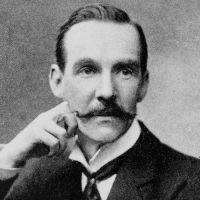
Portrait of Isaac Todhunter Isaac Todhunter,  The Elements of Euclid for the Use of Schools and Colleges (1872)

“ An equilateral triangle is that which has three equal sides:
25. An isosceles triangle is that which has two sides equal: 26. A scalene triangle is that which has three unequal sides:
27. A right-angled triangle is that which has a right angle:
[The side opposite to the right angle in a right-angled triangle is frequently called the hypotenuse.]
”
Source: Wikisource

Get perspective with Kwize: daily news enlightened by great literature