Gibbon

Definition and stakes

Richard Lydekker,  1911 Encyclopædia Britannica, Volume 11… (1911)

“ When they descend to the ground—which they must often do in order to obtain water—they frequently walk in the upright posture, either with the hands crossed behind the neck, or with the knuckles resting on the ground. Their usual food consists of leaves and fruits. Gibbons may be divided into two groups, the one represented by the siamang, Hylobates (Symphalangus) syndactylus, of Sumatra and the Malay Peninsula, and the other by a number of closely allied species. ”
Source: Wikisource

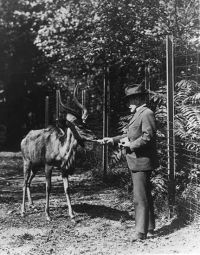
Portrait of William T. Hornaday William T. Hornaday,  The Minds and Manners of Wild Animals…

“ The gibbons (including the siamang) have tremendous voices, with numerous variations, and they love to use them. My acquaintance with them began in Borneo, in the dense and dark coastal forest that there forms their home. I remember their cries as vividly as if I had heard them again this morning. While feeding, or quietly enjoying the morning sun, the gray gibbon (Hylobates concolor) emits in leisurely succession a low staccato, whistle-like cry, like "Hoot! Hoot! Hoot!" which one can easily counterfeit by whistling. This is varied by another whistle cry of three notes, thus: "Who-ee-hoo! ”
Source: Gutenberg

Samuel G. Goodrich,  Illustrative Anecdotes of the Animal Kingdom

“ The Gibbon;—a native of Sumatra, Borneo, and Malacca. The arms are of immense length, and the hands and feet are formed for clinging to the limbs of trees, where it throws itself from branch to branch with surprising agility. The expression of the face is gentle, and rather melancholy. There are many species, all of which utter loud cries. ”
Source: Gutenberg

Get perspective with Kwize: daily news enlightened by great literature