
“ A handshake often creates a feeling of liking or of irritation between two strangers. Who does not dislike a "boneless" hand extended as though it were a spray of sea-weed, or a miniature boiled pudding? ”
Handshake
Definition and stakes
The handshake, a gesture representing greeting, agreement, or social connection, has been explored from various perspectives in literature and etiquette manuals. From Emily Post’s critique of awkward handshakes as sources of annoyance to Helen Keller’s striking contrast between unsettling and comforting touches, writers emphasize its ability to communicate emotion.
Walter Germain’s attention to formal procedures, such as glove etiquette, and Kafka’s portrayal of the handshake as a ritualized affirmation in The Trial, demonstrate its complex role in human interaction. Whether serving as a sign of courtesy or an unspoken measure of rapport, the handshake continues to be a subtle yet significant aspect of social behavior.
Quotes about “handshake”
 Helen Keller,
The Century Magazine, Volume 69…
(1905)
Helen Keller,
The Century Magazine, Volume 69…
(1905)
“ The handshake of some people makes you think of accident and sudden death. Contrast this ill-boding hand with the quick, skilful, quiet hand of a nurse whom I remember with affection because she took the best care of my teacher. ”
Walter Brown Murray, The Truth about Marriage (1931)
“ The thrill of which I speak may sometimes be recognized in shaking hands; and yet it is not always a matter to be decided by a handshake. But there ought to be a certain congeniality in the touch of the hand, a pleasurable feeling, a desire perhaps to keep hold of the hand. I know many married couples who still like to hold hands. ”
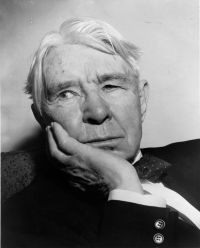 Carl Sandburg,
Cornhuskers
(1918)
Carl Sandburg,
Cornhuskers
(1918)
“ To a man across a thousand years I offer a handshake. I say to him: Brother, make the story short, for the stretch of a thousand years is short. ”
Thomas E. Sanders, Twenty Talks to Teachers (1908)
“ Learn how to shake hands. You are often judged by the handshake. The hand, the eye, the voice—these if used properly quickly overcome prejudice and barriers of opposition and build up forces in your favor. ”
 Franz Kafka,
The Trial
(1925)
Franz Kafka,
The Trial
(1925)
“ But now you must give me your hand, an agreement of this sort needs to be confirmed with a handshake." ”
Walter Germain, The Complete Bachelor: Manners for Men
“ A man removes his glove from his right hand on entering the drawing room, and holds this with his stick and hat in his left. The hat should be at an angle, the top about level with his nose. At weddings, the opera, and dances, where a woman is gloved, a man, if it is required to shake hands, does not remove his gloves. On ordinary occasions a woman is seldom gloved in her own drawing room, and if she is, handshaking is not usually expected. Should the hostess be gloved, as at a large affair, such as a formal or wedding reception, a man shakes hands with her with them on. ”
“ Fastidious and sensitive people are rather conservative in hand-shaking. Etiquette allows considerable latitude. It is proper and graceful, but not required, for two men to shake hands when introduced. A lady does not usually shake hands with a new acquaintance, unless the circumstances of the introduction make her responsible for allowing special cordiality, as when a person is introduced to her in her own house. A host and hostess shake hands with a guest; they may omit to shake hands with the same person when they meet him elsewhere. ”
Arthur Martine, Martine's Hand-book of Etiquette…
“ You need not stop to pull off your glove to shake hands with a lady or gentleman. If it is warm weather it is more agreeable to both parties that the glove should be on—especially if it is a lady with whom you shake hands, as the perspiration of your bare hand would be very likely to soil her glove.If a lady addresses an inquiry to a gentleman on the street, he will lift his hat, or at least touch it respectfully, as he replies. ”
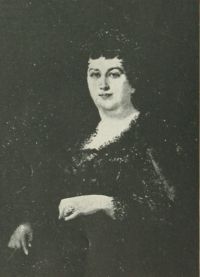 M. E. W. Sherwood,
Manners and Social Usages
M. E. W. Sherwood,
Manners and Social Usages
“ A lady silently courtesies when introduced, a gentleman makes a deep bow without speaking. We have had the custom of hand-shaking—and a very good custom it is—but perhaps the latest fashion in ceremonious introduction forbids it. If a gentleman carries his crush hat, and a lady her fan and a bouquet, hand-shaking may not be perfectly convenient. However, if a lady or gentleman extends a hand, it should be taken cordially. Always respond to the greeting in the key-note of the giver. ”
“ The etiquette of handshaking is simple. A man has no right to take a lady's hand until it is offered. He has even less right to pinch or retain it. Two young ladies shake hands gently and softly. A young lady gives her hand, but does not shake a gentleman's unless she is his friend. A lady should always rise to give her hand; a gentleman, of course, never dares to do so seated. On introduction in a room, a married lady generally offers her hand; a young lady, not. In a ball-room, where the introduction is to dancing, not to friendship, you never shake hands ”
 Nellie Bly,
Six Months In Mexico — Chapter XXXII.
(1889)
Nellie Bly,
Six Months In Mexico — Chapter XXXII.
(1889)
“ When men are introduced they clasp hands, not the way Americans do, but with thumbs interlocked, and embrace with the left arm; then the left hands are clasped and they embrace with the right arm, patting the back in a hearty manner; the more intimate they become the closer the embrace, and it is not unusual to see men kiss; these embraces are not saved for private or home use, but are as frequent on the streets as hat tipping is here ”
“ Hand-shaking is said to be an American habit. Certainly the social conditions in a republic are favorable to such a custom. It is a pity that a mode so adapted to express the warmth and loyalty of friendship should be indiscriminately employed in casual greetings. The pressure of the hand should mean more than it can mean, when, as now, it is bestowed with equal alacrity on life-long friend and recent acquaintance. ”
Samuel R. Wells, How to Behave: A Pocket Manual of Republican Etiquette…
“ You should not, however, offer a gloved hand to a lady or a superior who is ungloved. Foreigners are sometimes very sensitive in this matter, and might deem the glove an insult. It is well for a gentleman to carry his right-hand glove in his hand where he is likely to have occasion to shake hands. At a ball or a party the gloves should not be taken off. ”
Various, Punch, or the London Charivari…
“ The gentleman then thrusts the thumb of his left-hand into the arm-hole of his waistcoat, taps three times carelessly with his fingers upon his chest. By this signal he means to say—“How is your little heart?”The lady plucks a leaf out of her bouquet, and flings it playfully over her left shoulder, meaning thereby to intimate that her vital organ is “as free as that.”The gentleman, encouraged by the last signal, clasps his hands, and by placing both his thumbs together, protests that “Heaven has formed them for each other.” ”
Maud C. Cooke, Social Life; or, The Manners and Customs of Polite Society
“ The removal of a gentleman's glove in shaking hands with a lady is the relic of a habit based on necessity, and dating back to a day when the knight of old removed his iron gauntlet, lest he crush the maiden's hand within its grasp. ”
Maud C. Cooke, Social Life; or, The Manners and Customs of Polite Society
“ Every one knows, and shudders at, the woman who gives two, or at most, three fingers of a cold and lifeless hand for a moment into your keeping, and every one recognizes and fears the man who swallows up and crushes the entire hand within his powerful grasp. Each extreme is to be avoided.A lady should give her whole hand, not her fingers; a gentleman should receive it cordially, holding it neither too tightly nor too loosely, shaking it very slightly and not presuming to retain it. ”
“ When a gentleman stops to speak to a lady of his acquaintance in the street, he takes his hat off with his left hand, leaving his right free to shake hands, or he takes it off with his right and transfers it to his left. If he has a stick, he puts his stick in his left hand, takes off his hat with his right, transfers his hat also to his left hand, and gives her his right. If they walk ahead together, he at once puts his hat on ”
“ If you know but one member of the family and you find others only in the room, introduce yourself to them. Unless this is done, much awkwardness may be occasioned.ABOUT SHAKING HANDS.When a lady is introduced to a gentleman, she should merely bow but not give her hand, unless the gentleman is a well known friend of some member of the family. In that case she may do so if she pleases, as a mark of esteem or respect. A gentleman must not offer to shake hands with a lady until she has made the first movement. ”
S. Annie Frost, Frost's Laws and By-Laws of American Society
“ In many European countries kisses are exchanged, even between gentlemen, and an embrace is quite in accordance with even a somewhat formal salutation. In America, however, these demonstrations are mostly confined to gushing misses and school-girls.Men in this country acknowledge an introduction by extending the right hand in greeting—the whole hand—for it is positively insulting to offer two fingers, as some under-bred snobs will sometimes do, and it is almost as bad to extend the left hand, unless two persons are introduced at the same time, or the right hand is useless or occupied ”
“ The use of a megaphone or speaking trumpet for conveying the sound of the voice to a distance is based on the same principle.Why do We Always Shake Hands with Our Right Hand?The custom of shaking hands with the right hand has come down to us from the time when everyone carried a sword or knife. In those days when one met a stranger it was customary, as an indication of friendly intention, to hold out the right hand to show that it did not hold a sword or knife ready for attack. ”
Alfonso Josephs Sheafe, The Fascinating Boston
“ The lady places her left hand lightly upon the gentleman's arm, allowing her fore-arm to rest gently upon his arm. The partners stand at an easy distance from one another, inclining toward the common centre very slightly. The free hands are lightly joined at the side. This is merely to provide occupation for the disengaged arms, and the gentleman holds the tip of the lady's hand lightly in the bended fingers of his own. Guiding is accomplished by the gentleman through a slight lifting of his right elbow. ”
Helen Keller,
The Century Magazine, Volume 69…
(1905)
“ They throb and expand with life. Strangers have clasped my hand like that of a long-lost sister. Other people shake hands with me as if with the fear that I may do them mischief. Such persons hold out civil finger-tips which they permit you to touch, and in the moment of contact they retreat, and inwardly you hope that you will not be called upon again to take that hand of “dormouse valor.” It betokens a prudish mind, ungracious pride, and not seldom mistrust. It is the antipode to the hand of those who have large, lovable natures. ”
Charles C. Bombaugh, The literature of kissing (1876)
“ Two persons are plenty to corner and catch a kiss; more persons would spoil the sport. Take the left hand of the lady in your right; let your hat go to—any place out of the way; throw the left hand gently over the shoulder of the lady and let it fall down the right side. Do not be in a hurry; draw her gently, lovingly, to your heart. Her head will fall submissively on your shoulder, and a handsome shoulder-strap it makes. ”
Reginald Harvey Arnold, Simplex Munditiis, Gentlemen
“ When taking a lady’s hand, grasp it firmly, but gently, just sufficient pressure to convey the feeling of cordiality, nothing more, and raising her hand to the height of her waist, shake it gently two or three times, then release it; never hold it while speaking, and do not attempt that awkward, lately originated style of raising the hands above the face, with the fingers twisted out of shape; it is clumsy, decidedly ridiculous in appearance, and very uncomfortable for the lady. ”
“ Between gentlemen, an inclination of the head, a gesture of the hand, or the mere touching of the hat is sufficient; but in bowing to a lady, the hat must be lifted from the head. If you know people slightly, you recognize them [Pg 46] slightly; if you know them well, you bow with more familiarity. The body is not bent at all in bowing; the inclination of the head is all that is necessary.If the gentleman is smoking, he withdraws his cigar from his mouth before lifting his hat to a lady, or if he should happen to have his hand in his pocket he removes it. ”
Helen Keller,
The Century Magazine, Volume 69…
(1905)
“ The weariness, pain, darkness, and sweet patience were all to be felt in her thin, wasted, groping, loving hand. Few people who do not know me will understand, I think, how much I get of the mood of a friend who is engaged in oral conversation with somebody else. My hand follows his motions; I touch his hand, his arm, his face. I can tell when he is full of glee over a good joke which has not been repeated to me, or when he is telling a lively story. One of my friends is rather aggressive, and his hand always announces the coming of a dispute. ”
Maud C. Cooke, Social Life; or, The Manners and Customs of Polite Society
“ Should a gentleman sin against any of these particulars, a lady is justified in refusing to offer her hand next time.A young lady simply gives her hand to a gentleman, neither pressing nor shaking his, unless it be in the case of especial friends. Two-35- ladies shake hands quietly. Both ladies and gentlemen always rise to shake hands. Elderly people, or invalids, are permitted to excuse themselves and keep their seats.Ball-room introductions for dancing do not necessitate hand-shaking, a bow being all that is required. ”
Will Rossiter, The Art of Kissing: Curiously, Historically…
“ Kiss slowly and do it neatly;If you do the thing right and are halfway bright,You can win her sweet heart completely. Of course hugging is often a legitimate part of kissing. A Western writer has given us a humorous account of the dangers of hugging. He claims that hugging is a comparatively modern institution and draws the line between the hug and the embrace. The hug is an earnest, quick, impetuous contraction of the muscles of the arms and the chest when the object to be hugged lies within the circle bounded by the arms, while the chest is the goal or final point of the hug. ”
 Lillian Eichler,
Book of Etiquette, Volume 2, Part 4…
(1921)
Lillian Eichler,
Book of Etiquette, Volume 2, Part 4…
(1921)
“ When bowing to a woman or in acknowledgment of a greeting, when walking with a woman and bowing to an other man of his acquaintance, a gentleman raises his hat. Similarly, when bowing to a man who is accompanied by a woman, the courtesy is observed and also when a man is walking with another man who lifts his hat in greetings to a friend, whether or not that friend is known to him personally. The hat is also raised whenever a gentleman offers a civility to a lady, whether she be friend or stranger. ”
 Walter Scott,
The Fair Maid of Perth; Or, St…
Walter Scott,
The Fair Maid of Perth; Or, St…
“ Bethink you, that we employ the hands as pledges of friendship and good faith, and the feet have no such privilege. Brave men fight with their hands; cowards employ their feet in flight. A glove is borne aloft; a shoe is trampled in the mire. A man greets a friend with his open hand; he spurns a dog, or one whom he holds as mean as a dog, with his advanced foot. ”
S. Annie Frost, Frost's Laws and By-Laws of American Society
“ Shaking hands after an introduction has taken place is merely optional, not necessary; and is forbidden to an unmarried lady to whom a gentleman is introduced. A bow is all that etiquette requires. In introducing young persons to elder ones of good social standing, it is often a kindly act of encouragement for the latter to shake hands, with a few cordial words. ”
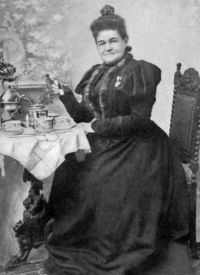 Marion Harland,
Marion Harland's Complete Etiquette
Marion Harland,
Marion Harland's Complete Etiquette
“ When men meet each other on the street they may recognize each other as they please,—by a nod, a wave of the hand, or by touching the hat. For a man to touch his hat to a woman is an insult, unless he be a servant—as a coachman receiving an order from his mistress—when he acknowledges the order by touching the brim of his hat with his hand. Did more men appreciate that they were giving the “coachman’s salute” to a woman, mortification, if not courtesy, might prevent a repetition of the offense. ”
 Fredrika Bremer,
The Homes of the New World
(1853)
Fredrika Bremer,
The Homes of the New World
(1853)
“ If either man or woman wish to choose a partner, they go out of the circle and place their handkerchief on the shoulder of the desired partner, or put a hat upon his or her head, or an ornament of some kind upon them; and I saw, on this occasion, one young negro woman whirling round with a man's hat on her head, and hung all over with handkerchiefs. It is also a common custom, but not of the most refined kind, to place a small silver coin in the mouth of the dancing lady at the close of the dance. ”
William Clarke, Three Courses and a Dessert
“ The sight of a hand in one of these things invariably produces an emotion of pity in my bosom for the four long, cold, naked fingers, which protrude from the sockets of the stalls. In the matter of gloves, women are frequently so rash and inconsiderate, as 'to make the judicious grieve.' I have told every lady, with whom I have the honour to be intimate, and who has happened to have large, ignoble hands, that she ought not to wear tight gloves ”
