Various, Popular Science Monthly (1901)
“ One is tempted to ask how far the industrial progress of the nineteenth century, the growth of factories, the development of urban life, will alter the conditions affecting the production of eminent men. ”
Various, Popular Science Monthly (1901)
“ One is tempted to ask how far the industrial progress of the nineteenth century, the growth of factories, the development of urban life, will alter the conditions affecting the production of eminent men. ”
 Peter Kropotkin,
Fields, Factories and Workshops…
Peter Kropotkin,
Fields, Factories and Workshops…
“ Must all this skill, all this intelligence, be swept away by the factory, instead of becoming a new fertile source of progress under a better organisation of production? must all this independence and inventiveness of the worker disappear before the factory levelling? and, if it must, would such a transformation be a progress, as so many economists who have only studied figures and not human beings are ready to maintain? ”
Peter Kropotkin,
Mutual Aid: A Factor of Evolution
(1902)
“ As to the sudden industrial progress which has been achieved during our own century, and which is usually ascribed to the triumph of individualism and competition, it certainly has a much deeper origin than that. Once the great discoveries of the fifteenth century were made, especially that of the pressure of the atmosphere, supported by a series of advances in natural philosophy--and they were made under the medieval city organization,--once these discoveries were made, the invention of the steam-motor, and all the revolution which the conquest of a new power implied, had necessarily to follow. ”
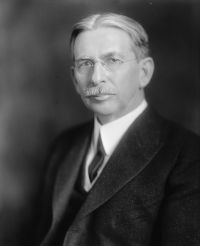 James Hartness,
Industrial Progress and Human Economics
James Hartness,
Industrial Progress and Human Economics
“ What are the boundaries that divide the Jack of all Trades, the specialist and the victim of an overdose of repetition work.Why industrial managers should know the cardinal principles of invention, of industrial engineering, industrial management, industrial relations and the human factor in engineering and in the industries.Why a plant may be growing in size and paying dividends and may still be dead so far as the spirit of enterprise is concerned.Why some men try to manage industrial plants regardless of the cardinal principles of progress of workers and the state. ”
John Rae, Contemporary Socialism
“ It will no doubt bring upon industry fresh transformations, but we can hardly expect them to be so numerous or so rapid as in the brilliant era of industrial progress and colonial development we have passed through, and some at least of the changes that are in store for us point, as I have shown in the introductory chapter of this book, to a greater diffusion rather than a greater concentration in the future. ”
J. A. Hobson, The Evolution of Modern Capitalism…
“ The social and moral progress of industrial nations requires, as a first condition of orderly progress, that these cases of arrested growth shall be absorbed into the general mass of machine-industry. ”
James Hartness,
Industrial Progress and Human Economics
“ We are already making good progress in various branches of agriculture, granite and marble work, and in various branches of manufacturing of wood, textiles and metal, but a direct comparison with our manufacturing states shows that we do not bring into the state an adequate return for our labor. ”
1911 Encyclopædia Britannica, Volume 6… (1911)
“ Stated otherwise, that is why the industrial factor is everywhere the most powerful factor in civilization; and why the economic interpretation is the most searching interpretation of history at its every stage. It is the basal fact that progress implies increased average working efficiency—a growing ratio between average effort and average achievement—that gives sure warrant for such a prognostication as has just been attempted concerning the future industrial unification of our race. ”
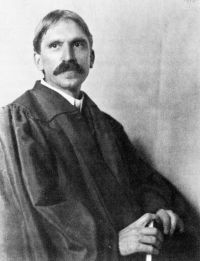 John Dewey,
The School and Society — The School and Social Progress
(1899)
John Dewey,
The School and Society — The School and Social Progress
(1899)
“ The change that comes first to mind, the one that overshadows and even controls all others, is the industrial one—the application of science resulting in the great inventions that have utilized the forces of nature on a vast and inexpensive scale: the growth of a world-wide market as the object of production, of vast manufacturing centers to supply this market, of cheap and rapid means of communication and distribution between all its parts. ”
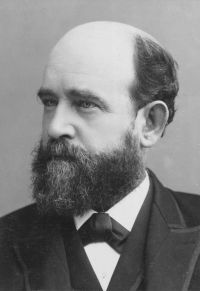 Henry George,
Progress and Poverty, Volumes I and II
Henry George,
Progress and Poverty, Volumes I and II
“ The inevitable result was to check production, and this check to production propagated itself in a cessation of demand, which checked production to the furthest verge of the wide circle of exchanges, operating with accumulated force in the centers of the great industrial commonwealth into which commerce links the civilized world. ”
James Hartness,
Industrial Progress and Human Economics
“ At the present time the productive power of a day's work varies greatly throughout the country. It reaches its highest point where the most efficient implements and machines are used; where there is a high degree of special ability acquired by each executive and workman, such as has been attained in our highly specialized manufacturing industries, many of which may be found in our neighboring states. ”
James Hartness,
Industrial Progress and Human Economics
“ MANUFACTURERS AND NEW INDUSTRIES.One of the forces that operates against increase in the number of industrial establishments is the fact that we do not realize the need of human progress in our plants. ”
James Hartness,
Industrial Progress and Human Economics
“ Some may ask why should we consider other industries when we can find many good opportunities in our present enterprises. The answer is that our people drift away to other states to get into these industries for there they have discovered that the best chance to produce a large value for a day's work is where best implements are used and where there is the best organization of workers. ”
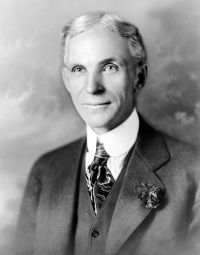 Henry Ford,
My Life and Work
(1922)
Henry Ford,
My Life and Work
(1922)
“ We have only started on our development of our country—we have not as yet, with all our talk of wonderful progress, done more than scratch the surface. The progress has been wonderful enough—but when we compare what we have done with what there is to do, then our past accomplishments are as nothing. When we consider that more power is used merely in ploughing the soil than is used in all the industrial establishments of the country put together, an inkling comes of how much opportunity there is ahead. ”
Jonathan Thayer Lincoln, The factory (1912)
“ The Industrial Revolution, thus springing from the sudden growth in the use of machinery, occasioned not only economic but political and social results. On the economic side, the effect was to extend old industries and to create new ones, as well as to revolutionize the methods of the production and distribution of wealth. ”
Henry George,
Progress and Poverty, Volumes I and II
“ That there is a common cause, and that it is either what we call material progress or something closely connected with material progress, becomes more than an inference when it is noted that the phenomena we class together and speak of as industrial depression are but intensifications of phenomena which always accompany material progress, and which show themselves more clearly and strongly as material progress goes on. Where the conditions to which material progress everywhere tends are most fully realized—that is to say, where population is densest, wealth greatest, and the machinery of production and exchange most highly developed—we find the deepest poverty, the sharpest struggle for existence, and the most of enforced idleness. ”
 John Stuart Mill,
Principles of Political Economy
John Stuart Mill,
Principles of Political Economy
“ One is, the [pg 389] tendency of every extension of the market to improve the processes of production. A country which produces for a larger market than its own can introduce a more extended division of labor, can make greater use of machinery, and is more likely to make inventions and improvements in the processes of production. Whatever causes a greater quantity of anything to be produced in the same place tends to the general increase of the productive powers of the world.267 There is (2) another consideration, principally applicable to an early stage of industrial advancement. ”
J. A. Hobson, The Evolution of Modern Capitalism…
“ On the contrary, within this last generation a number of discoveries have taken place in almost all the chief industrial arts, in the opening up of new supplies of raw material, and in the improvement of industrial organisation, which have registered enormous advances of productive power. ”
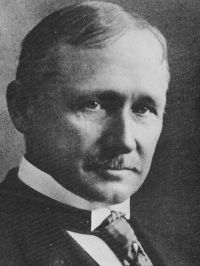 Frederick Winslow Taylor,
The Principles of Scientific Management
(1913)
Frederick Winslow Taylor,
The Principles of Scientific Management
(1913)
“ And this third great party should be given its proper share of any gain. In fact, a glance at industrial history shows that in the end the whole people receive the greater part of the benefit coming from industrial improvements. In the past hundred years, for example, the greatest factor tending toward increasing the output, and thereby the prosperity of the civilized world, has been the introduction of machinery to replace hand labor. And without doubt the greatest gain through this change has come to the whole people—the consumer. ”
 Edwin A. Pratt,
A History of Inland Transport and Communication in England…
(1912)
Edwin A. Pratt,
A History of Inland Transport and Communication in England…
(1912)
“ The main causes of this industrial revolution were—the application of a number of inventions and improved processes to leading industries; the incalculable advantages derived from steam power; the immense increase in the supplies of cotton, coal, minerals and other raw materials; the greater wealth of the nation, allowing of much more capital being available for industrial enterprises ”
Richard Roberts, The Unfinished Programme of Democracy
“ It is probable that under existing conditions, some such changes as these are all we can hope for over large areas of industrial life; perhaps, indeed, without a general recognition of the real social significance of large scale production, the best we can ever do will consist of further modification of industrial conditions along these lines. ”
 Scott Nearing,
The New Education
Scott Nearing,
The New Education
“ Then steam was applied to industry; the machine replaced the man; semi-skilled and unskilled labor replaced skilled labor; great numbers of men and women, and even of children, crowded together in factories to spin thread, make bolts and washers, weave ribbon, bake bread, manufacture machinery, or do some one of the many hundreds of things now done in factories. The change from home industry to factory industry is well named the Industrial Revolution. It completely overturned the established and accepted means of making a living. ”
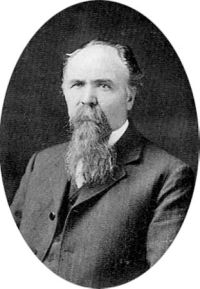 Franklin Hiram King,
Farmers of forty centuries
(1911)
Franklin Hiram King,
Farmers of forty centuries
(1911)
“ But above any other factor, and perhaps greater than all of them combined in contributing to the high maintenance efficiency attained in these countries must be placed the standard of living to which the industrial classes have been compelled to adjust themselves, combined with their remarkable industry and with the most intense economy they practice along every line of effort and of living. ”
Common Program of the Chinese People's Political Consultative Conference
“ In order to lay the foundation for the industrialization of the country, the central point of industrial work shall be the planned, systematic rehabilitation and development of heavy industry, such as mining, the iron and steel industry, power industry, machine-making industry, electrical industry and the main chemical industries, etc. At the same time, the production of the textile industry and other light industries beneficial to the national welfare and to the people's livelihood shall be restored and increased so as to meet the needs of the people's daily consumption. ”
 William Lyon Mackenzie King,
The Four Parties to Industry
(1919)
William Lyon Mackenzie King,
The Four Parties to Industry
(1919)
“ Industry is the means by which the material resources of the world are transformed, through human intelligence and human energy, with the aid of natural powers, tools, and machines, into commodities and services available for human use. It is a vast process of transformation, itself a series of transforming processes so inter-related and numerous as to unite mankind, in this age of world-wide industrial expansion, in an enterprise that encompasses the globe. The Parties to Industry We are accustomed to discuss the problems of industry in terms of Capital and Labor. ”
Henry K. Rowe, Society: Its Origin and Development
“ It was provincial in thought, speech, and habits. It was given over to agriculture, small trade, and rude home manufacture. Presently came the revolutionary inventions of textile machinery, of the steam-engine, and of processes for extracting and utilizing coal and iron. The heavy, costly machinery required capital and the factory. Concentrated capital and machinery required workers. The working people were forced to give up their small home manufacturing and their unprofitable farming and move to the industrial barracks and workrooms of the manufacturing centres. ”
 Elizabeth Gurley Flynn,
Meet the Communists
(1945)
Elizabeth Gurley Flynn,
Meet the Communists
(1945)
“ There is also the highest degree of technical development and of industrial efficiency as well as productivity, possible in the great modern plants, mines and railroads. But they do not belong to the people. ”
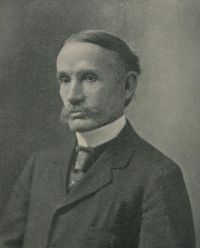 John Bates Clark,
Essentials of Economic Theory
John Bates Clark,
Essentials of Economic Theory
“ Since the great areas of new land are no longer available as a future resource, the hope of labor during the coming centuries, under any form of industrial organization, whether it be competitive or socialistic, rests on the prospect of continued technical gains,—an unending succession of calls on the exhaustless serving power of nature. ”
Harry Chase Brearley, Time Telling through the Ages
“ These are but a few of the countless improvements that had contributed to the rapid rise of this country as a manufacturing nation instead of one chiefly agricultural.Millions had already found employment in the factories, the transportation systems, and other collective-labor establishments. Schools had multiplied throughout the country. Trains, for the most part, were run on schedule time. Business offices, accompanying the development of the great industrial concerns, employed thousands. ”
Various, Mother Earth, Vol. 1 No. 3, May 1906
“ Strewn among the hills and valleys lay bits of industry that had been passed by technical progress, as so many damned, spooklike spots; and yet those, who vegetated, worked and gradually perished here, were compelled to compete with the great productive giants of steel and iron machinery. ”
Charles A. Ellwood, Sociology and Modern Social Problems
“ In centralizing manufacturing plants in cities, certain industrial economies are secured, such as: (1) economy in motor power, whether it be water or coal; (2) economy in machinery—it is not necessary to duplicate machines ”
 Frederick Jackson Turner,
The Frontier in American History…
(1921)
Frederick Jackson Turner,
The Frontier in American History…
(1921)
“ The development of large scale factory production, the benefit of combination in the competitive struggle, and the tremendous advantage of concentration in securing possession of the unoccupied opportunities, were so great that vast accumulations of capital became the normal agency of the industrial world. ”
Peter Kropotkin,
The Conquest of Bread
(1906)
“ Indeed, it suffices to study the processes already in use to extract coals and ore, to obtain steel and work it, to manufacture what is used for clothing, etc., in large industrial establishments, in order to perceive that we could already increase our production fourfold and yet economize work. ”
Scott Nearing,
The Next Step: A Plan for Economic World Federation
“ Mines have been opened, factories established, railroads built, electric plants constructed, by some individual or [Pg 67] corporation interested in making a profit on the investment, and with little or no relation to the well-being of the community. There has been no recognized intelligent guidance behind the development of the industrial system. ”
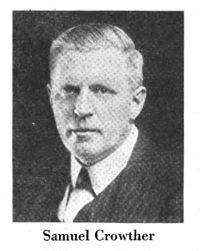 Samuel Crowther,
My Life and Work
Samuel Crowther,
My Life and Work
“ The belief that an industrial country has to concentrate its industries is not, in my opinion, well-founded. That is only a stage in industrial development. As we learn more about manufacturing and learn to make articles with interchangeable parts, then those parts can be made under the best possible conditions. ”
J. A. Hobson, The Evolution of Modern Capitalism…
“ The direct causal connection between the increased productive power of modern machinery and trade depression clearly emerges from a comparison of the fluctuations in the several departments of industry in different industrial countries. ”
 August Bebel,
Woman and Socialism
August Bebel,
Woman and Socialism
“ In industry it is difficult to recognize, because every civilized nation in a healthy state of development must present an extension of industrial production, for the following four reasons: 1. Because occupations that were formerly domestic in character have been taken over by industry. ”
 Frank A. Fetter,
The Principles of Economics, with Applications to Practical Problems
Frank A. Fetter,
The Principles of Economics, with Applications to Practical Problems
“ Man anticipates the future, directs forces, and groups materials to his purpose of getting a regular food-supply. He is thus himself forced into settled life, begins hand-production, and [Pg 262] makes the first steps in commerce. Then gradually comes the industrial stage, in which control over nature grows, supplies increase, machinery and motive forces are utilized, and humanity is in the full tide of industrial development. These are not sharply marked changes, but throughout all there is a growth of security, of certainty, and of productivity. ”
 Frank W. BlackmarIndustrial Workers of the WorldHenry George
 Thorstein VeblenPeter KropotkinJ. A. HobsonJames Hartness
 Theodore RooseveltFrank A. FetterVariousFrederick Winslow TaylorScott NearingSamuel SmilesJohn Stuart MillFranklin Hiram KingEdwin A. PrattJohn RaeHenry FordJonathan Thayer LincolnRichard Roberts