Law of Scotland

Definition and stakes

Robert S. Rait The Scottish Parliament Before the Union of the Crowns

If the production of a legal system forms but a small apologia for a Parliament which existed [xxvi] for several centuries, it nevertheless entitles the Scottish Estates to be reckoned among the forces which have made the nation; and it is legitimate cause of satisfaction that, in spite of all the forces of misgovernment which held sway for so long, the peculiarity of the law of Scotland is its regard for the poor and the weak.
Source: Gutenberg

Robert S. Rait The Scottish Parliament Before the Union of the Crowns

After the War of Independence, Scottish lawyers borrowed little from England, and, gradually, important differences began to emerge. Mr. Hill Burton has pointed out that the statement, frequently made, that the civil [xxiii] law is part of the law of Scotland, "can only be true of those portions which have from time to time been incorporated with it." The selection of these portions and their local adaptation formed part of the work of the Judicial Committee of the Estates.
Source: Gutenberg

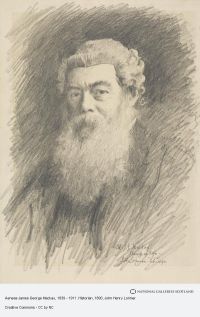
Portrait of Andrew Lang Andrew Lang A Short History of Scotland

Scotland had but little of the constitutional evolution so conspicuous in the history of England. The reason is that while the English kings, with their fiefs and wars in France, had constantly to be asking their parliaments for money, and while Parliament first exacted the redress of grievances, in Scotland the king was expected “to live of his own” on the revenue of crown-lands, rents, feudal aids, fines exacted in Courts of Law, and duties on merchandise.
Source: Gutenberg

Get perspective with Kwize: daily news enlightened by great literature