A Study of the Bhâgavata Purâna…
“ When the races of the Sixth Manvantara therefore became reborn in the Seventh Manvantara, they were the most intellectual of all races, but they had also the power given to them of developing spiritual faculties. ”
Manvantara, a concept rooted in Hindu cosmology, denotes a vast cyclical epoch governed by a Manu, a progenitor of humanity, and marked by distinct spiritual and temporal dynamics. This theme has been explored by scholars and philosophers such as F. Max Müller, who emphasized its administrative and divine order, and H. P. Blavatsky, who connected it to esoteric evolution and the interplay of illusion and reality.
Dalip Singh Saund highlighted its relationship to existential inquiry, while Muhsin Fani framed it mathematically as a manifestation of divine time. These perspectives collectively underscore manvantara as a framework for understanding cyclical creation, spiritual advancement, and the interaction of cosmic forces, intertwined with related themes like kalpa, yuga, and karma.
A Study of the Bhâgavata Purâna…
“ When the races of the Sixth Manvantara therefore became reborn in the Seventh Manvantara, they were the most intellectual of all races, but they had also the power given to them of developing spiritual faculties. ”
A Study of the Bhâgavata Purâna…
“ Each Manvantara has its own place in the history of the Kalpa, and the general evolution has to be worked out in the way best adapted to that Manvantara. The administration of each Manvantara is in the hands of a separate set of kings and ministers. Vishnu incarnates in each Manvantara, as the king of all who serve as administrative officers of that Manvantara and he is as such called the special Avatâra for that Manvantara. The divine kings, the Rishis, the Devas, all work under His direction. ”
Muhsin Fani, The Dabistán, or School of manners…
“ The before-mentioned age of the gods, or twelve thousand of their years, being multiplied by seventy-one, constitutes a Manvantara, or the reign of a Menu.There are numberless Manvantaras: creations also, and destructions of worlds innumerable: the Being supremely exalted performs all this with as much ease as if in sport ”
 H. P. Blavatsky,
The Secret Doctrine, Vol. 1 of 4
H. P. Blavatsky,
The Secret Doctrine, Vol. 1 of 4
“ Three distinct representations of the Universe, in its three distinct aspects, are impressed upon our thoughts by the Esoteric Philosophy: the Pre-existing, evolved from the Ever-existing, and the Phenomenal—the world of illusion, the reflection, and shadow thereof. During the great mystery and drama of life, known as the Manvantara, real Kosmos is like the objects placed behind the white screen upon which shadows are thrown. The actual figures and things remain invisible, while the wires of evolution are pulled by unseen hands. ”
 Dalip Singh Saund,
My mother India
(1930)
Dalip Singh Saund,
My mother India
(1930)
“ Their only ambition was to acquire knowledge of the universe,—of its origin and cause,—and to understand the whence and whither, the who and what of the human soul.” The early pioneers of Hindu thought lay down for rest on the open, fertile plains of the Ganges during the fragrant summer nights of India, and their eyes sought the starry heavens above. Then they looked into themselves, and must have asked, “What are we? What is this life on earth meant for? ”
 Arthur George Villiers Peel,
The Future of England
(1912)
Arthur George Villiers Peel,
The Future of England
(1912)
“ No one more than the oriental has made life bow to religion: no one more than he has made religion bow to life. In the height of his spiritual fervour, in the depth of his materialism, in the satisfaction of his soul by mysticism, in the gratification of his body by luxury, he has surpassed the world. But India never had a citizen. ”
Arthur Berriedale Keith, The Mythology of All Races/Volume 6 (1917)
“ It has been necessary, therefore, to circumscribe narrowly the scope of the subject by restricting the treatment to that mythology which stands in close connexion with religion and which conveys to us a conception of the manner in which the Indian pictured to himself the origin of the world and of life, the destiny of the universe and of the souls of man, the gods and the evil spirits who supported or menaced his existence. ”
 Romesh Chunder Dutt,
History of India
(1906)
Romesh Chunder Dutt,
History of India
(1906)
“ The sky which bends over all, the beautiful and blushing dawn which like a busy housewife wakes men from slumber and sends them to their work, the gorgeous tropical sun which vivifies the earth, the air which pervades the world, the fire which cheers and enlightens man, and the violent storms which in India usher in those copious rains which fill the land with plenty—these were the gods whom the early Hindus loved to extol and to worship. ”
Chitta Ranjan Das, India for Indians
“ I am not for belittling the glory of the culture of India under those empires—I have the deepest veneration for them and I say the purpose of Indian history is that throughout the ages, through every success, through every failure, through every battle which was won, through every battle which was lost, the history of India was working out her destiny and turning out the great Indian nation. ”
 Swami Vivekananda,
The Complete Works of Swami Vivekananda…
Swami Vivekananda,
The Complete Works of Swami Vivekananda…
“ Well, here are the Persian, the Greek, the Yunchi, the Hun, the Chin, the Scythian, and many more, melted and fused, the Jews, Parsees, Arabs, Mongols, down to the descendants of the Vikings and the lords of the German forests, yet undigested — an ocean of humanity, composed of these race-waves seething, boiling, struggling, constantly changing form, rising to the surface, and spreading, and swallowing little ones, again subsiding — this is the history of India. ”
 F. Max Müller,
India: What can it teach us?
F. Max Müller,
India: What can it teach us?
“ Here lies the general, the truly human interest which the ancient literature of India possesses, and which gives it a claim on the attention, not only of Oriental scholars or of students of ancient history, but of every educated man and woman. There are problems which we may put aside for a time, ay, which we must put aside while engaged each in our own hard struggle for life, but which will recur for all that, and which, whenever they do recur, will stir us more deeply than we like to confess to others, or even to ourselves. ”
Dalip Singh Saund,
My mother India
(1930)
“ To love leisure, ideals, and peace has been the criterion of Hindu wisdom. Those who have closely studied the history of the Hindu nation know the illumination, the peace, the joy, the strength that its lessons bring into the lives of those simple, virtuous people.Hindu civilization has been, on the whole, humane and wholesome, and the life of the people of India has been one of unalloyed usefulness and service to humanity. India has always been the home of various religions and its people have always been divided into innumerable faiths. ”
 Valmiki,
The Rámáyan of Válmíki, translated into English verse
Valmiki,
The Rámáyan of Válmíki, translated into English verse
“ The Vánar king in turn reproved:“Why dost thou, Báli, thus revile,And castest not a glance the whileOn claims of duty, love, and gain,And customs o'er the world that reign?Why dost thou blame me, rash and blind,Fickle as all thy Vánar kind,Slighting each rule of ancient daysWhich all the good and prudent praise?This land, each hill and woody chase,Belongs to old Ikshváku's race:With bird and beast and man, the wholeIs ours to cherish and control.Now Bharat, prompt at duty's call,Wise, just, and true, is lord of all. ”
 H. G. Wells,
The Outline of History: Being a Plain History of Life and Mankind
H. G. Wells,
The Outline of History: Being a Plain History of Life and Mankind
“ There was no sea life, there were no pirate raiders, no strange traders. One might write a history of India coming down to four hundred years ago and hardly mention the sea.The history of India for many centuries had been happier, less fierce, and more dreamlike than any other history. The noblemen, the rajahs, hunted; life was largely made up of love stories. Here and there a maharajah arose amidst the rajahs and built a city, caught and tamed many elephants, slew many tigers, and left a tradition of his splendour and his wonderful processions. ”
Valmiki,
The Rámáyan of Válmíki, translated into English verse
“ Canto CVI. Bharat's Speech.Good Bharat, by the river side,To virtuous Ráma's speech replied,And thus with varied lore addressedThe prince, while nobles round him pressed:“In all this world whom e'er can weFind equal, scourge of foes, to thee?No ill upon thy bosom weighs,No thoughts of joy thy spirit raise.Approved art thou of sages old,To whom thy doubts are ever told.Alike in death and life, to theeThe same to be and not to be.The man who such a soul can gainCan ne'er be crushed by woe or pain.Pure as the Gods, high-minded, wise,Concealed from thee no secret lies. ”
John Welsh Dulles, Life in India (1855)
“ Reader! let the millions of India have a place within your heart! Remember their darkness and their degradation! Remember that they have immortal souls! Remember them at the mercy-seat; and when you thank God that you were not born in a heathen land, cry to him to send the gospel to them, and ask him what you can do to hasten the day when the kingdoms of this world shall have become the kingdoms of our God and of his Christ. ”
F. Max Müller,
Auld lang syne. Second series
(1899)
“ It was a recognised thing in India—I speak, of course, of ancient India—that a man who had fought his fight might retire from the world, shake off all shackles, and become free, even here on earth. Many left their homes and lived in forests—a most delightful way of life in India. These anchorites, fugitives from the world, wanted very little to support life, and that little, so far as we know, was either supplied by nature or given them readily by the members of their family, or even by strangers. ”
Swami Vivekananda,
The Complete Works of Swami Vivekananda…
“ Look back, therefore, as far as you can, drink deep of the eternal fountains that are behind, and after that, look forward, march forward and make India brighter, greater, much higher than she ever was. Our ancestors were great. We must first recall that. We must learn the elements of our being, the blood that courses in our veins; we must have faith in that blood and what it did in the past; and out of that faith and consciousness of past greatness, we must build an India yet greater than what she has been. ”
Muhsin Fani, The Dabistán, or School of manners…
“ Above the six circles, into which the Hindus divide the human body, is “the window of life, and the passage of the soul, which is the top and middle of the head, and in that place is the flower of the back of one thousand leaves: this is the residence of the glorious divinity, that is, of the world-deceiving queen, and in this beautiful site reposes her origin. ”
Swami Vivekananda,
The Complete Works of Swami Vivekananda…
“ The ancient history of India is full of descriptions of the gigantic energies and their multifarious workings, the boundless spirit, the combination of indomitable action and reaction of the various forces, and, above all, the profound thoughtfulness of a godly race. ”
 Flora Annie Webster Steel,
India Through the Ages: A Popular and Picturesque History of Hindustan
Flora Annie Webster Steel,
India Through the Ages: A Popular and Picturesque History of Hindustan
“ Are we to treat the monotonous singing voice which even now echoes out over the length and breadth of India, as in the sunsetting some Brahman recites the ancient hymns--are we to treat this as the first trace of Ancient India? Or, as we sit listening, are we to watch the distant horizon, so purple against the gold of the sky, and wonder if it is only our own unseeing eyes which prevent our tracing the low curve that may mark the site of a town, ancient when the Aryans swept it into nothingness? ”
Valmiki,
The Rámáyan of Válmíki, translated into English verse
“ Methinks Ayodhyá's royal townWhere dwells my sire of high renown,With all her men and dames to-nightWill mourn us vanished from their sight.For, by his virtues won, they clingIn fond affection to their king,And thee and me, O brave and true,And Bharat and Śatrughna too.I for my sire and mother feelDeep sorrow o'er my bosom steal,Lest mourning us, oppressed with fears,They blind their eyes with endless tears.Yet Bharat's duteous love will showSweet comfort in their hours of woe,And with kind words their hearts sustain,Suggesting duty, bliss, and gain. ”
Francis Napier, Convocation Addresses of the Universities of Bombay and Madras (1892)
“ The imagination and the heart of the Hindu will probably remain oriental, however much his reason may become European. But for the reason, gentlemen, how ample is the intellectual circle into which you are now admitted! The natural and abstract sciences, history, political, literary, social, and aesthetic, the study and practice of the fine arts, law and physic, the principles of agriculture, sanitary, penal and economic enquiries, all claim your attention, and all bear upon the phenomena and the interests of your own country. ”
F. Max Müller,
India: What can it teach us?
“ But to the historian of the human race, to the student of the development of the human mind, those few solitary wanderers are after all the true representatives of India from age to age. Do not let us be deceived. ”
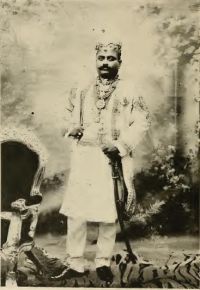 Venkata Ranga Rao,
Advice to the Indian Aristocracy
(1905)
Venkata Ranga Rao,
Advice to the Indian Aristocracy
(1905)
“ It will be a pleasure to such as love India and her peoples to read the work of a highly educated, intelligent and travelled author, in which the destruction of all Hindu individuality is not considered per se as a merit, but in which on the contrary it is regarded as wrong in fact, in art, and in imagination to impair the ancient self- sufficient and highly complex civilization, to the task of providing a substitute for which Europeans and new Hindus are alike wholly unequal. ”
Swami Vivekananda,
The Complete Works of Swami Vivekananda…
“ Of that ancient Indian race, upon which the rays of civilisation first dawned, where deep thoughtfulness first revealed itself in full glory, there are still found hundreds of thousands of its children, born of its mind — the inheritors of its thoughts and sentiments — ready to claim them. ”
F. Max Müller,
Chips from a German Workshop, Volume 1
“ What are we likely to learn from a book composed nearly four thousand years ago, and intended from the beginning for an uncultivated race of mere heathens and savages,—a book which the natives of India have never published themselves, although, to the present day, they profess to regard it as the highest authority for their religion, morals, and philosophy? Are we, the people of England or of Europe, in the nineteenth century, likely to gain any new light on religious, moral, or philosophical questions from the old songs of the Brahmans? ”
 Harriet Martineau,
Once a Week
(1863)
Harriet Martineau,
Once a Week
(1863)
“ In the midst of the great moving picture of Indian history, during the middle period of our century, we may have a moment’s attention to spare for the friendship of the three rulers of the time; and some sympathy for them under the discovery so clearly appointed to them,—that the fulfilment of the highest and most lawful dreams of youthful ambition involves a very full experience of the mournfulness of human life. ”
F. Max Müller,
India: What can it teach us?
“ But I feel equally impatient when I see other scholars criticising the ancient literature of India as if it were the work of the nineteenth century, as if it represented an enemy that must be defeated, and that can claim no mercy at our hands. ”
Dalip Singh Saund,
My mother India
(1930)
“ Such a civilization has built up the enormous literature of the Hindus embodied in the Vedas, Upnishads, the epic poems of Ramayna and Mahabharata, and the immortal works of Kalidasa, a literature comprising in itself an achievement of the human mind which may be considered sublime, and of which any civilization, ancient or modern, may feel justly proud. ”
Various, Poets of John Company (1921)
“ The Art of Living in India. No more shall tragic stories fill our rhymes Come turn and look at life in softer climes; In Eastern India's realm pursue the route, Where passions burn within, and Suns without. ”
 Sarvepalli Radhakrishnan,
The Philosophy of Rabindranath Tagore
(1918)
Sarvepalli Radhakrishnan,
The Philosophy of Rabindranath Tagore
(1918)
“ But India is an ancient land with established traditions, honoured throughout recorded history for her spiritual civilisation, for her dignity of soul, for her intense piety, for her valour and chivalry, tolerance and hospitality, and love and peace. ”
Swami Vivekananda,
The Complete Works of Swami Vivekananda…
“ In speaking of the sages of India, my mind goes back to those periods of which history has no record, and tradition tries in vain to bring the secrets out of the gloom of the past. The sages of India have been almost innumerable, for what has the Hindu nation been doing for thousands of years except producing sages? ”
Henry Bartle Edward Frere, Convocation Addresses of the Universities of Bombay and Madras (1892)
“ I think we see around us many reasons for hoping that, in this respect, there is a movement going on in the awakening intellect of India, which, in fact, has marked the dawn of a new era of civilization in every age of which we have any record. ”
Romesh Chunder Dutt,
History of India
(1906)
“ Even at that remote age, Hindu civilization must have been hundreds or thousands of years old, and from that time the literary works of successive periods form a continuous picture of the culture and the history of India for three thousand years, so full, so clear, that he who runs may read. ”
W. H. Davenport Adams, Curiosities of Superstition, and Sketches of Some Unrevealed Religions
“ But in the form in which they have come down to us they do something more than this. They comprehend, more or less thoroughly, the five following subjects:—1, Primary creation, or cosmogony; 2, Secondary creation, or the destruction and renovation of worlds, including chronology; 3, Genealogy of gods and patriarchs; 4, Reigns of the Manus, or periods called Manwantaras; and 5, History, or such particulars as are extant of the princes of the solar and lunar races, and of their descendants to modern times. ”
Various, The Atlantic Monthly, Volume 01…
“ A singular characteristic of the ancient Indian legends is the mingling of two separate courses of tradition. In their poetic conceptions, and perhaps under the hands of their priests, the old myths of the Creation are constantly confused with the accounts of the first periods of their civilization. ”
